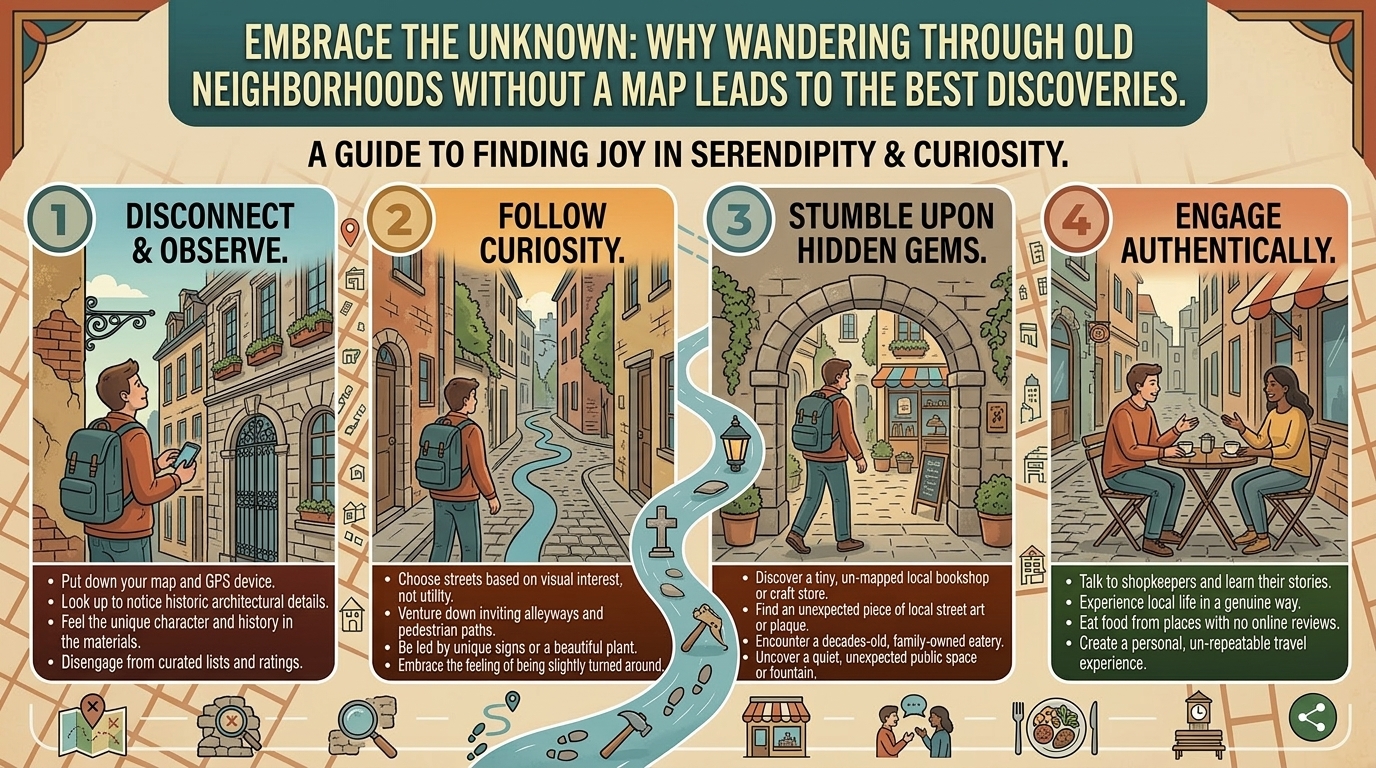
Why Wandering Through Old Neighborhoods Without a Map Leads to the Best Discoveries
Introduction: The Lost Art of Getting Lost in a Hyper-Tracked World
In our modern age of hyper-efficiency, GPS tracking, and algorithmic itineraries, getting lost feels like a modern sin. Across high-octane economic and cultural powerhouses like New York, San Francisco, Los Angeles, Seattle, and Austin, we navigate life through glowing glass rectangles. We step out of our apartments or rideshares, punch an address into Google Maps, slip in noise-canceling earbuds, and march blindly along a pre-calculated route. We optimize every minute, eliminate all friction, and arrive at our destination without ever looking up.
In doing so, we rob ourselves of something essential: serendipity.
When you eliminate the map, put away the destination-driven checklist, and allow yourself to wander aimlessly through historic, time-worn urban neighborhoods, the city transforms. You stop being a passive tourist checking boxes and become an active explorer.
At nyattitude.com, we celebrate style, culture, and intentional living. This comprehensive masterclass explores the psychological science, cultural rewards, and practical art of unmapped urban wandering, showing you why ditching the map leads to the absolute best discoveries.
Part 1: The Psychology of Drift – Understanding “Dérive”
To understand why unmapped walking works wonders for the human brain, we can look to mid-20th-century European avant-garde philosophy, specifically the Situationist International movement and their concept of the dérive (translated as “drift”).
+-----------------------------------+-----------------------------------+
| Algorithmic GPS Navigation        | The Unmapped Dérive (Drift)       |
+-----------------------------------+-----------------------------------+
| Goal-oriented (Point A to Point B)| Open-ended, experiential wandering|
| Encourages tunnel vision          | Encourages panoramic observation  |
| Erases unexpected friction        | Welcomes serendipitous encounters |
| Heightens transit anxiety         | Induces a state of flow and calm  |
+-----------------------------------+-----------------------------------+
1. Breaking the Tyranny of Efficiency
When guided by a GPS app, your brain operates under cognitive tunnel vision. You are looking for street names that match a screen, ignoring your immediate surroundings because your primary goal is arrival. Drifting breaks this cycle. It replaces the anxiety of efficiency with the pleasure of curiosity.
2. Activating the Explorer’s Mindset
When you abandon the map, your brain is forced to rely on natural environmental cues: the slope of a hill, the smell of a bakery, the architectural shift of a building facade, or the sound of children playing in a hidden courtyard. This sensory engagement stimulates neuroplasticity and transforms ordinary streets into living museums.
Part 2: What You Miss When You Stick to the App
Why do pre-planned tourist itineraries and algorithmic walking routes so often fall flat? Because algorithms are designed to optimize for consensus, popularity, and commercial predictability.
- The Tourist Trap Loop: Navigation apps direct millions of people down the exact same commercial corridors, leading you to crowded cafes with overpriced menus and sanitized gift shops.
- The Erasure of Micro-Cultures: Real neighborhood culture lives in the gaps—down the narrow alleys, behind iron gates, on residential staircases, and inside mom-and-pop storefronts that cannot afford digital advertising budgets.
- The Loss of Spatial Intuition: Relying entirely on turn-by-turn audio directions weakens your brain’s internal compass. When you wander without a map, you build a genuine, visceral mental map of a city’s geography.
Part 3: Legendary Urban Landscapes Made for Wandering
Certain cities and neighborhoods are uniquely engineered by history to reward unmapped exploration. Here is how wandering manifests across our core cultural hubs:
1. New York City: The West Village & Greenwich Village
- The Environment: Unlike Manhattan’s rigid grid system north of 14th Street, the winding, tree-lined streets of Greenwich Village (laid out before the Commissioners’ Plan of 1811) are a masterclass in geometric chaos. Streets cross at odd angles, alleyways open into private courtyards, and historic Federal-style townhomes stand shoulder-to-shoulder with modern bohemian boutiques.
- What You Discover: Hidden mews, historic jazz clubs tucked into basements, independent bookshops, and centuries-old brick townhouses bearing gas lamps.
2. San Francisco: North Beach & Telegraph Hill
- The Environment: A dizzying vertical labyrinth of steep hills, cable car tracks, Italian bakeries, and secret staircases winding through lush eucalyptus groves up toward Coit Tower.
- What You Discover: A vibrant fusion of old-school Italian beatnik culture, hidden community gardens clinging to vertical cliffs, and breathtaking panoramic views of the bay opening up unexpectedly at the end of a dead-end residential lane.
3. Austin, Texas: East Austin & Travis Heights
- The Environment: A fascinating cultural collision where historic 1920s craftsman bungalows, vibrant street murals, indie coffee roasters, and modern architecture intersect.
- What You Discover: Improvised backyard art installations, vintage clothing syndicates operating out of repurposed garages, and shaded creek-side trails that feel miles away from downtown traffic.
4. Seattle, Washington: Capitol Hill & Ballard Backstreets
- The Environment: A dynamic blend of historic Scandinavian maritime roots, indie music history, and lush Pacific Northwest residential greenery.
- What You Discover: Tiny neighborhood tool libraries, hidden neighborhood pubs tucked into residential corners, and public staircases smothered in native ferns and flowering vines.
Part 4: Tactical Tips for Safe and Rewarding Unmapped Wandering
Ditching the map does not mean throwing caution to the wind. To ensure your drift is deeply rewarding and entirely stress-free, follow these foundational rules:
+-------+-----------------------------------+-----------------------------------+
| Tip   | Action Strategy                   | Purpose                           |
+-------+-----------------------------------+-----------------------------------+
| 1     | Establish an Outer Boundary       | Prevent genuine disorientation    |
| 2     | Follow Sensory Anchors            | Let interesting sounds or smells guide you|
| 3     | Keep a Physical Emergency Card    | Know your home base or transit hub|
| 4     | Practice Urban Courtesy           | Respect private residential spaces|
+-------+-----------------------------------+-----------------------------------+
1. The Anchor Boundary Method
Choose a massive, unmissable geographical anchor before you start—such as a major river, a coastal shoreline, a prominent bridge, or a major transit terminal. As long as you know that walking downhill leads to the water or walking toward the skyscraper cluster leads to the train, you can never truly be lost.
2. Trust Your Sensory Compass
If you smell roasting coffee beans down a side street, or notice an interesting stone archway half-hidden behind weeping willow branches, let that curiosity pull you off your current trajectory. The best discoveries always happen just one block past where most people turn around.
Frequently Asked Questions (FAQ)
1. Is wandering without a map safe in unfamiliar cities?
Yes, provided you exercise basic situational awareness, stick to well-traveled residential or commercial districts during daylight hours, keep your phone securely stashed in case of emergency, and trust your instincts if a block feels uncomfortable.
2. What should I do if I get completely lost and need to get back?
Never panic. Step into a local café, bookstore, or neighborhood shop, buy a small item, and politely ask the clerk for directions to the nearest subway station or main avenue. Alternatively, you can pull out your phone’s map app as an absolute last resort.
3. How long should an unmapped urban wandering session last?
Two to three hours is the sweet spot. Anything less feels rushed; anything more than four hours can lead to physical fatigue and sensory exhaustion, especially when walking across hard urban concrete.
4. What footwear is essential for unmapped city walking?
Comfort is non-negotiable. Wear broken-in walking shoes or athletic sneakers with thick, shock-absorbing soles, paired with seamless, blister-resistant socks. Never break in brand-new shoes on a wandering expedition.
5. Should I carry a camera or rely on my smartphone?
Both work wonderfully! A smartphone camera is convenient for capturing impromptu architectural details or street signs, but bringing a compact mirrorless camera or a small pocket notebook can help you document your discoveries intentionally.
6. How do I find neighborhoods that are safe and interesting to drift through?
Research historical districts, arts districts, and older residential enclaves online before your trip. Pick a neighborhood known for pedestrian-friendly architecture, local mom-and-pop shops, and tree-lined streets.
7. Can I wander effectively in cities with grid systems like Manhattan?
Absolutely. While grid systems are logical, older grids (like the West Village or Lower East Side) feature offset blocks, diagonal avenues, and historic alleys that disrupt the predictable pattern, creating delightful surprises.
8. What is the best time of day for an unmapped neighborhood walk?
Early morning (right after sunrise) offers quiet streets, beautiful golden lighting, and empty sidewalks. Late afternoon (golden hour before sunset) provides gorgeous shadows and a lively neighborhood evening transition.
9. How do I avoid looking like an obvious, vulnerable tourist while wandering?
Walk with purpose, keep your head up observing architecture rather than staring down at a screen, dress casually to blend in with local residents, and avoid standing frozen in the middle of busy sidewalks blocking foot traffic.
10. Where can I find more urban lifestyle guides and travel inspiration?
For continuous insights on stylish city living, curated neighborhood explorations, and intentional cultural travel, keep your browser locked right here to nyattitude.com!
Conclusion
Wandering through old neighborhoods without a map is an act of reclaiming your curiosity from the algorithms of modern life. By stepping off the pre-calculated path, leaving the rigid itinerary behind, and allowing yourself to drift through historic streets, you open the door to authentic discoveries that no travel app could ever predict. Whether you are turning down a brick-lined mews in New York, climbing a hidden staircase in San Francisco, or exploring a historic bungalow lane in Austin, unmapped wandering transforms a city from a place you visit into a world you experience.
At nyattitude.com, we empower you to navigate life and travel with style, intuition, and wonder. Put away the map, step outside, and see what the city reveals to you today!