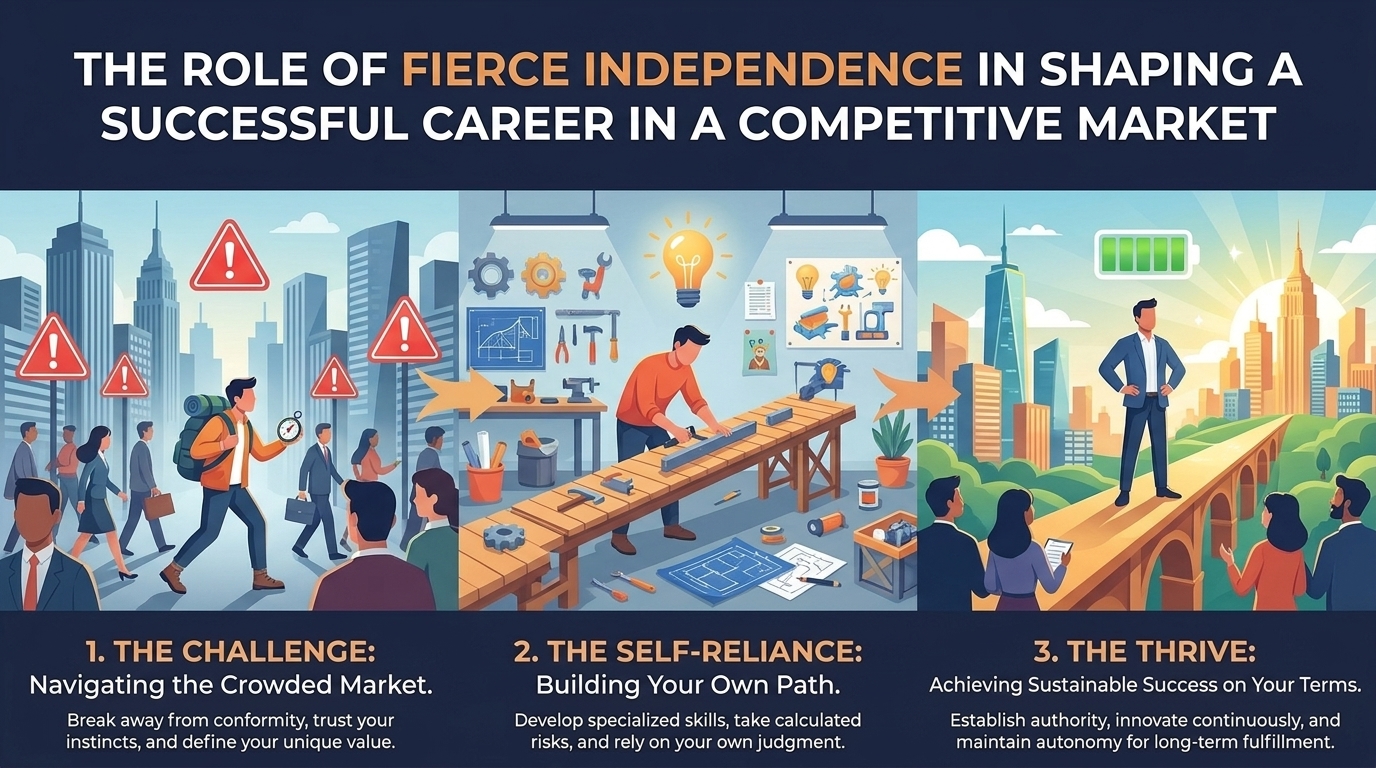
In the modern professional arena, conformity is a quiet career killer. When thousands of graduates pour out of universities each year with identical resumes, polished LinkedIn profiles, and conventional playbooks, blending in has never been easier—and it has never been more dangerous. In hyper-competitive regional markets, safety yields average results, while bold, uncompromised autonomy creates outliers.
Across America’s most demanding and dynamic metropolitan economic engines—from the high-stakes financial canyons of New York and the disruptive, paradigm-shifting laboratories of San Francisco, to the sprawling creative and entrepreneurial incubators of California, the complex policy networks of Washington, and the high-energy economic booms across Texas—professional survival requires more than competence. It demands fierce independence.
Fierce independence is not about being difficult, abrasive, or stubbornly isolated. It is the psychological capacity to trust your internal compass, challenge consensus dogma, take calculated contrarian risks, and carve out a distinct professional identity when every institutional voice is telling you to fall in line. This comprehensive guide explores the psychology of independent career building, why competitive markets reward autonomy, and actionable strategies to forge an unstoppable path forward.
1. The Psychology of Autonomy: Why Conformity Stifles Career Growth
To understand why fierce independence is essential for top-tier success, we must examine how modern organizational structures and educational systems condition us to follow the crowd.
- The Industrial Compliance Model: Traditional school and corporate structures are largely designed to reward compliance—doing what you are told, meeting predefined rubrics, and coloring safely inside the lines.
- The Comfort of the Herd: Evolutionary psychology teaches us that staying with the tribe feels safe. Standing out or dissenting creates social anxiety and triggers the fear of rejection. Consequently, most professionals choose the slow, safe corporate death of conformity over the thrilling volatility of independent execution.
- The Outlier Advantage: In economics and career development, asymmetric rewards belong to those who see what others miss or dare to build what others dismiss. If your strategy matches the consensus average, your financial and professional outcomes will inevitably mirror that average.
2. Regional Landscapes of Autonomy: Coast-to-Coast Independence
Different metropolitan regions foster unique commercial cultures, requiring distinct flavors of fierce independence to break through the noise:
New York and San Francisco: Boardroom Grit and Disruption
- New York: Independence in New York manifests as unshakeable conviction in high-pressure boardrooms, media conglomerates, and financial markets. It is the ability to stand your ground when everyone else is panicking, trusting your analytical and creative instincts against institutional skepticism.
- San Francisco: In the Bay Area, fierce independence is the bedrock of tech disruption and venture creation. Founders and engineers must possess the contrarian grit to build solutions that traditional markets initially mock or reject, believing deeply in a future that others cannot yet see.
Texas, California, and Washington: Building, Scaling, and Civic Vision
- California: Across broader California, independent careers in entertainment, design, and green tech require blazing new trails rather than waiting for gatekeepers to hand you permission.
- Texas: In booming Texas hubs like Austin, Dallas, and Houston, independence is rooted in a rugged, self-reliant “builder” ethos. Texas business culture heavily respects those who chart their own course, take ownership of their outcomes, and execute without corporate hand-holding.
- Washington: In the Pacific Northwest, independent professional minds must navigate complex institutional policy and corporate tech ecosystems by maintaining intellectual integrity and refusing to dilute bold visions for the sake of bureaucratic comfort.
3. The Core Pillars of Professional Independence
Fierce independence is sustained by practical behavioral habits and cognitive frameworks. Implement these four pillars to build your autonomous career foundation:
| Independence Pillar | Tactical Execution | Professional Benefit |
| Contrarian Thinking | Actively research industry assumptions and ask: “Where is the current consensus completely wrong?” | Positions you at the forefront of market shifts before they become mainstream trends. |
| Internal Locus of Control | Stop waiting for mentors, bosses, or market conditions to grant you permission to launch your project. | Eliminates helplessness and accelerates your personal output and accountability. |
| Boundary Enforcement | Ruthlessly protect your time, creative vision, and strategic priorities from dilution by committee. | Keeps your work sharp, authentic, and unmistakably yours. |
| Self-Directed Skill Acquisition | Identify future-proof skills independently and master them before your industry demands them. | Ensures you remain irreplaceable in a rapidly evolving economic landscape. |
4. Step-by-Step Blueprint: Cultivating Fierce Independence Without Isolating
True independence does not mean burning bridges or working in a total vacuum. It requires a balanced approach to autonomy and collaboration. Use this four-step blueprint:
- Audit Your Influences: Review the podcasts, books, newsletters, and colleagues shaping your daily thinking. If your information diet matches 99% of your peers, your output will be indistinguishable from theirs. Intentionally inject contrarian, cross-disciplinary, and independent voices into your daily routine.
- Take Ownership of a “Sandbox” Project: Carve out a specific professional domain—a newsletter, an open-source tool, a creative portfolio, or a specialized consulting service—where you have 100% creative and strategic control. Use this sandbox to test uncompromised ideas.
- Master the Art of Constructive Dissent: When disagreeing with conventional corporate or creative consensus, frame your perspective around objective market data, customer value, and long-term vision rather than emotional rebellion. Independent thinking is most powerful when delivered with undeniable competence.
- Build a Micro-Network of Outliers: Surround yourself with other independent thinkers, builders, and contrarians who challenge institutional groupthink. A tight-knit mastermind of independent operators provides the emotional support and strategic feedback you need to stay bold.
5. Ten Frequently Asked Questions (FAQ)
1. What is the difference between fierce independence and professional arrogance?
Professional arrogance involves dismissing feedback, treating others with disrespect, and assuming you never need to learn. Fierce independence is deep self-reliance, intellectual curiosity, and the courage to trust your vision while remaining rigorously objective and open to market data.
2. Is it risky to be an independent thinker in a traditional corporate environment?
It can be, if poorly communicated. However, forward-thinking organizations desperately need intrapreneurs—independent thinkers who challenge broken processes. The key is aligning your independence with the company’s ultimate growth goals.
3. How do I develop independence if I have spent my whole life following rules?
Start small. Pick one minor professional or creative decision each week where you consciously choose your own path instead of defaulting to what everyone else is doing. Build your autonomy muscle gradually.
4. Why do competitive markets punish conformity over the long term?
Competitive markets eventually commoditize conformity. When everyone offers the exact same skill set using the exact same playbook, pricing pressure destroys profit margins and career security. Differentiation is your only defense.
5. Can remote work enhance or hinder professional independence?
Remote and hybrid work structures can massively enhance independence by reducing office politics and forcing you to be judged purely on output. However, it requires intense self-discipline to avoid drifting.
6. How do I handle criticism when my independent choices go against the grain?
Remind yourself that genuine innovation always attracts skepticism. If your choices make everyone instantly comfortable, you are likely playing it too safe. Let results speak louder than critics.
7. What role does financial independence play in career autonomy?
Building a financial runway (savings or diversified income streams) is what ultimately grants you the psychological freedom to say “no” to bad projects, toxic employers, and compromises that dilute your vision.
8. How do major cities foster an environment where independent thinkers thrive?
High-density hubs like New York and San Francisco concentrate capital, diverse talent, and massive markets, making it much easier to find your niche audience or investors who specifically reward bold, non-conformist ideas.
9. Is fierce independence more important for entrepreneurs or corporate employees?
It is vital for both. While entrepreneurs need it to survive market uncertainty, corporate professionals need fierce independence to rise into executive leadership, drive innovation, and avoid getting lost in middle management.
10. Where can I find more resources on career strategy, mindset, and thriving in major cities?
Keep exploring specialized lifestyle, career, and culture hubs like nyattitude.com, where we provide actionable insights, local strategies, and expert guides to help you build an unstoppable, independent career across America’s greatest cities.
Conclusion
Fierce independence is the ultimate differentiator in a crowded, competitive market. Whether you are navigating the high-stakes financial towers of New York, innovating in the tech labs of San Francisco, building ventures across California, shaping policy in Washington, or scaling businesses in Texas, the professionals who leave a lasting legacy are those who refuse to blend into the background. By cultivating an internal locus of control, embracing contrarian thinking, and executing your vision with unwavering discipline, you transform your career from a game of following instructions into a masterclass of self-authored success.
Ready to build an unstoppable independent career, explore local culture, and elevate your professional journey? Continue browsing nyattitude.com to inspire your next big move!