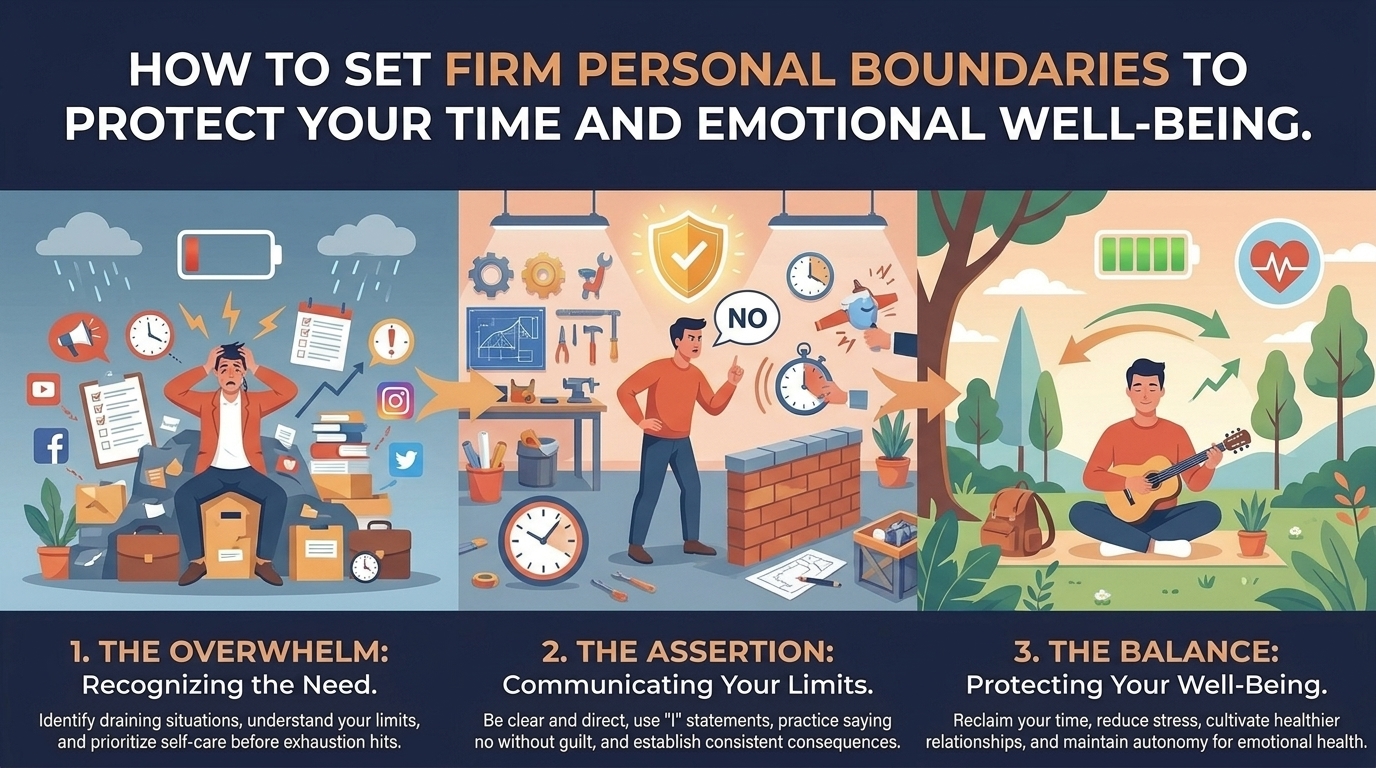
In our hyper-connected, always-on modern society, the lines between our professional ambitions, social obligations, and personal lives have blurred beyond recognition. With smartphones acting as portable tethers to our workplaces, Slack notifications pinging late into the evening, and social expectations demanding constant availability, many high-achieving individuals feel as though their lives are no longer their own.
Nowhere is this invisible pressure more intense than in America’s most demanding regional hubs. Whether you are racing against the clock in the financial and media corridors of New York, scaling a high-velocity startup in San Francisco or broader California, navigating complex stakeholder networks in Washington, or driving rapid economic expansion across Texas, the cultural expectation is often to say “yes” to everything, hustle endlessly, and sacrifice your personal life at the altar of productivity.
The hidden cost of this perpetual availability is devastating: chronic burnout, fractured relationships, deep resentment, and a severe depletion of your emotional well-being.
Protecting your most valuable assets—your time and your mental energy—requires mastering a critical life skill: setting firm, unshakeable personal boundaries. This comprehensive guide explores the psychology of boundary setting, why high-achievers struggle with saying “no,” and a step-by-step framework to establish boundaries that protect your peace and elevate your long-term success.
1. The Psychology of Boundaries: Why We Struggle to Say “No”
Before you can establish effective personal boundaries, you must understand why setting them feels so psychologically uncomfortable. Humans are fundamentally wired for social belonging. From an evolutionary standpoint, rejection by the tribe meant social or physical peril.
- The People-Pleasing Trap: Many ambitious professionals suffer from deep-seated conditioning that equates their worth with external validation. Saying “no” triggers an irrational fear of being perceived as selfish, lazy, or incompetent.
- The Boundary Spectrum: Boundaries are not brick walls designed to isolate you; they are fences with gates. They define where you begin and where others end, dictating what behavior you will accept in your life and what you will not.
- The Cost of Soft Boundaries: When you fail to set firm boundaries, you teach others that your time, energy, and emotional bandwidth have zero cost. Over time, people will unconsciously consume as much of your bandwidth as you allow, leading directly to resentment and burnout.
2. Regional Landscapes of Pressure: Coast-to-Coast Boundary Challenges
Different metropolitan regions foster distinct cultural expectations around work, availability, and social interaction, requiring tailored boundary strategies:
New York and San Francisco: The Always-On Metropolis
- New York: In NYC, the cultural rhythm is fast, urgent, and relentless. The implicit expectation is that you answer emails within minutes, take late-night calls, and sacrifice personal time for professional prestige. Setting boundaries here requires immense professional courage and radical clarity.
- San Francisco: In the Bay Area, the blurring lines between work and life are institutionalized. Startup culture often glorifies “living and breathing” your company 24/7. Establishing boundaries in SF means recognizing that sustainable innovation requires strict cognitive recovery.
Texas, California, and Washington: Growth, Culture, and Institutional Pace
- California: Across broader California, professionals balancing creative output, entertainment demands, or tech ventures often struggle with boundary fatigue in sunlit cultures that promote perpetual motion and social visibility.
- Texas: In booming Texas hubs like Austin, Dallas, and Houston, rapid economic expansion and high-energy networking mean social and professional opportunities are endless. Protecting your calendar requires prioritizing deep work over social FOMO (Fear Of Missing Out).
- Washington: In the Pacific Northwest, boundary management in policy, environmental science, or corporate tech often involves navigating complex stakeholder relationships where saying “no” requires tact, diplomacy, and ironclad structural clarity.
3. The Core Pillars of Effective Boundary Setting
Setting firm boundaries is an art form that balances empathy with unwavering self-respect. Implement these four core pillars:
| Boundary Pillar | Strategic Execution | Long-Term Benefit |
| Clarity Over Aggression | State your limits clearly, calmly, and directly without over-explaining, apologizing, or making up elaborate excuses. | Prevents others from finding loopholes or misinterpreting your boundaries as negotiable. |
| Temporal Shielding | Establish strict time blocks for deep work, family, rest, and digital disconnection (e.g., no work comms after 8 PM). | Reclaims your calendar and protects your nervous system from chronic, low-grade stress. |
| Emotional Insulation | Recognize that you are not responsible for managing other people’s emotional reactions to your boundaries. | Eliminates the guilt trap of trying to keep everyone else comfortable at the expense of your own sanity. |
| Enforceable Consequences | Determine in advance what action you will take if someone repeatedly violates your boundary (e.g., leaving a meeting, muting notifications). | Transforms a boundary from a wishful suggestion into an absolute standard of respect. |
4. Step-by-Step Blueprint: How to Set Boundaries Without Burning Bridges
Setting boundaries does not require confrontation or hostility. Use this four-step tactical framework to communicate your limits professionally and gracefully:
- Audit Your Current Bandwidth Drain: Track your time and emotional energy for one week. Identify exactly where your boundaries are weakest—is it a boss who dumps work on your desk at 5 PM? Friends who drain your emotional energy without offering support? Pinpoint your pain points.
- Draft Your Boundary Script in Advance: When caught off guard, we tend to default to people-pleasing. Prepare clear, professional scripts. For example: “I want to give this project my absolute best attention, but I am at capacity this week. I can review it first thing Monday morning.”
- Communicate Early and Proactively: Do not wait until you are boiling over with resentment to set a boundary. Set expectations clearly at the beginning of a project, a new job, or a relationship so rules of engagement are transparent.
- Hold the Line with Compassionate Consistency: The first time you set a boundary, people may test it because they are used to your old behavior. Hold your ground calmly and consistently. If they push back, restate your boundary without getting defensive.
5. Ten Frequently Asked Questions (FAQ)
1. What is the difference between a personal boundary and a rule to control others?
A rule attempts to control other people’s behavior (e.g., “You must not text me late”). A personal boundary focuses entirely on your behavior and what you will accept (e.g., “I turn my phone on silent at 9 PM and will not respond until morning”).
2. Why do I feel so guilty every time I say “no” to someone?
Guilt is a conditioned emotional response resulting from years of people-pleasing. Recognizing that saying “no” to an external request is simply saying “yes” to your own well-being helps neutralize that guilt over time.
3. How do I set firm boundaries with a demanding boss or client without risking my career?
Frame your boundaries around performance, quality, and mutual value. Instead of saying “I won’t work late,” communicate capacity constraints professionally: “To ensure I deliver high-quality results on priority A, I cannot take on task B until next week.”
4. What should I do if someone repeatedly ignores or disrespects my boundaries?
Enforce consequences. If someone consistently violates your communicated limits, you must step back, limit your exposure, or remove yourself from the dynamic entirely. Boundaries without consequences are merely suggestions.
5. Can setting boundaries damage my personal relationships?
Healthy relationships will adapt to and respect your boundaries. Relationships that rely on your lack of boundaries, self-sacrifice, or codependency may experience friction, which often reveals underlying imbalances that needed addressing anyway.
6. How do I protect my personal time when working remotely or from a home office?
Create strict physical and temporal transitions. Dress for work even at home, establish a dedicated workspace, and use a hard shutdown ritual at the end of the day to separate professional life from personal sanctuary.
7. Is it ever acceptable to bend or break my own boundaries?
Occasional, conscious flexibility for genuine emergencies is fine, provided it is the rare exception rather than the rule. If you constantly break your own boundaries for others, you teach them that your limits do not matter.
8. How do I handle passive-aggressive pushback when I set a boundary?
Stay calm, neutral, and unreactive. Do not J.A.D.E. (Justify, Argue, Defend, or Explain). Simply repeat your boundary calmly if necessary, or change the subject.
9. Why are high-achieving professionals in major cities particularly prone to boundary issues?
Major metropolitan hubs concentrate intense competition, status-driven cultures, and high financial stakes, creating an environment where individuals feel they must sacrifice everything to stay relevant and competitive.
10. Where can I find more resources on mental well-being, personal growth, and urban success?
Keep exploring specialized lifestyle, career, and culture hubs like nyattitude.com, where we provide actionable insights, local strategies, and expert guides to help you build a balanced, thriving life across America’s greatest cities.
Conclusion
Setting firm personal boundaries is not an act of selfishness; it is the ultimate act of self-preservation and self-respect. Without clear boundaries, your time, energy, and emotional well-being are left exposed to the demands of a relentless world. Whether you are navigating the high-speed corporate trenches of New York, innovating in the tech sectors of San Francisco, building your career across California, shaping policy in Washington, or scaling ventures in Texas, guarding your bandwidth allows you to show up as your absolute best, most focused, and most creative self. Reclaim your time, protect your peace, and build a sustainable life of purpose and power.
Ready to protect your energy, master your mindset, and elevate your personal growth? Continue browsing nyattitude.com to inspire your journey forward!