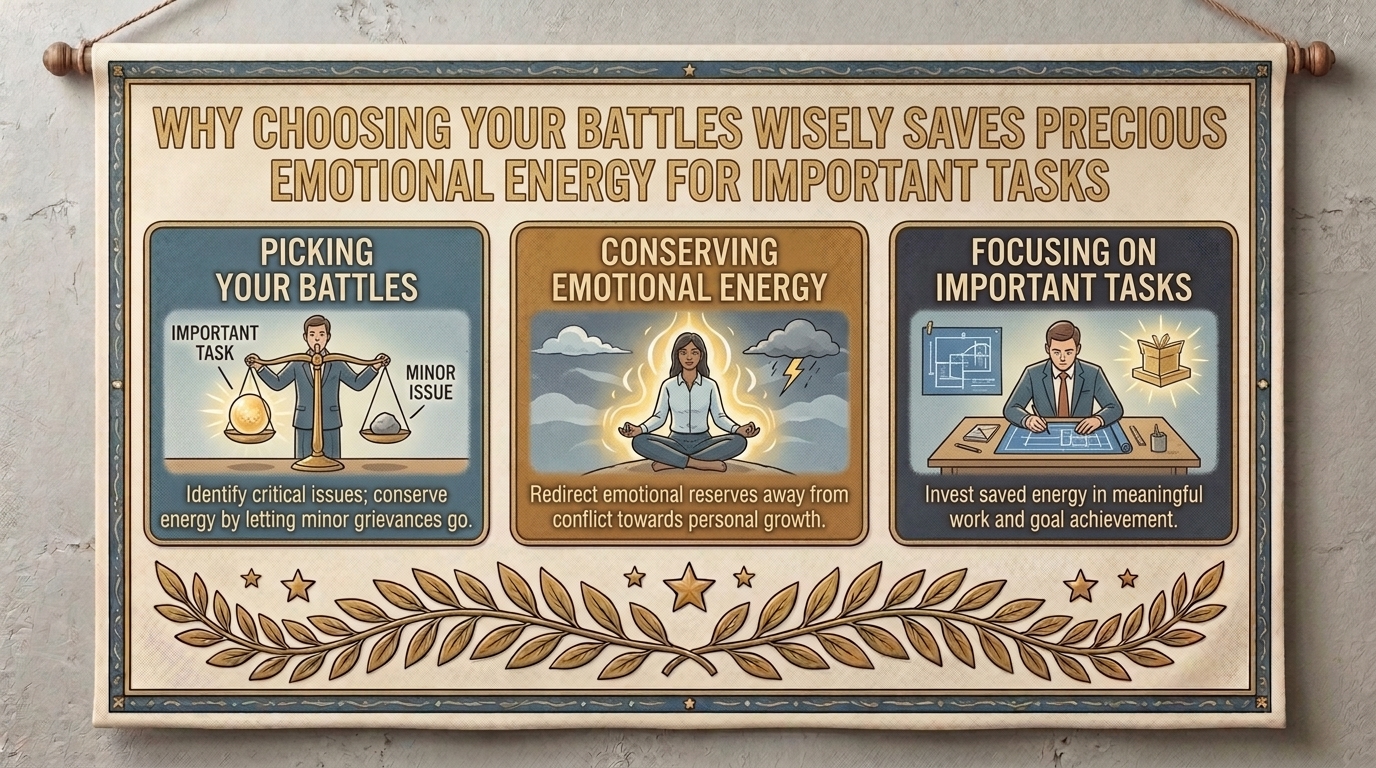
In the modern professional arena and our increasingly complex personal lives, we are bombarded with constant demands, ideological clashes, micro-conflicts, and competing priorities. Whether you are navigating high-stakes corporate negotiations in New York, scaling a fast-moving startup in San Francisco or the broader California tech ecosystem, managing regulatory and public relations hurdles in Washington, or driving rapid growth across fast-paced business hubs in Texas, the friction of daily life can quickly drain your mental battery.
Most high achievers fall into the trap of reactive engagement. They treat every slight, every ideological disagreement, every poorly worded email, and every minor procedural roadblock as an emergency requiring an immediate, robust defense. The hidden cost of this constant combativeness is not just stress; it is decision fatigue and the depletion of emotional capital.
Emotional energy is a finite daily resource. When you spend 80% of your emotional bandwidth fighting trivial turf wars, managing petty workplace politics, or arguing on digital platforms, you leave yourself with zero reserves for deep work, strategic innovation, high-impact leadership, and personal fulfillment.
This comprehensive guide explores the psychology of conflict, the hidden neurology of emotional drainage, actionable frameworks for strategic disengagement, and practical tips on how to master the art of choosing your battles wisely to protect your most valuable asset: your focus.
Part 1: The Economics of Emotional Energy
To understand why choosing your battles is a strategic imperative, we must first look at emotional energy through the lens of economics.
1. Ego Depletion and Cognitive Load
Psychologist Roy Baumeister popularized the concept of ego depletion, which suggests that self-control and decision-making draw upon a shared, limited pool of mental energy. Every time you consciously suppress an angry impulse, debate a difficult colleague over a minor detail, or force yourself to stay calm during an unnecessary confrontation, you deplete your reserve of self-regulation.
By the time you sit down to tackle high-impact tasks—such as writing a core company strategy, designing a product roadmap, or closing a major business deal—your brain is already running on fumes. The result? Subpar execution, procrastination, and errors in judgment.
2. The Opportunity Cost of Conflict
In finance, opportunity cost represents the potential benefits an individual misses out on when choosing one alternative over another. The exact same principle applies to emotional energy:
- The Cost of Engagement: Every minute spent defending your ego in a low-stakes argument is a minute stolen from creative problem-solving, deep work, or personal recovery.
- The Compounding Effect of Small Frictions: Minor daily battles accumulate, keeping your nervous system in a chronic state of low-grade fight-or-flight. This sustained cortisol release impairs your prefrontal cortex, dampening long-term strategic vision.
Part 2: The Psychology Behind the Need to Fight Everything
Why do intelligent professionals struggle so much to let things go? Several deeply ingrained psychological drivers compel us to pick up every weapon handed to us:
- The Need for Validation: Many people tie their professional self-worth to being “right” in every interaction. Letting an argument go feels like losing status or admitting defeat.
- Loss Aversion: Coined by behavioral economists Amos Tversky and Daniel Kahneman, loss aversion proves that the psychological pain of losing an argument or appearing weak is twice as powerful as the pleasure of winning.
- Hyper-Connected Environments: Modern digital communication platforms (Slack, email, social media) create an artificial sense of urgency, tricking our brains into believing that every conversational thread requires an immediate, defensive rebuttal.
Recognizing these psychological traps is the first step toward reclaiming your emotional autonomy.
Part 3: The 4-Part Framework for Choosing Your Battles
Not all conflicts are created equal. To preserve your emotional capital, you need a reliable filtering system to evaluate whether a dispute is worth your time and mental energy. Before entering any confrontation, run it through this four-part strategic filter.
[ Incoming Conflict / Disagreement ]
               │
               ▼
   1. Is the core issue aligned with your ultimate goals? ──( No )──► [ DISENGAGE ]
               │ (Yes)
               ▼
   2. What are the irreversible long-term consequences? ──( Low )──► [ LET IT GO ]
               │ (High)
               ▼
   3. Do you have direct influence or leverage here? ────( No )──► [ ACCEPT & ADAPT ]
               │ (Yes)
               ▼
   4. Is the emotional ROI worth the energy cost? ───────( No )──► [ REDIRECT ]
               │ (Yes)
               ▼
       [ ENGAGE STRATEGICALLY ]
1. The Long-Term Impact Test
- Ask yourself: Will this matter in 5 weeks, 5 months, or 5 years?
- The Rule: If the issue will have zero bearing on your life, career trajectory, or core relationships a month from now, drop it immediately. Most daily irritations fail this timeline test.
2. The Alignment and Values Test
- Ask yourself: Does this conflict threaten your core ethical boundaries, your physical safety, or your primary professional mission?
- The Rule: If someone steps on your core values or attempts to undermine an essential project objective, stand your ground. If it is merely a clash of personal styles, egos, or preferences, let it slide.
3. The Locus of Leverage Test
- Ask yourself: Can your intervention realistically change the outcome, or are you shouting into a vacuum?
- The Rule: If you lack decision-making authority, leverage, or influence over the situation, fighting is an exercise in futility. Conserve your energy for environments where your voice actually moves the needle.
4. The Emotional Return on Investment (ROI) Test
- Ask yourself: What is the energy cost of this fight compared to the tangible return?
- The Rule: If winning an argument yields zero material or relational benefit while costing you hours of rumination and emotional drainage, the ROI is negative. Walk away.
Part 4: Regional Perspectives: Navigating Conflict Across Major Business Hubs
High-pressure environments demand tailored approaches to conflict management. Here is how strategic disengagement applies across major economic landscapes:
- New York: In high-speed, hyper-competitive financial and media sectors, bravado and fast-paced verbal sparring are common. Choosing your battles here means ignoring posturing and industry gossip, focusing entirely on transactional integrity and bottom-line outcomes.
- San Francisco & California: Innovation ecosystems thrive on rapid iteration, strong opinions, and cultural debates. Strategic disengagement involves separating ideological noise from product execution, refusing to get bogged down in endless debate loops.
- Washington: In public policy, government relations, and regulatory sectors, optics and stakeholder politics dominate. Here, choosing your battles means picking strategic hills to die on during legislative cycles while maintaining diplomatic grace on secondary issues.
- Texas: Known for direct, pragmatic, and growth-oriented corporate cultures, Texas business environments value efficiency. Disengaging from unproductive interpersonal friction allows leaders to stay laser-focused on scaling operations, expansion, and practical partnerships.
Part 5: Actionable Tips to Protect Your Emotional Energy Daily
Implementing the philosophy of selective engagement requires daily operational habits. Adopt these five practical strategies to safeguard your focus:
1. Implement a 24-Hour “Cool-Down” Rule for Digital Conflict
When you receive an inflammatory email, Slack message, or social media comment that triggers your defense mechanisms, do not reply immediately.
- Actionable step: Enforce a strict 24-hour waiting period before responding to non-emergency provocations. In most cases, the emotional charge dissipates entirely by the next day, or you realize a response wasn’t necessary at all.
2. Master the Art of Professional Disengagement Phrases
You do not need to win every argument to exit it with dignity. Equip yourself with neutral, low-friction closing phrases that shut down circular debates without escalating tension:
- “That’s an interesting perspective; let’s circle back on this if priorities shift.”
- “I can see we view this differently. Let’s agree to focus on our primary deliverables for now.”
- “Thanks for sharing your thoughts; I’ll take them under advisement.”
3. Audit Your Information and Social Environment
Your tolerance for unnecessary battles is heavily influenced by your inputs. If you surround yourself with outrage culture, toxic workplace gossip, or constant social media friction, your baseline irritability skyrockets.
- Actionable step: Conduct a weekly audit of your digital feeds, group chats, and professional associations. Mute or disconnect from sources that trigger constant combative urges.
4. Redirect Energy Into Deep Work Blocks
Nature abhors a vacuum. If you simply try to stop fighting without redirecting your focus, your brain will naturally drift back to old reactive habits.
- Actionable step: Block out the first two to three hours of your workday for deep work—uninterrupted, high-value creation. When your calendar is anchored by meaningful execution, petty distractions lose their magnetic pull.
5. Cultivate Physical Recovery Rituals
Emotional regulation is deeply tied to physiological state. When you are sleep-deprived, hungry, or over-caffeinated, your brain’s emotional center (the amygdala) overrides your rational center (the prefrontal cortex), making you far more likely to pick unnecessary fights.
- Actionable step: Prioritize baseline physical recovery—consistent sleep, hydration, and movement—as a non-negotiable professional tool.
Part 6: 10 Frequently Asked Questions (FAQs)
1. Does choosing your battles mean being passive or backing down from challenges?
Not at all. Choosing your battles is an active, highly strategic form of leadership. It means you refuse to waste ammunition on skirmishes so that you have overwhelming force available when a truly vital conflict arises.
2. How do I stop ruminating after walking away from an argument?
Ruminating happens when your brain feels an argument is “unresolved.” Counteract this by writing down your thoughts in a private journal to achieve closure, then deliberately switch your physical environment or dive into an engaging task to break the feedback loop.
3. What should I do if my boss or client drags me into petty or low-stakes conflicts?
Acknowledge their input professionally, pivot the conversation back to overarching metrics or deliverables, and gently frame the issue around time and resource allocation. Most managers will back down when they see you prioritizing core business results.
4. Isn’t letting things go a sign of weakness in competitive industries?
True confidence requires no performance. Weakness is defined by an inability to control one’s impulses, leading to reactive engagement in every trivial dispute. Choosing your battles projects supreme self-assurance and emotional maturity.
5. How can I tell the difference between a healthy debate and an ego-driven battle?
A healthy debate focuses on facts, ideas, and optimizing outcomes, with all parties open to changing their minds. An ego-driven battle focuses on winning, defending personal pride, and proving someone else wrong regardless of objective truth.
6. Can choosing your battles help prevent professional burnout?
Yes, dramatically. Chronic low-grade conflict is one of the leading drivers of emotional exhaustion and burnout. By eliminating unnecessary friction, you preserve the mental energy needed for sustained creative engagement.
7. How do I practice this when working in a remote or asynchronous team environment?
Written communication lacks tone and nuance, making misunderstandings common. Assume positive intent, refuse to read hostility into brief messages, and take complex or tense discussions offline via a quick phone call only if the issue passes the strategic filter.
8. What if someone interprets my silence or disengagement as agreement?
You can disengage from the conflict while firmly stating your position on the outcome. For example: “I see we aren’t going to align on this approach, but I will proceed with the agreed-upon project deliverables as discussed.”
9. How long does it take to retrain your brain to stop reacting to everything?
Like any mental habit, rewiring your response takes consistent practice. Most people notice a significant shift in their emotional bandwidth and stress levels after 3 to 4 weeks of consciously applying the 4-part decision filter.
10. How do leaders benefit most from mastering the art of selective engagement?
Leaders who pick their battles wisely earn the deep respect of their teams. When a leader rarely reacts emotionally but speaks with absolute clarity on major issues, their team knows that when they do take a stand, it matters profoundly.
Conclusion
Energy is the ultimate currency of achievement. No matter how brilliant your strategy, how extensive your network, or how advanced your technical skills, you cannot outperform chronic emotional depletion.
By learning to distinguish between petty systemic friction and critical professional milestones, you stop leaking vital mental power into meaningless disputes. Whether you are navigating dynamic markets in Texas, fast-evolving tech ecosystems in California, policy landscapes in Washington, or corporate hubs in New York, mastering the art of choosing your battles wisely clears the path for what truly matters: deep focus, high-impact execution, and sustainable long-term success.