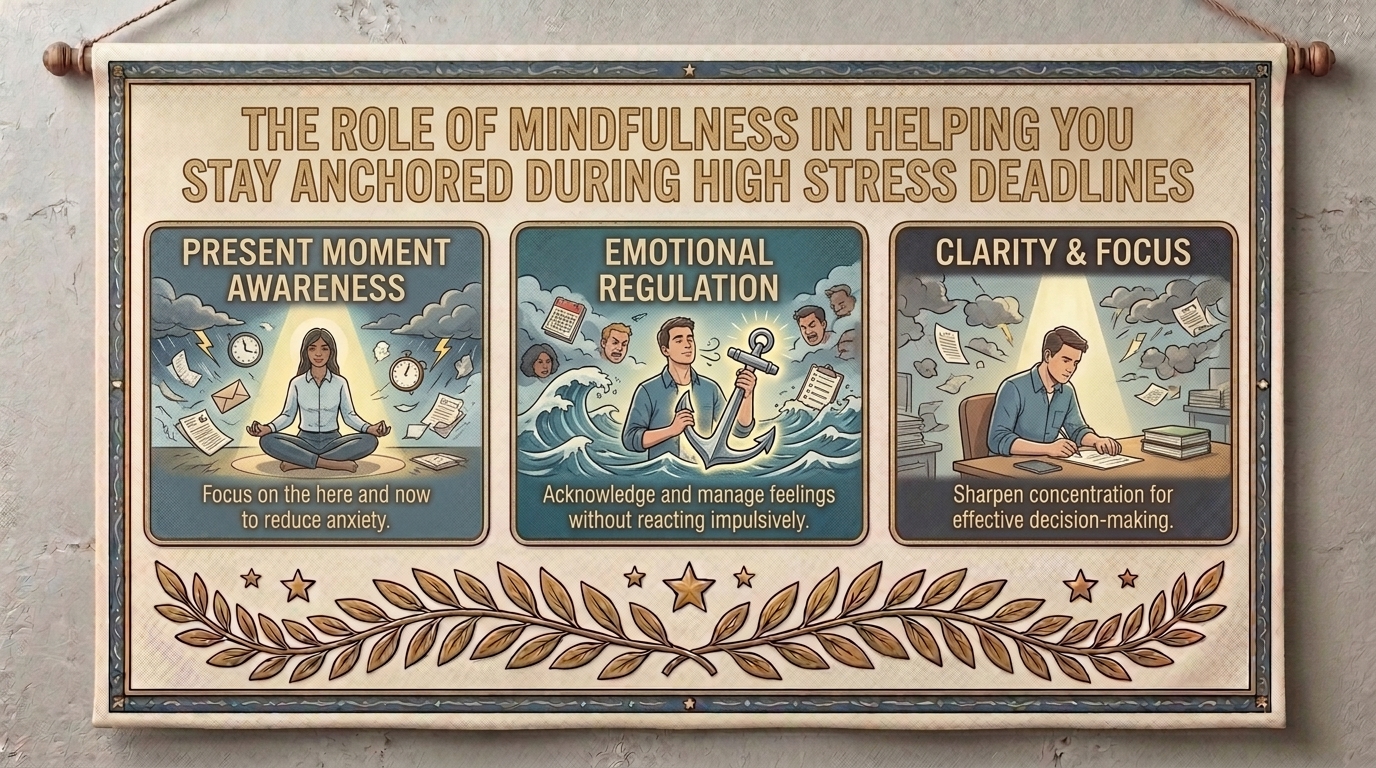
In the modern professional landscape, the high-stress deadline has become an inescapable reality. Whether you are racing against a funding round closing in San Francisco or California, managing rapid operational scaling in Texas, delivering high-stakes financial reports in New York, or navigating critical legislative and regulatory timelines in Washington, high-pressure environments demand elite performance under fire.
When deadlines loom and pressure spikes, the human body reacts automatically. Heart rates elevate, breathing becomes shallow, cortisol and adrenaline flood the bloodstream, and cognitive bandwidth narrows. Under this biological siege, professionals often resort to chronic multitasking, hyper-reactivity, and desperate shortcuts. The ironic result? Productivity plummets, decision-making becomes flawed, and burnout creeps in.
True high performance under pressure is not about running faster on a broken treadmill; it is about learning how to pause, center your focus, and execute with absolute clarity. Mindfulness—the psychological practice of maintaining a moment-by-moment awareness of our thoughts, feelings, bodily sensations, and surrounding environment through a gentle, nurturing lens—is the ultimate cognitive anchor.
This comprehensive guide explores the neuroscience of deadline-induced stress, the specific mechanisms of mindfulness, actionable implementation strategies for high-pressure work environments, and practical ways to stay anchored when the clock is ticking down.
Part 1: The Neuroscience of Deadline Stress vs. Mindful Focus
To understand why mindfulness is a tactical performance tool rather than mere relaxation, we must examine what happens inside the brain during extreme deadline pressure.
1. The Hijacked Brain: Amygdala vs. Prefrontal Cortex
When a high-stress deadline triggers a sense of emergency, the amygdala (the brain’s emotional and survival center) perceives the deadline as an immediate threat. It triggers the sympathetic nervous system, flooding your system with stress hormones.
Simultaneously, blood flow is diverted away from the prefrontal cortex—the seat of executive function, strategic planning, creative problem-solving, and emotional regulation. In simple terms: under acute stress, your brain physically loses its capacity to think clearly. You become reactive, prone to errors, and hyper-sensitive to distractions.
2. How Mindfulness Reclaims Prefrontal Function
Mindfulness acts as a neurological circuit breaker. By focusing intentionally on your breath, physical sensations, or immediate environment, you activate the parasympathetic nervous system (the “rest and digest” response).
Neuroscientific imaging studies reveal that regular mindfulness practice actually shrinks the physical size of the amygdala and strengthens neural connections in the prefrontal cortex. During a high-stress deadline, mindfulness allows you to bypass the panic response, keeping your executive functioning online precisely when you need it most.
Part 2: The Core Pillars of Deadline Mindfulness
Mindfulness in a professional setting does not require sitting cross-legged on a cushion for an hour while ignoring your inbox. In high-stakes environments, mindfulness is built on three core pillars:
[ THE THREE PILLARS OF DEADLINE MINDFULNESS ]
       │
       ├── 1. Radical Awareness (Catching mental panic early)
       ├── 2. Tactical Disengagement (Stepping back from the noise)
       └── 3. Single-Tasking Immersion (Executing one metric at a time)
1. Radical Awareness
The ability to notice your stress levels before they cross into panic. It is recognizing: “My shoulders are locked, my breath is shallow, and I am rushing just to feel busy.” Naming the state defuses its power.
2. Tactical Disengagement
The disciplined pause. Taking 60 to 120 seconds to step away from the active panic loop, reset your physiological baseline, and re-enter your task with a clear strategic head.
3. Single-Tasking Immersion
The antidote to deadline fragmentation. Instead of having 30 tabs open and trying to answer emails while writing a core report, mindfulness anchors you entirely to the single action required in the present moment.
Part 3: Actionable Strategies to Stay Anchored Under Pressure
Integrating mindfulness into a high-pressure career requires concrete, tactical habits that fit seamlessly into a demanding workday. Implement these five strategies when deadlines threaten to overwhelm you:
1. The 3-Minute Box Breathing Reset
When acute deadline pressure hits, your nervous system needs immediate physical intervention.
- Actionable step: Practice box breathing: Inhale for 4 seconds, hold for 4 seconds, exhale for 4 seconds, and hold for 4 seconds. Repeat this cycle for 3 minutes. This specific rhythm rapidly lowers cortisol and resets heart rate variability.
2. The “Brain Dump” and Priority Filter
Panic during deadlines often stems from cognitive overload—feeling like you have ten urgent tasks occupying the same mental space simultaneously.
- Actionable step: Take a blank sheet of paper and dump every single task, worry, and sub-deadline out of your head. Then, apply the 80/20 rule: identify the single task that will move the needle by 80%, bracket everything else, and commit entirely to that one objective.
3. Hourly Micro-Check-Ins (The Anchor Bell)
When deep in flow or stress, hours pass without a single conscious breath, leading to severe mental fatigue by afternoon.
- Actionable step: Set a subtle hourly chime on your watch or phone. When it rings, take 10 seconds to drop your shoulders, take one deep breath, check your posture, and ask: “What am I rushing right now, and how can I bring calm focus back to this task?”
4. Digital Quarantine During Deep Execution
Notifications are engineered to trigger micro-spikes of anxiety and distraction, shattering your focus.
- Actionable step: When working on a critical deadline deliverable, put your phone in another room, close all communication apps (Slack, email, messaging tools), and set a timer for 50 minutes of absolute, distraction-free execution.
5. Mindful Transition Rituals Between Tasks
Jumping straight from a stressful client call into drafting a complex proposal guarantees that your cortisol from the call bleeds into your writing.
- Actionable step: Take a 2-minute buffer between major work blocks. Stand up, stretch, drink a glass of water, and consciously reset your mental slate before opening the next file.
Part 4: Regional Perspectives: Managing Pressure Across Major Economic Hubs
High-stress deadlines look and feel different depending on your geographic and industrial ecosystem:
- New York: Fast-paced financial quarters, media crunches, and corporate boardroom deadlines demand split-second precision. Mindfulness here prevents emotional trading, impulsive decision-making, and chronic burnout in high-stakes environments.
- San Francisco & California: Rapid venture funding cycles, product launch sprints, and hyper-competitive tech releases create relentless velocity. Mindfulness acts as an internal anchor against the culture of constant hustle and speed-induced errors.
- Washington: Legislative advocacy windows, policy drafting deadlines, and high-stakes compliance reviews require diplomatic grace and sharp attention to detail. Mindfulness helps leaders maintain calm composure amidst intense partisan and stakeholder pressure.
- Texas: Rapid business expansion, massive corporate logistics projects, and energy sector timelines demand robust, pragmatic execution. Mindfulness ensures that rapid scaling does not compromise operational safety or strategic clarity.
Part 5: 10 Frequently Asked Questions (FAQs)
1. Isn’t mindfulness just a slow-paced practice that doesn’t fit fast-paced deadlines?
This is a common misconception. Mindfulness actually accelerates productivity by eliminating the wasted time and cognitive errors caused by panic, distraction, and multitasking. A calm mind works faster and smarter.
2. How can I practice mindfulness when I only have 5 minutes before a major deadline presentation?
Use a rapid sensory anchor. Plant your feet firmly on the floor, feel the physical support of your chair, take three deep, slow abdominal breaths, and mentally rehearse your upcoming execution with complete calm detachment.
3. What if my mind keeps wandering back to the deadline panic while I try to meditate?
Mind wandering is normal—it is what the brain evolved to do. The moment you notice your mind wandering back to panic, simply and gently redirect your attention back to your breath without self-judgment. That act of redirection is the mental workout.
4. Can mindfulness help prevent physical symptoms of stress like tension headaches or jaw clenching?
Yes. Mindfulness cultivates somatic (bodily) awareness, allowing you to notice physical tension early in the cycle and consciously release it before it develops into a full-blown stress migraine or physical ailment.
5. How do I maintain mindfulness when my entire team or company is in a state of panic?
Calm is just as contagious as panic. When leadership and team members see you maintaining a grounded, methodical, and calm demeanor under pressure, it helps stabilize the emotional temperature of the entire room.
6. Do I need special apps or meditation cushions to practice workplace mindfulness?
None at all. Workplace mindfulness can be practiced sitting at your desk, walking down a hallway, or listening to a colleague. It is entirely about your internal state of awareness, not external props.
7. How long does it take for mindfulness to actually change how I handle stress?
While techniques like box breathing provide immediate physiological relief within minutes, noticeable rewiring of your baseline stress reactivity typically occurs after 3 to 4 weeks of daily, consistent practice.
8. What is the difference between mindfulness and compartmentalization?
Compartmentalization is pushing emotions or stress away into a mental box to deal with later (which often leads to emotional explosions down the line). Mindfulness involves observing the stress with clarity, acknowledging it, and letting it pass through you without letting it hijack your decisions.
9. How can managers encourage mindfulness among stressed team members without sounding cliché?
Managers should model boundaries—such as not sending frantic late-night emails, encouraging micro-breaks, focusing performance reviews on sustainable output rather than hours logged, and creating psychological safety.
10. Can mindfulness improve the quality of creative work during tight timelines?
Dramatically. Creativity requires access to the prefrontal cortex and associative thinking. By clearing out the stress-induced mental static, mindfulness opens up the cognitive space required for breakthrough ideas.
Conclusion
High-stress deadlines are an inevitable feature of ambitious careers. Whether you are navigating fast-paced financial markets in New York, launching tech products in California and San Francisco, shaping policy in Washington, or scaling operations in Texas, the external pressure will always be present.
You cannot always control the timeline or the external demands placed upon you, but you have absolute sovereignty over your internal response. By integrating mindfulness into your daily workflow—leveraging radical awareness, tactical breathing pauses, and single-tasking immersion—you transform deadlines from sources of panic into moments of peak, focused execution. Stay anchored, protect your cognitive energy, and let clarity guide your success.