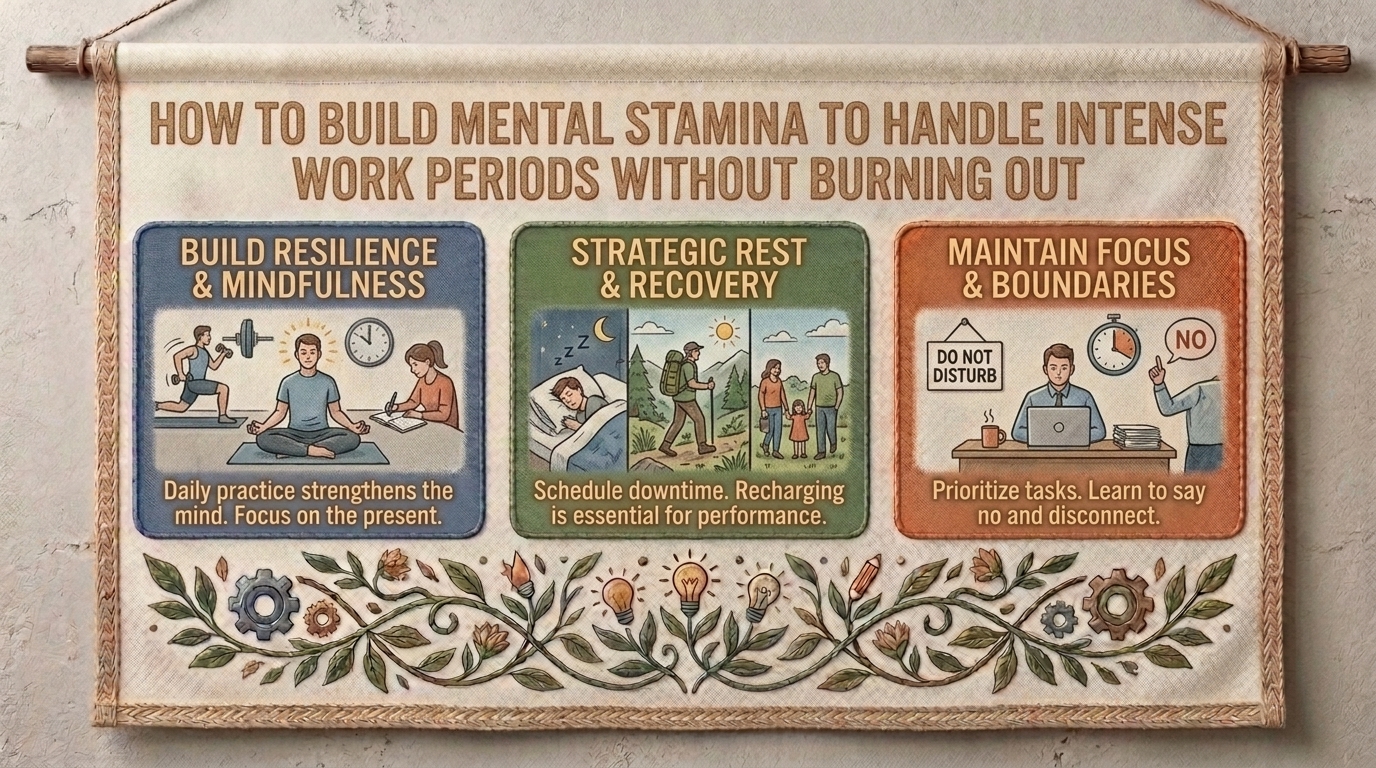
How to Build Mental Stamina to Handle Intense Work Periods Without Burning Out
Introduction
In the modern knowledge economy, high performance is rarely measured by a standard forty-hour workweek. Instead, it is defined by intense, high-velocity sprints: product launches, fiscal quarter closes, venture capital funding rounds, legal trials, and massive enterprise overhauls.
Whether you are navigating the breakneck financial corridors of New York, scaling disruptive tech startups in San Francisco, managing rapid corporate expansion across Texas, spearheading critical policy and tech initiatives in Washington, or driving creative industries throughout California, enduring intense work periods is an inevitable part of ambitious career growth.
Yet, there is a dangerous collective misconception that mental stamina means pushing your foot on the gas pedal until the engine explodes. We glorify the “hustle culture” myth of skipping sleep, subsisting on caffeine, and ignoring physical exhaustion in the name of output.
Inevitably, this approach leads to a hard crash: severe burnout, cognitive fatigue, emotional irritability, and a catastrophic drop in the quality of your work. True mental stamina is not about enduring abuse; it is about building sustainable cognitive endurance, energetic discipline, and psychological resilience.
For visionary professionals, leaders, and entrepreneurs engaging with platforms like nyattitude.com, mastering the science of mental stamina is the ultimate competitive advantage for thriving under pressure without sacrificing your health. This comprehensive guide explores the neuroscience of cognitive endurance, the hidden traps of burnout, step-by-step stamina protocols, regional navigation across major U.S. hubs, actionable daily tips, and answers to the most frequently asked questions.
1. The Neuroscience of Cognitive Fatigue: Why the Brain Burns Out
To understand how to build mental stamina, we must first look beneath the skull into how the brain expends and depletes its energy resources during intense work blocks.
The Myth of Infinite Willpower
Many professionals treat willpower and focus as infinite personality traits. If they fail to finish a project, they blame their personal discipline. In reality, focus is powered by the prefrontal cortex—the evolutionary newest region of the human brain responsible for executive function, decision-making, emotional regulation, and complex strategic planning.
- Glucose and Metabolic Drain: The prefrontal cortex is an intensely high-metabolic engine. Every time you make a hard choice, resist a distraction, write strategic code, or resolve a conflict, your brain burns through glucose and neurotransmitters. When these resources are depleted without adequate recovery, you experience decision fatigue and cognitive burnout. Your brain literally lacks the fuel required to maintain high-level operations.
Cortisol and the Chronic Stress Trap
During prolonged intense work periods without breaks, the body triggers the release of cortisol and adrenaline. While these stress hormones are useful in short bursts to meet a deadline, chronic elevation keeps your nervous system trapped in a state of hyper-arousal. This impairs memory consolidation, shrinks synaptic plasticity, and causes emotional exhaustion.
2. The Difference Between Hustle and Stamina
It is vital to distinguish between destructive hustle culture and sustainable mental stamina:
- Hustle Culture: Relies on brute force, sleep deprivation, and emotional reactivity. It operates on a linear model: more hours worked equals more output produced. Eventually, it hits a wall of diminishing returns and total burnout.
- Mental Stamina: Relies on rhythmic energy management, strategic recovery, and cognitive agility. It operates on a compounding model: protected focus intervals paired with deliberate rest yield exponentially higher-quality output with zero systemic breakdown.
3. Regional Perspectives: Managing Intensity Across Major U.S. Hubs
The pressure of intense work periods takes on distinct cultural rhythms and operational styles across the diverse geographic landscapes connected to nyattitude.com:
- New York: Within the high-stakes pressure cookers of Wall Street, corporate law, and global media, the work culture demands relentless speed. New York professionals must master elite mental stamina to outlast high-stress market cycles without letting the city’s frantic pace compromise their physical and mental health.
- San Francisco: Grounded in the hyper-competitive tech startup ecosystem, San Francisco professionals face intense milestone-driven sprints, pitch deadlines, and product shipping cycles. Sustainable stamina here requires balancing late-night coding blocks with mandatory outdoor decompression and wellness protocols.
- Texas: Spanning massive economic expansion hubs like Austin, Dallas, and Houston, Texas business culture combines ambitious corporate scale with a deep appreciation for lifestyle balance and personal grit. Leaders here build stamina by pacing long-term enterprise growth with weekend family grounding.
- Washington: Anchored by federal agencies, defense contractors, and high-level policy think tanks, Washington professionals navigate intense bureaucratic and political scrutiny. Stamina here relies on diplomatic patience, structured compartmentalization, and intellectual detachment from high-tension political cycles.
- California (Southern & Broader): Balancing entertainment industries, creative arts, and holistic wellness culture, California encourages an integration of intense professional output with rigorous mental health practices, mindfulness, and outdoor vitality.
4. Step-by-Step Framework: The Cognitive Stamina Protocol
Building unbreakable mental endurance during a high-intensity work season requires a deliberate, structured framework. Follow these five steps:
Step 1: Establish Strict Cognitive Time-Blocking
Do not approach an intense work period by sitting at your desk for ten hours straight answering emails and reacting to pings. Divide your day into rigid, high-focus blocks (e.g., 90-minute ultradian rhythm sprints) dedicated exclusively to your highest-leverage strategic priorities, followed by mandatory offline breaks.
Step 2: Implement “Hard Stops” for Deep Recovery
Mental stamina is built during recovery, not during work. Just as a physical marathon runner cannot sprint continuously without tearing muscle tissue, your brain cannot process complex data without downtime. Set an unmovable hard stop for your workday, after which digital devices are put away and your nervous system is allowed to transition into rest.
Step 3: Master Physiological Regulation
When stress spikes during a heavy workload, your breathing becomes shallow, spiking your heart rate and fueling anxiety. Use physiological sighs (two quick inhales through the nose followed by a long, slow exhale through the mouth) to instantly down-regulate your nervous system in under sixty seconds.
Step 4: Guard Your Sleep Architecture Like Capital
No productivity hack, no nootropic stack, and no amount of caffeine can replace deep, restorative sleep. During sleep, your brain’s glymphatic system activates, washing away metabolic waste products accumulated during intense cognitive work. Guard your 7 to 8 hours of sleep like you would guard your most valuable financial asset.
Step 5: Perform Weekly Cognitive Audits
At the end of every intense week, review where your energy went. Did you spend hours on low-value administrative busywork, or did you protect your energy for high-impact milestones? Ruthlessly trim energy leaks for the upcoming week.
5. Actionable Tips to Maintain High Stamina Daily
Incorporate these practical micro-habits into your intense work schedule to protect your energy and prevent burnout:
- Take Real Micro-Breaks: Between focus blocks, step away from your monitor entirely. Look out a window at a distant horizon to relax your visual cortex, stretch your spine, or drink a glass of water.
- Hydrate and Fuel Cleanly: Dehydration is one of the leading hidden causes of brain fog and afternoon fatigue. Keep water at your desk and consume clean, protein-rich meals that stabilize blood sugar rather than causing insulin spikes and crashes.
- Batch Your Shallow Work: Do not let emails and minor administrative tasks fracture your attention all day long. Batch shallow work into specific 30-minute windows (e.g., late morning and late afternoon) to protect your deep-focus stamina.
- Disconnect Completely on Weekends: If your work period spans multiple weeks, fiercely protect your weekends. Complete cognitive disconnection allows your brain to enter the default mode network, consolidating memories and solving complex problems subconsciously.
- Set Boundaries on Availability: Communicate clear response-time expectations with clients, managers, and team members. Constant availability creates an insidious state of hyper-vigilance that drains your cognitive battery.
- Move Your Body Daily: Intense desk work pools blood in your lower extremities and tightens hip flexors. A brisk 20-minute walk or light workout resets your nervous system, pumps oxygen to your brain, and provides an instant second wind.
6. Ten Frequently Asked Questions (FAQs)
1. What is the precise definition of mental stamina?
Mental stamina is the psychological and physiological capacity to sustain high levels of focus, cognitive performance, emotional resilience, and strategic problem-solving over extended periods of intense pressure without experiencing burnout or cognitive collapse.
2. Why do I feel completely exhausted even after sitting at a desk all day doing “knowledge work”?
Knowledge work requires continuous prefrontal cortex activation, decision-making, and emotional regulation. This burns massive amounts of glucose and neurotransmitters, leading to severe mental fatigue even though your physical body remained stationary.
3. How can I tell the difference between normal tiredness and actual burnout?
Normal tiredness is temporary and is fully cured by a good night’s sleep or a relaxing weekend. Burnout is a chronic state of physical and emotional exhaustion accompanied by cynicism, detachment, and a persistent inability to recover energy even after resting.
4. What are ultradian rhythms, and how do they relate to mental stamina?
Ultradian rhythms are natural 90-to-120-minute biological cycles throughout the day during which our bodies shift from high-frequency alertness to lower-frequency rest. Aligning your deep work sprints with these natural cycles maximizes stamina and prevents fatigue.
5. How does lack of sleep destroy my cognitive stamina?
Sleep deprivation impairs prefrontal cortex function, slows reaction times, ruins working memory, and spikes emotional reactivity. Over time, chronic sleep debt makes even minor daily challenges feel insurmountable.
6. Can I build mental stamina the same way I build physical endurance?
Yes. Just like muscle hypertrophy requires progressive overload followed by rest, building mental stamina requires pushing into challenging cognitive tasks for structured intervals followed by absolute recovery and proper nutrition.
7. What should I do when I hit an afternoon mental wall?
Step away from your desk immediately. Do not try to push through it with more caffeine. Get some fresh air, hydrate, do light physical stretching, or take a 15-minute non-sleep deep rest (NSDR) or meditation break to reset your brain chemistry.
8. How do fast-paced metropolitan hubs like New York and San Francisco impact burnout rates?
The hyper-competitive environments of New York and San Francisco create immense cultural pressure to overwork, often normalizing chronic exhaustion. Professionals in these regions must establish fierce, intentional boundaries to protect their mental stamina.
9. Does multitasking help or hurt mental stamina?
Multitasking is a myth; what the brain actually does is rapid task-switching. This constant shifting creates “attention residue,” draining your cognitive reserves and destroying your mental stamina in record time.
10. What is the single most important habit I can start today to build mental stamina?
Establish a rigid boundary around your deep-focus work blocks, pairing them with mandatory offline recovery breaks and protecting 7 to 8 hours of uninterrupted sleep every single night.
Conclusion
Intense work periods are an inevitable reality of building an ambitious career, but burnout does not have to be. By trading the destructive myths of hustle culture for the science of cognitive stamina, rhythmic focus blocks, and rigorous recovery, you unlock a sustainable reservoir of high-level performance.
Whether you are scaling your enterprise across Texas, New York, California, Washington, or San Francisco, remember that your greatest asset is a sharp, rested, and resilient mind. Protect your energy fiercely, pace your sprints, and build a career designed for enduring excellence.
What is one intense work habit or late-night routine you can eliminate this week to protect your mental stamina and prevent burnout?