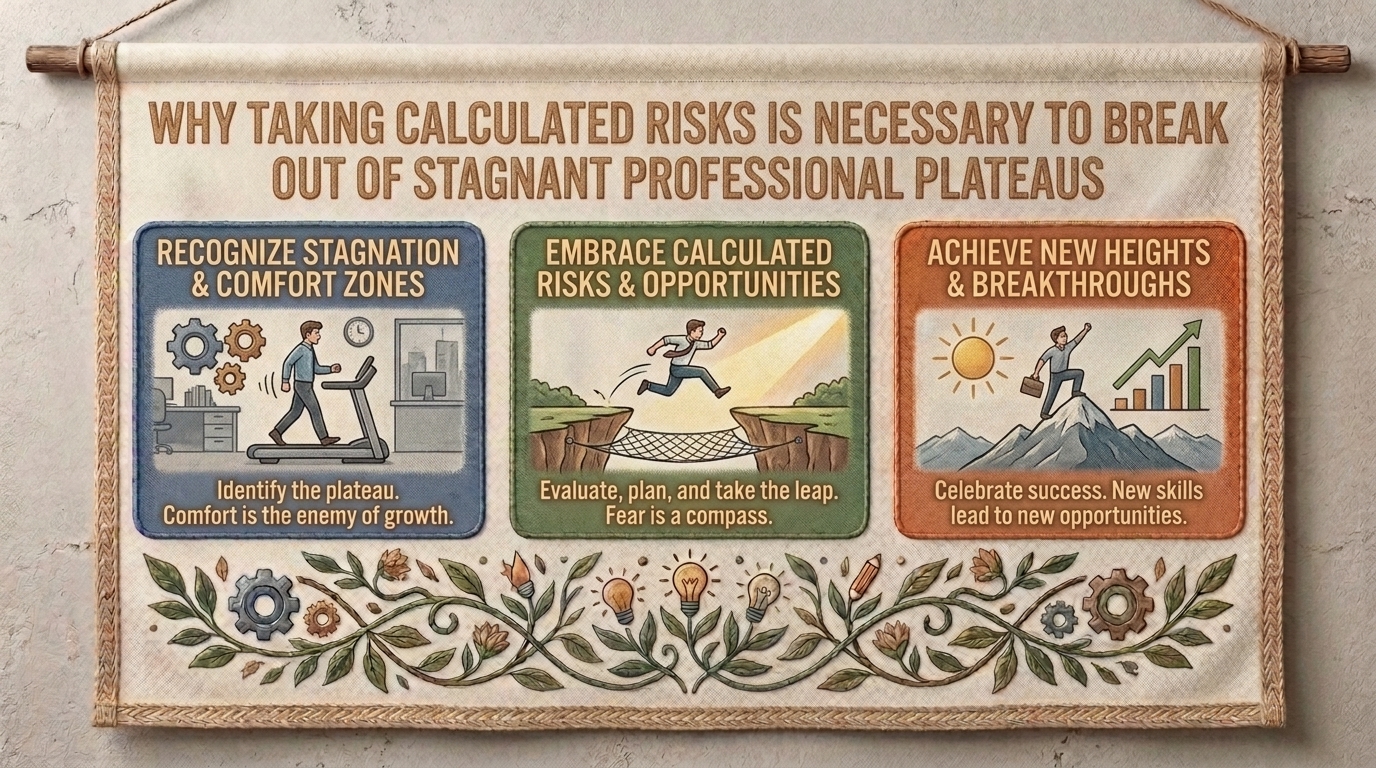
Why Taking Calculated Risks Is Necessary to Break Out of Stagnant Professional Plateaus
Introduction
Every ambitious professional eventually hits a wall. You wake up one morning, look at your calendar, look at your output, and realize you are no longer growing—you are merely repeating. You have mastered your current job description, your income has plateaued, your daily tasks feel entirely automatic, and the fiery passion that once drove your career has curdled into a comfortable, suffocating routine.
Whether you are navigating the high-stakes financial corridors of New York, scaling venture-backed startups in San Francisco, building enterprise operations across Texas, designing public policy and technology in Washington, or driving creative industries throughout California, professional stagnation is the silent killer of modern ambition.
Most people respond to stagnation by working harder within the cage. They clock more hours, answer emails on weekends, and hope that sheer volume will force a breakthrough. But working harder at a broken, stagnant strategy only digs you deeper into your rut.
The true antidote to professional plateauing is not working harder; it is taking calculated risks.
Growth and comfort cannot coexist. To break out of mediocrity and step into your highest tier of contribution, you must be willing to step off the precipice of certainty and embrace intelligent uncertainty.
For visionary entrepreneurs, corporate leaders, and modern professionals engaging with platforms like nyattitude.com, understanding the mechanics of risk is the ultimate competitive advantage. This comprehensive guide explores the neuroscience of risk-taking, the hidden dangers of comfort, step-by-step risk-assessment frameworks, regional navigation across major U.S. hubs, actionable daily tips, and answers to the most frequently asked questions.
1. The Neuroscience of Comfort: Why Our Brains Crave Plateaus
To understand why breaking out of a professional plateau is so psychologically difficult, we must examine how the human brain processes security versus risk.
The Brain’s Efficiency Drive
The human brain is fundamentally a survival and energy-conservation organ. Over evolutionary history, expending unnecessary energy on novel or risky behaviors carried lethal consequences.
- The Comfort Loop: When you first enter a new career role or industry, your brain fires rapidly, building new neural pathways to master the environment. Once mastery is achieved, your brain automates those routines into the basal ganglia, turning complex professional tasks into unconscious habits. While this saves metabolic energy, it locks you into a neurological plateau. Staying in your comfort zone feels safe because it requires zero cognitive friction, but it starves your professional evolution.
The Fear of Loss (Loss Aversion)
Behavioral economists Daniel Kahneman and Amos Tversky demonstrated through prospect theory that human beings feel the pain of a potential loss twice as intensely as the pleasure of an equivalent gain. This psychological quirk—loss aversion—keeps talented professionals trapped in stagnant jobs, dead-end roles, or uninspiring companies for years. We cling to the familiar misery of a plateau rather than risking the temporary discomfort of stepping into the unknown.
2. The Myth of “Safe” Choices in a Disrupted Economy
In a rapidly shifting global economy driven by technological disruption, artificial intelligence, and evolving market demands, the greatest risk you can take is refusing to take risks.
The Illusion of Job Security
In previous generations, staying at a single corporation for thirty years while keeping your head down was considered the ultimate definition of career security. Today, that exact strategy is the most dangerous gamble you can make. When you refuse to innovate, stretch your skill set, or take bold professional leaps, your capabilities atrophy. When industry shifts inevitably occur, you find yourself completely unprepared, obsolete, and vulnerable to sudden disruption. Calculated risks are not reckless gambles; they are proactive investments in your own future resilience.
3. Regional Perspectives: Risk and Reward Across Major U.S. Hubs
The culture of risk-taking, innovation, and career reinvention takes on distinct personalities across the diverse geographic landscapes connected to nyattitude.com:
- New York: Known for its high-stakes financial markets, media empires, and corporate law sectors, New York professionals understand that massive reward requires sophisticated risk calibration. Calculated financial and career leaps here demand rigorous due diligence coupled with decisive execution.
- San Francisco: At the epicenter of venture capital and software disruption, risk-taking is baked into the cultural DNA. The local tech ecosystem embraces the mantra of failing fast, iterating, and pivoting, treating professional risk as an essential prerequisite for innovation.
- Texas: Spanning thriving business hubs like Austin, Dallas, and Houston, Texas combines ambitious corporate expansion with a frontier entrepreneurial spirit. Business leaders here take bold calculated risks on scaling operations, real estate, and energy diversification with a fierce commitment to execution.
- Washington: Anchored by public policy, defense contracting, and federal advocacy, Washington professionals navigate calculated risks in high-visibility regulatory arenas where strategic diplomacy meets systemic institutional change.
- California (Southern & Broader): Balancing entertainment, wellness, and creative lifestyle design, California encourages professional pivots that align career trajectory with personal authenticity and creative freedom.
4. Step-by-Step Framework: How to Take Calculated, High-Upside Risks
Taking a risk does not mean quitting your job on a whim, liquidating your savings, or jumping out of an airplane without a parachute. Calculated risk-taking is a disciplined, scientific process. Follow these five steps to break out of your professional plateau:
Step 1: Audit Your Current Plateau
Identify the exact symptoms of your stagnation. Are you no longer learning new skills? Has your income flattened? Do you feel bored or cynical during your workday? Quantify your plateau so you understand what you are trying to escape.
Step 2: Define the “Worst-Case Scenario” (Pre-Mortem)
Fear paralyzes us because our imaginations exaggerate the consequences of failure. Run a formal pre-mortem: Ask yourself, “If I take this risk and it completely fails, what is the absolute worst thing that could happen?” Write it down. Once you look the worst-case scenario in the eye, you realize you can survive it, recover from it, and adapt.
Step 3: Calculate the Asymmetric Upside
In investing, an asymmetric risk-return profile means your downside is strictly limited, while your potential upside is virtually limitless. Apply this to your career: If you pitch a bold new project, volunteer for an unproven leadership role, or start a side venture, what is the worst that happens? (You get a polite “no” and learn a lesson). What is the best that happens? (You unlock a massive career leap, new revenue stream, or industry recognition).
Step 4: Build a Safety Net
Mitigate your risk through preparation. Save a financial runway, build a strong professional network, or test your new venture part-time before jumping in headfirst. A calculated risk always includes risk-mitigation strategies.
Step 5: Execute with Decisive Momentum
Once you have done your due diligence, calculated the downside, and built your safety net, cut off your retreat options and execute. Hesitation breeds second-guessing; decisive action converts risk into momentum.
5. Actionable Tips to Cultivate a Risk-Taking Mindset Daily
Incorporate these practical micro-habits into your professional life to train your brain to embrace calculated friction:
- Say “Yes” to Unfamiliar Challenges: The next time you are offered a project that feels slightly above your current skill level—forcing you to learn on the fly—say yes immediately and figure out how to deliver afterward.
- Conduct a Monthly “Comfort Audit”: Once a month, review your calendar and tasks. If 90% of what you did was easy, comfortable, and repetitive, you are stagnating. Force yourself to introduce one uncomfortable, high-growth challenge the following month.
- Reframe Failure as Data Collection: Eradicate the word “failure” from your professional vocabulary and replace it with “experimentation.” Every failed risk provides priceless market feedback that guides your next iteration.
- Network Outside Your Echo Chamber: Regularly schedule coffee chats or calls with professionals in completely different industries or roles. Exposing yourself to diverse perspectives makes taking career leaps feel less terrifying.
- Set “Stretch” Metrics: Stop setting modest, easily achievable goals. Set aggressive, seemingly unreasonable milestones that force you to completely reinvent your workflow, marketing strategy, or skill set.
- Protect Your Energy from Naysayers: When you decide to take a calculated risk, do not broadcast it to chronic pessimists or risk-averse people who will project their own fears onto you. Share your plans exclusively with mentors who champion growth.
6. Ten Frequently Asked Questions (FAQs)
1. What is the precise definition of a “calculated risk”?
A calculated risk is a hazard or uncertain venture undertaken after thorough evaluation of its potential negative consequences, costs, and worst-case scenarios, balanced against a high asymmetric upside and backed by proactive mitigation strategies.
2. Why do most professionals choose to stay in stagnant plateaus instead of taking risks?
Human psychology is governed by loss aversion and comfort-seeking neurobiology. We instinctively prefer the familiar misery of a plateau over the terrifying uncertainty of change, fearing embarrassment, financial instability, or failure more than we desire growth.
3. How do I know for sure if my career has officially plateaued?
You have plateaued when you can complete your core job responsibilities on autopilot without learning anything new, your professional growth has stalled for over 12 months, and you feel a pervasive sense of boredom or apathy toward your work.
4. What is the difference between a “reckless gamble” and a “calculated risk”?
A reckless gamble relies on blind luck, ignores potential downsides, and lacks preparation or fallback plans. A calculated risk involves deep research, quantified worst-case scenarios, risk mitigation, and a high probability of asymmetric return.
5. How can I manage the anxiety and fear that come with taking a big career risk?
Acknowledge that anxiety is a normal physiological response to novelty. Manage it by focusing on your preparation, executing a step-by-step mitigation plan, and reminding yourself that regret over not trying hurts far longer than the temporary discomfort of failure.
6. What should I do if my calculated risk results in failure?
Perform a thorough objective review. Extract the lessons learned, update your mental models, acknowledge your courage for trying, and pivot immediately toward your next venture. True professionals weaponize past failures as fuel for future mastery.
7. How do fast-paced metropolitan hubs like San Francisco and New York view career risks?
These hyper-competitive markets view calculated risk-taking as an absolute prerequisite for leadership and innovation. Professionals who never take risks are viewed as stagnant, while intelligent risk-takers command respect and opportunity.
8. How can I practice taking calculated risks on a small scale?
Start with low-stakes risks: volunteer to present at a major meeting, pitch an unconventional idea to your leadership team, learn a complex software tool outside your comfort zone, or launch a small side project on the weekends.
9. Does taking professional risks increase my risk of burnout?
Uncalculated, erratic risks can lead to burnout. However, calculated risks that align with your core values and long-term vision actually cure burnout by restoring your sense of agency, excitement, and forward momentum.
10. What is the single best first step I can take today to break my plateau?
Identify one bold, high-upside career move you have been putting off out of fear. Write down the worst-case scenario, outline a simple risk-mitigation plan, and take one concrete micro-action toward executing it before the week ends.
Conclusion
Stagnation is a comfortable coffin. While staying on your plateau feels safe in the short term, it slowly drains your professional vitality, leaves you vulnerable to disruption, and robs you of your true potential.
Whether you are scaling your enterprise across Texas, New York, California, Washington, or San Francisco, remember that your greatest breakthroughs lie just on the other side of your comfort zone. Embrace the uncertainty, calculate your downside, and take the bold leap your future demands.
What is one stagnant area of your professional life, and what is one calculated risk you can commit to taking this month to break out of your plateau?