For many ambitious professionals, entrepreneurs, and creatives, the mere mention of a “networking event” triggers a familiar wave of fatigue. Picture the classic scene: a crowded hotel ballroom or downtown loft in Manhattan (New York) or SoMa (San Francisco), pulsating with ambient noise, blinding lights, and hundreds of strangers clutching drinks while aggressively thrusting digital cards or elevator pitches into each other’s faces.
Whether you are navigating high-stakes venture ecosystems across California, building community ties throughout Texas, or engaging with policy and tech innovators in Washington, traditional professional networking is frequently viewed as a necessary evil.
It is often dismissed as transactional, superficial, and emotionally exhausting—especially for introverts, deep thinkers, and those who value genuine human connection over shallow badge-swapping.
However, career growth, strategic partnerships, and entrepreneurial success rarely happen in complete isolation. Relationships are the lifeblood of modern commerce, innovation, and personal evolution. The challenge is not whether networking is important, but how we approach it.
You do not have to compromise your authenticity, exhaust your social battery, or morph into an over-enthusiastic extrovert to build a powerful professional network.
For founders, leaders, and modern professionals engaging with platforms like nyattitude.com, mastering the art of low-friction, high-authenticity networking is the ultimate professional superpower. This comprehensive guide explores the psychology of social energy, the pitfalls of transactional mingling, step-by-step frameworks for human-centric networking, regional nuances across major U.S. hubs, actionable tips for preserving your energy, and answers to the most frequently asked questions.
1. The Psychology of Networking Fatigue
To navigate networking events without burning out, we must first understand why traditional mixers drain us so profoundly.
The Introvert-Extrovert Energy Spectrum
Psychologically, social interactions draw on our internal cognitive and emotional reserves. Extroverts often recharge their social batteries by interacting with groups and external environments, whereas introverts (and even ambiverts) expend energy in large group settings and must retreat to solitude to recharge.
- The Problem: Traditional networking events are engineered for rapid-fire, high-stimulus extroversion. When you force yourself to play a role that contradicts your natural wiring, your nervous system perceives the interaction as a performance threat, spiking cortisol and inducing rapid social exhaustion.
Transactional Fatigue vs. Relational Fulfillment
The root cause of inauthenticity is transactionality. When you enter a room viewing every person merely as a stepping stone, a lead generator, or a resume line, conversations feel hollow and exhausting. Humans possess an acute radar for insincerity; trying to fake enthusiasm for someone’s line of work drains your emotional reserves because your brain is expending massive energy to maintain a facade.
2. Reframing Networking: From “Collecting Leads” to “Curating Community”
The most liberating shift you can make is abandoning the concept of “networking” entirely and replacing it with relationship curation or curious exploration.
1. Shift from Pitching to Inquiry
You do not need an elevator pitch. In fact, opening a conversation with a rehearsed, 60-second commercial about your business or title immediately frames the interaction as a sales pitch, putting your conversation partner on the defensive. Instead, lead with genuine curiosity. People love talking about what excites them; becoming a master listener instantly flips the dynamic from an exhausting performance to an engaging dialogue.
2. Quality Over Quantity
The old-school networking advice of collecting fifty business cards and handing out flyers is utterly obsolete. Walking away from a two-hour event with fifty forgotten contacts is a waste of time. Walking away with one or two deep, memorable, values-aligned connections is a massive professional victory.
3. Regional Dynamics: Networking Across Major U.S. Hubs
Networking etiquette and cultural expectations vary significantly across the diverse economic and geographical landscapes connected to nyattitude.com:
- New York: Fast-paced, hyper-efficient, and direct. Networking in Manhattan often happens at high velocity, where brevity is respected. Authenticity here means cutting through corporate fluff immediately, respecting people’s time, and engaging in sharp, substance-driven dialogue.
- San Francisco: Innovation-centric, informal, and future-focused. Bay Area networking often blends casual settings (coffee shops, outdoor walks, hackathons) with deep discussions on technology, philosophy, and scale. Authenticity involves sharing visionary ideas and embracing intellectual curiosity without corporate stiffness.
- Texas: Warm, hospitable, and deeply relational. Spanning Austin, Dallas, and Houston, Texas networking prioritizes personal character, storytelling, and long-term community trust over rapid transactions. Conversations often start with family, hobbies, or local roots before touching business.
- Washington: Diplomatic, policy-driven, and highly analytical. Networking in Washington requires balancing political awareness with strategic systems-thinking. Authenticity here is demonstrated through thoughtful inquiry, institutional literacy, and respectful discourse across diverse viewpoints.
- California (Southern & Broader): Balancing wellness, creative industries, and media, California culture encourages holistic connection. Networking here often feels organic, blending professional ambition with creative collaboration, wellness values, and lifestyle alignment.
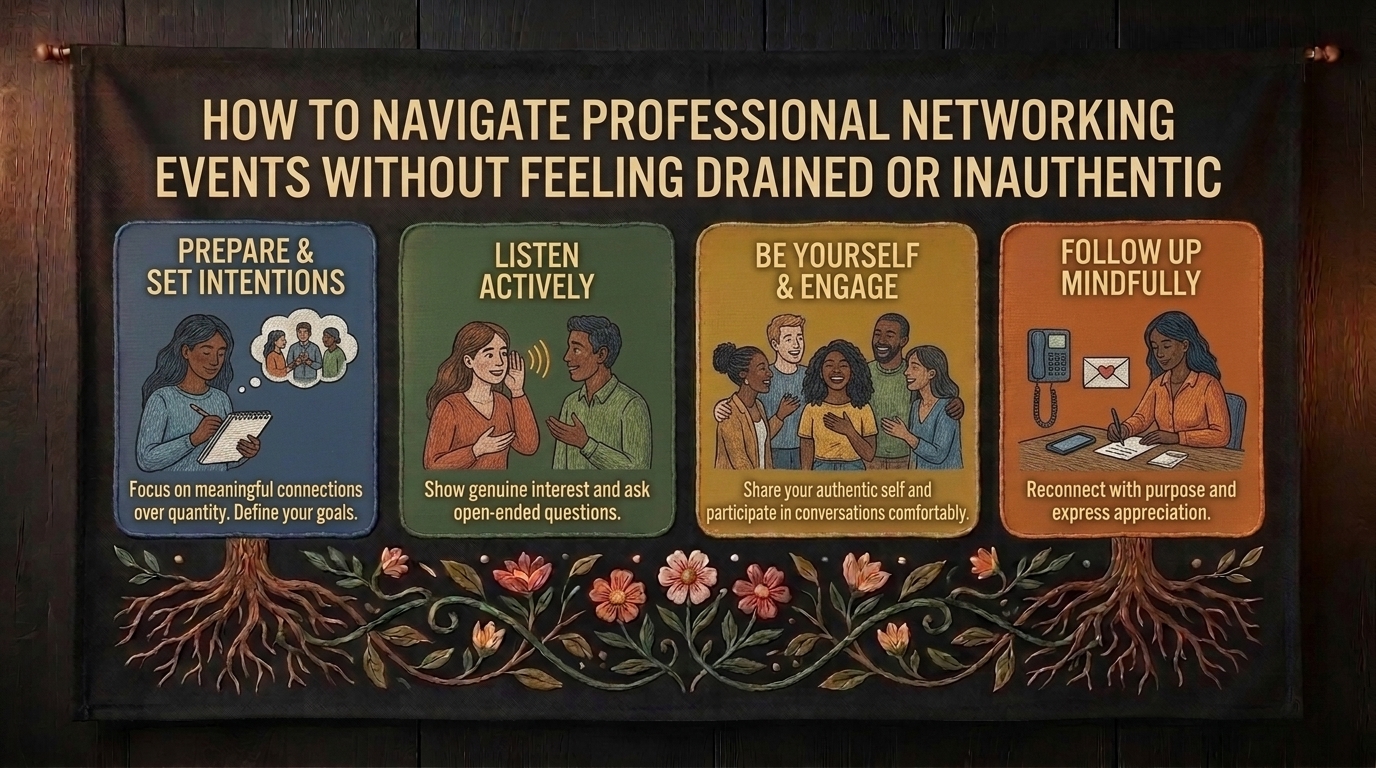
4. Step-by-Step Framework: The Low-Drain Networking Blueprint
You can systematically design your approach to social and professional gatherings to protect your energy and ensure absolute authenticity. Follow this step-by-step framework:
Step 1: Pre-Event Intention and Boundary Setting
Before you ever step foot in a venue, set clear operational boundaries:
- Time Boxing: Decide in advance how long you will stay (e.g., “I am attending for exactly 75 minutes, from 6:00 PM to 7:15 PM”). Knowing there is a definitive exit time prevents social claustrophobia.
- The Two-Connection Goal: Give yourself a micro-target. Instead of trying to meet everyone, set a goal to have two genuinely engaging, high-quality conversations. Once achieved, you have permission to leave guilt-free.
Step 2: The “Wallflower Advantage” and Strategic Positioning
You do not need to plunge into the chaotic center of a loud room. Arrive slightly early when the room is calmer and quieter. Position yourself near the registration desk, the refreshment table, or a quieter corner. This naturally attracts other solo attendees who are also looking for a low-pressure, one-on-one conversation starter.
Step 3: Ditch the Elevator Pitch for the “Human Opener”
Instead of asking, “What do you do?” (which triggers robotic corporate answers), use openers that invite human personality:
- “What brought you out to this event tonight?”
- “What is one project you’re working on right now that actually excites you?”
- “If you weren’t in your current industry, what do you think you’d be doing?”
Step 4: Master the Graceful Exit
One of the most draining parts of networking is getting trapped in a monologue by an over-talkative person with no way out. Master the art of the polite, warm exit:
- “It has been wonderful chatting with you about [Topic]. I want to circulate and grab a quick glass of water, but let’s exchange contact info so we can continue this conversation later.”
- “I promised myself I would connect with one of the event organizers before heading out, but I’m so glad our paths crossed tonight.”
Step 5: The Post-Event Recovery Ritual
Just as athletes require a cool-down period after a sprint, your nervous system needs a decompression window after a social event. Do not jump straight back into answering emails or taking calls. Spend 20 minutes in silence, take a walk, or listen to calming music to clear your social residue.
5. Actionable Tips to Stay Energized and Authentic
Incorporate these practical daily habits to make networking effortless and stress-free:
- Leverage Digital-First Relationship Building: You don’t have to live at physical mixers to build a network. Use platforms like LinkedIn, curated newsletters, or digital communities to build relationships asynchronously through thoughtful comments, shared insights, and direct, value-first messages.
- Host Your Own Micro-Gatherings: Instead of navigating loud, draining cocktail mixers, host a small dinner party, coffee roundtable, or mastermind of 4 to 6 interesting people. You control the guest list, the environment, and the conversational depth.
- Be Radically Honest About Who You Are: If someone asks what you do and you are between projects, exploring a pivot, or working on something unconventional, own it with pride. Authenticity is magnetic; people are instantly refreshed when someone drops the polished corporate mask.
- Focus Entirely on Giving Value First: When you meet someone, ask yourself: How can I help this person? Do I know a resource, a book, or a connection that could solve their current problem? Generosity completely eliminates networking anxiety.
- Wear Comfortable, Confident Attire: Physical discomfort (tight shoes, stiff collars, pinching jackets) subtly drains your psychological bandwidth. Wear clothes that make you feel like your best, most grounded self.
- Limit Alcohol Consumption: While it’s tempting to use drinks as social lubricant to numb social anxiety, alcohol dehydrates you, impairs executive functioning, and often leads to conversational regret. Opt for sparkling water with lime.
6. Ten Frequently Asked Questions (FAQs)
1. Why do I feel physically and emotionally exhausted after networking events?
Large social gatherings flood your senses with sensory overload (noise, lights, crowds) and require continuous cognitive performance (reading social cues, maintaining small talk, managing impressions). For introverted or deeply focused individuals, this depletes neurotransmitter reserves and spikes stress hormones.
2. How can an introvert successfully network without faking extroversion?
Introverts possess superpower traits for networking: listening skills, empathy, depth of thought, and observation. Lean into these strengths. Instead of working the room, focus on having deep, one-on-one conversations where you do 80% listening and 20% meaningful questioning.
3. What should I say when someone asks “What do you do?” and my career is in transition?
Own your transition with confidence and curiosity. You can say: “I spent years in [Previous Field] scaling operations, and right now I am in an exciting transition phase exploring opportunities in [New Field/Venture], looking at how emerging technologies intersect with human behavior.”
4. Is it okay to leave a networking event after only 30 minutes?
Absolutely. If you arrive, scan the room, realize the energy or crowd is not aligned with your goals, and decide to leave after 30 minutes, you have honored your boundaries. Your time and mental energy are your most valuable non-renewable assets.
5. How do I follow up authentically without feeling like a spammer?
Forget canned sales templates. Follow up within 48 hours with a personalized message referencing a specific detail from your conversation. Better yet, share something of immediate value—such as an article, book recommendation, or contact introduction you discussed during your chat.
6. How do I handle people who only want to network transactionally?
Politely engage for a brief moment, offer a mutual exchange of contact info if appropriate, and use a graceful exit line. You are under no obligation to spend your evening entertaining people who treat human beings like business cards.
7. Can I build a powerful network entirely online without attending physical events?
Yes. Many of the most influential modern networks, partnerships, and ventures are built entirely through digital engagement, thoughtful writing, podcasting, online mastermind groups, and targeted one-on-one virtual coffee chats.
8. How do I overcome the anxiety of walking into a room where I don’t know anyone?
Normalize the feeling of initial awkwardness—everyone in that room feels a degree of it. Remind yourself that most people are secretly hoping someone else will walk up and introduce themselves. Taking that brave first step makes you an instant hero to another solo attendee.
9. How do regional business cultures impact networking styles?
Fast-paced metropolitan hubs like New York demand speed and conciseness, while relational hubs like Texas prioritize warmth and storytelling. Understanding local cultural norms helps you tailor your approach so you never feel out of place.
10. How long does it take to build a strong professional network using low-drain methods?
Quality compounds slowly over time. While transactional networking yields immediate card collections that go nowhere, authentic relationship curation yields trusted allies, lifelong mentors, and strategic partners within 6 to 12 months of consistent, intentional engagement.
Conclusion
Networking does not have to be a draining, superficial chore that forces you to compromise your authentic self. By abandoning the pressure of the elevator pitch, setting firm time boundaries, prioritizing deep one-on-one connections over crowd-surfing, and leading with genuine curiosity, you can build a powerful, supportive network while protecting your precious energy.
Whether you are scaling an enterprise across Texas, New York, California, Washington, or San Francisco, remember that the most enduring professional relationships are built not on how many hands you shake, but on how authentically you show up as your true self.
What is one boundary you can set for your next professional gathering to ensure you walk away feeling energized rather than drained?