Human beings are hardwired for certainty. From our evolutionary origins spent scanning the savannah for predictable predators and reliable food sources to our modern desire for stable career tracks, financial security, and structured retirement plans, our brains treat the unknown as an inherent threat.
Whether navigating the fast-paced venture capital ecosystems of San Francisco, managing high-stakes financial institutions in New York, scaling corporate and agricultural enterprises across Texas, spearheading technological and public policy breakthroughs in Washington, or driving creative industries throughout California, modern life demands constant navigation through the unpredictable.
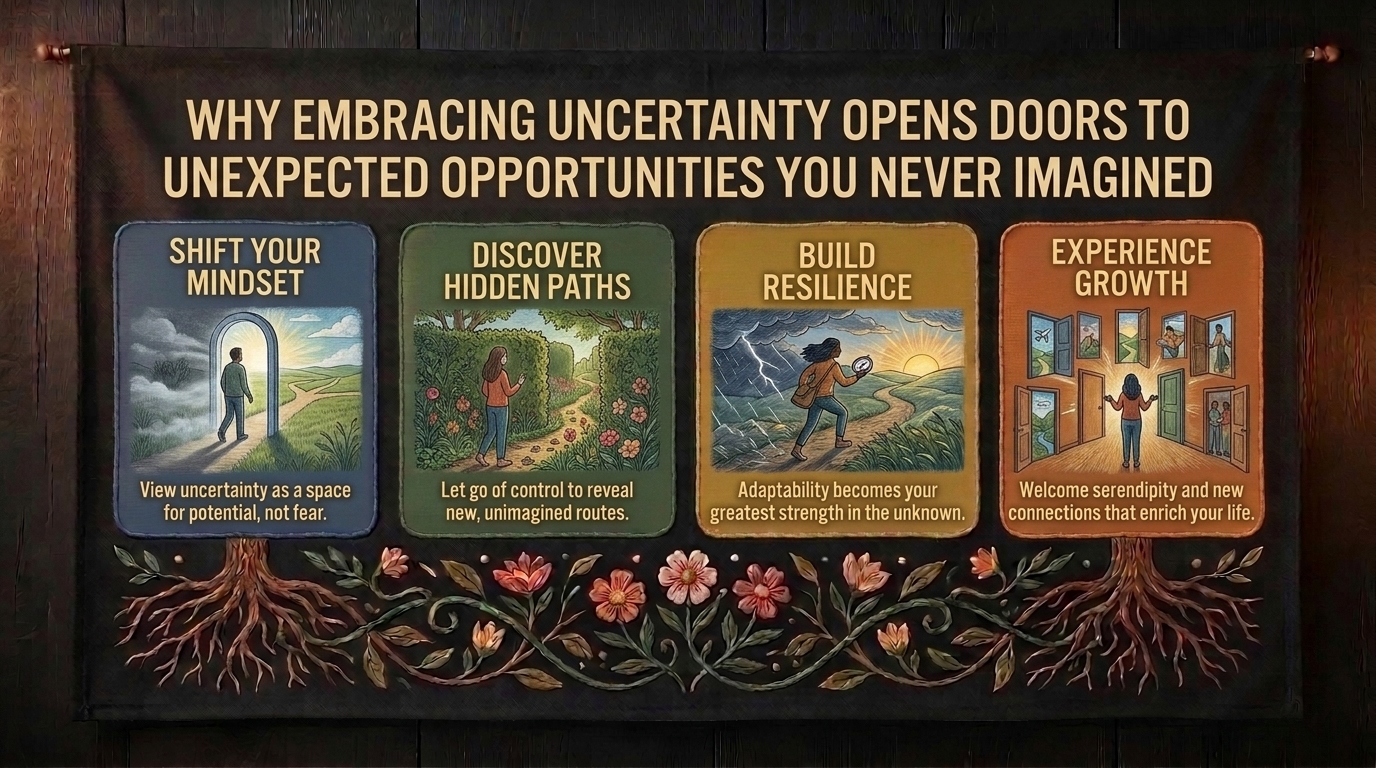
Yet, a profound psychological paradox defines our pursuit of success: the harder we fight to control every variable, eliminate risk, and lock down rigid futures, the more vulnerable we become to systemic disruption. Worse still, by clinging exclusively to what is safe and predictable, we accidentally slam the door on the exact serendipitous breakthroughs, creative pivots, and life-changing opportunities we secretly crave.
The greatest breakthroughs in innovation, art, science, and personal growth are almost never born from absolute certainty; they are catalyzed by the willingness to step into the fog of the unknown.
For visionary entrepreneurs, ambitious professionals, and modern creators engaging with platforms like nyattitude.com, mastering the art of embracing uncertainty is the ultimate competitive advantage. This comprehensive guide explores the neuroscience of risk, the illusion of predictability, step-by-step frameworks for welcoming ambiguity, regional dynamics across major U.S. markets, actionable tips, and answers to the most frequently asked questions.
1. The Psychology of Certainty-Seeking
To understand why embracing uncertainty is so transformative, we must first examine why our brains instinctively reject it.
The Brain as a Prediction Machine
Neuroscientists describe the human brain as a sophisticated prediction machine. Operating through the lens of predictive coding, your brain constantly anticipates what will happen next based on past experiences to conserve metabolic energy and protect you from harm.
- The Problem: When you encounter an ambiguous situation, a sudden market shift, a career setback, or an unplanned life pivot, your brain’s prediction engine stalls. It perceives this lack of data as danger, flooding your system with cortisol and triggering anxiety.
The Comfort Zone Trap
Because uncertainty feels uncomfortable, we default to our comfort zones—repeating familiar habits, staying in unfulfilling jobs, or executing stale business strategies simply because they are predictable. While comfort zones keep anxiety low, they also guarantee stagnation. Opportunities live in the exact spaces where your predictive algorithms fail.
2. Serendipity and the Physics of the Unknown
In management literature and innovation theory, a massive role is played by a phenomenon known as serendipity—the occurrence of valuable events by chance. However, true serendipity is not pure luck; it is a collaborative dance between preparedness and unexpected exposure to uncertainty.
The Prepared Mind in Chaos
Louis Pasteur famously noted that “chance favors the prepared mind.” When you tightly script every minute of your life, you build a fortress that blocks out accidental discoveries.
- When you open yourself up to uncertainty—by exploring unfamiliar industries, talking to strangers outside your immediate network, or taking a calculated professional risk—you exponentially increase your “serendipity surface area.”
The Non-Linear Nature of Growth
Linear thinking tells us that Effort A leads predictably to Result B. Reality, however, is radically non-linear. The most transformative chapters of your professional and personal life often originate from unexpected detours: a failed project that forced you into a revolutionary new market, a canceled meeting that led to an accidental introduction, or a market crash that inspired a disruptive product pivot.
3. Regional Perspectives: Navigating Uncertainty Across Major U.S. Hubs
The cultural relationship with risk, ambiguity, and uncertainty varies significantly across the diverse economic landscapes connected to nyattitude.com:
- New York: Anchored by high-stakes finance, media, and corporate law, New York is a market where macroeconomic volatility shifts daily. Professionals here must master the art of calculated risk, treating market uncertainty not as a crisis, but as a fluid environment where agility yields outsized rewards.
- San Francisco: As the global capital of technological disruption, venture capital, and startup experimentation, San Francisco thrives on the unknown. The local ethos of “fail fast, pivot faster” is a direct testament to embracing uncertainty as the raw material of innovation.
- Texas: Spanning thriving entrepreneurial hubs like Austin, Dallas, and Houston, Texas combines bold economic expansion with a resilient pioneering spirit. Embracing uncertainty here looks like trusting local grit, backing bold ventures, and remaining adaptable amid rapid regional growth.
- Washington: Driven by public policy, defense contracting, and Pacific Northwest tech, Washington requires leaders to navigate complex regulatory and geopolitical unknowns. Embracing ambiguity in this region involves systems-level thinking and diplomatic resilience.
- California (Southern & Broader): Balancing wellness culture with creative entertainment and design, California encourages fluid self-actualization. Uncertainty here is viewed as a creative canvas, allowing artists and entrepreneurs to reinvent their paths organically.
4. Step-by-Step Framework: How to Befriend the Unknown
Befriending uncertainty does not mean acting recklessly or abandoning all planning. It means building a psychological and operational framework to thrive when outcomes are ambiguous. Follow these steps:
Step 1: Conduct a “Risk Audit”
Examine your current projects, investments, and career choices. Are you taking zero risks? If your path for the next five years is 100% predictable, you are likely missing out on asymmetric upside. Identify one calculated risk or unfamiliar domain you can explore this quarter.
Step 2: Reframe Anxiety as Excitement
Physiologically, the bodily sensations of anxiety (racing heart, heightened alertness, adrenaline rush) are almost identical to the sensations of excitement. When facing an uncertain situation, consciously reframe your internal narrative: “I am not terrified; my body is simply getting energized for an exciting new challenge.”
Step 3: Implement “Optionality” in Your Strategy
Instead of betting everything on a single, rigid path, build optionality into your life and business. Maintain diversified income streams, cultivate cross-disciplinary skills, and keep doors open with diverse networks. Optionality ensures that when uncertainty strikes, you have multiple viable paths forward.
Step 4: Run Low-Risk, High-Reward Experiments
You don’t have to leap off a cliff blindly to embrace uncertainty. Run small, low-stakes experiments. Test a new business idea on weekends, write a blog post in an unfamiliar genre, or pitch an unconventional partnership. Let the data from small experiments guide your larger leaps.
Step 5: Practice Radical Acceptance of What You Cannot Control
Stoic philosophy teaches the fundamental dichotomy of control: focus intensely on your own actions and mindset while radically letting go of external outcomes. When you stop fighting the unpredictable weather of the market or life, you free up massive cognitive bandwidth to execute brilliantly on what is within your power.
5. Actionable Tips to Cultivate Comfort with Ambiguity
Incorporate these practical daily habits to train your mind to welcome the unknown:
- Deliberately Introduce Micro-Uncertainties: Visit a new neighborhood without a map, try a completely unfamiliar cuisine, read books from genres you normally avoid, or say “yes” to an impromptu coffee chat with an unfamiliar colleague.
- Journal Your “Surprise Wins”: Keep a log of unexpected blessings, accidental introductions, or fortunate twists of fate from your past. Reviewing how past uncertainties ultimately led to great outcomes trains your brain to trust the unknown.
- Audit Your Need for Approval: Often, our fear of uncertainty is really a fear of what others will think if our unconventional path doesn’t work out immediately. Detach your self-worth from external validation.
- Build a Cash and Mental Runway: True risk-taking is far less terrifying when you have built a personal safety net. Maintain an emergency fund and robust psychological health reserves so you can weather transitional fog calmly.
- Embrace the “Beginner’s Mind”: Drop the burden of needing to be the smartest person in the room. When entering unknown territory, adopt the humble curiosity of a novice eager to learn.
- Limit Doom-Scrolling and Over-Analysis: Consuming endless news feeds and analytical reports creates an illusion of control while actually paralyzing action. Gather essential data quickly, then trust your intuition to take the leap.
6. Ten Frequently Asked Questions (FAQs)
1. What is the difference between taking calculated risks and reckless gambling?
Reckless gambling involves throwing caution to the wind with no plan, data, or safety net. Calculated risks involve evaluating potential downsides, building personal or financial runways, running small exploratory tests, and ensuring that even a worst-case scenario is survivable.
2. Why does our brain experience physical anxiety when facing uncertainty?
Evolutionarily, our brains developed a negativity bias to treat the unknown as a potential predator or survival threat. This triggers the amygdala, flooding our system with stress hormones. Recognizing that this is just a biological reflex helps you neutralize it with prefrontal logic.
3. How can embracing uncertainty boost my career or business growth?
When you embrace uncertainty, you stop hiding in crowded, hyper-competitive status games. Instead, you explore blue-ocean strategies, pioneer innovative products, pivot rapidly when markets shift, and spot unique opportunities that risk-averse competitors completely miss.
4. How do I balance having clear long-term goals with being open to unknown opportunities?
Think of your long-term goal as a distant mountain peak and your daily plan as a flexible compass. Commit to the destination, but remain entirely unattached to the specific route. If an unexpected, exciting path opens up on your journey, give yourself permission to explore it.
5. What are the common signs that I am living too rigidly?
Signs of excessive rigidity include chronic frustration when minor plans change, analysis paralysis when making decisions without 100% data, deep fear of failure, an obsession with control, and a pervasive sense of boredom or stagnation in your daily life.
6. Can learning to embrace uncertainty help prevent burnout?
Yes. Burnout often stems from the exhausting, impossible attempt to control every single outcome, client, employee, and market variable. Accepting that certain things are outside your control relieves you of an unbearable psychological weight.
7. How do I encourage my team or employees to embrace uncertainty?
Create psychological safety. If your team fears being punished for exploratory failures, they will default to safe, uninspired mediocrity. Reward intelligent experimentation, celebrate bold pivots, and treat unexpected failures as valuable data.
8. How long does it take to train my mind to become comfortable with ambiguity?
Like building any psychological muscle, noticeable improvements in your tolerance for ambiguity typically emerge within 6 to 12 weeks of consistent micro-risk taking, mindfulness, and cognitive reframing exercises.
9. How do fast-paced hubs like San Francisco or New York view uncertainty?
In innovation and financial hubs, uncertainty is not viewed as an anomaly—it is viewed as the default operating environment. Professionals in these markets understand that volatility creates the very vacuum from which massive market opportunities emerge.
10. What is the single best first step I can take today to welcome the unknown?
Identify one area of your life or career where you have been hesitating out of fear of the unknown. Take one small, imperfect action toward it within the next 24 hours. Momentum dissolves fear instantly.
Conclusion
Certainty is a comforting illusion, but uncertainty is where magic, innovation, and genuine life transformation happen. By stepping out of the rigid fortress of predictability and embracing the open expanse of the unknown, you unlock doors to unexpected opportunities you could never have planned for.
Whether you are building a visionary enterprise across Texas, New York, California, Washington, or San Francisco, remember that your greatest breakthroughs lie just beyond the edge of your comfort zone. Trust the journey, welcome the unknown, and watch how serendipity transforms your world.
What is one exciting unknown opportunity or bold pivot you have been putting off out of fear, and what is one small step you can take toward it today?