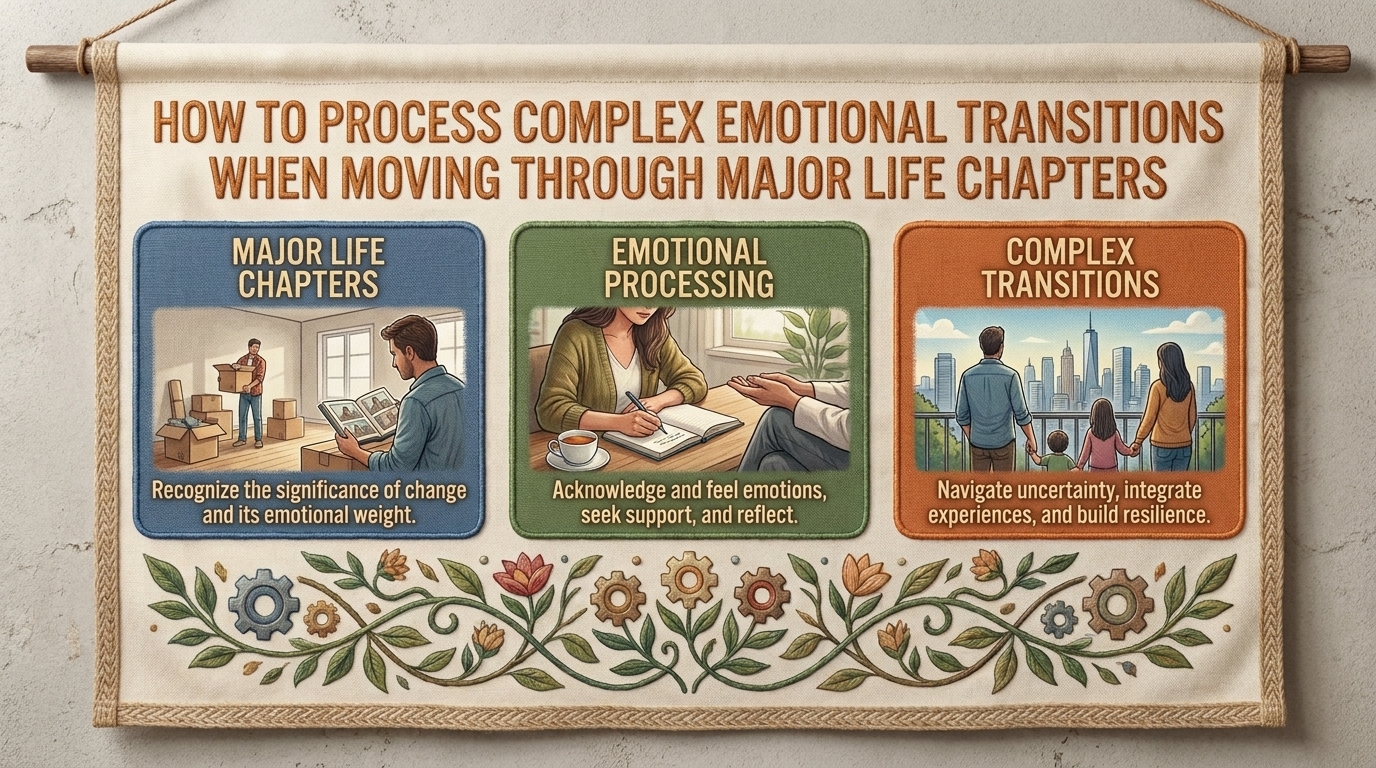
How to Process Complex Emotional Transitions When Moving Through Major Life Chapters
Introduction
Life is rarely a smooth, predictable linear progression. Instead, it is defined by distinct, often turbulent chapters: launching a new enterprise, relocating across the country, stepping out of a long-term career path, or entering a completely uncharted phase of personal evolution.
Whether you are navigating the high-velocity corporate and financial corridors of New York, scaling disruptive ventures in San Francisco, building expansive businesses across Texas, spearheading policy or technological shifts in Washington, or driving creative and lifestyle revolutions throughout California, major life transitions are an inevitable part of modern ambition.
Yet, society often prepares us poorly for the emotional weight of these shifts. We focus entirely on the logistics—signing contracts, packing moving boxes, updating LinkedIn profiles, or adjusting financial portfolios—while completely neglecting the complex psychological toll.
When your external reality changes faster than your internal emotional operating system can process, you experience transition shock. You might achieve a long-awaited dream or relocate to an exciting new city, only to find yourself blindsided by a profound sense of grief, disorientation, and emotional exhaustion.
Learning how to process complex emotional transitions without suppressing them or burning out is an essential masterclass for modern leaders, creators, and professionals.
For forward-thinking individuals engaging with platforms like nyattitude.com, mastering the emotional architecture of change is the ultimate prerequisite for sustainable success. This comprehensive guide explores the neuroscience of transition, the hidden grief of growth, step-by-step emotional processing frameworks, regional navigation across major U.S. hubs, actionable daily tips, and answers to the most frequently asked questions.
1. The Neuroscience of Change: Why Transitions Trigger Emotional Turbulence
To understand why major life chapters feel so emotionally heavy, we must examine how the human brain reacts to structural disruption.
The Brain’s Addiction to Predictability
Neurobiologically, the human brain is a pattern-matching survival organ. It builds extensive neural highways around your daily routines, professional titles, social circles, and physical environments to conserve metabolic energy.
- The Disruption: When you initiate a major life change—even a positive, chosen one—you instantly shatter those familiar neural pathways. Your brain’s predictive models fail, forcing it to expend massive energy building new maps. This neurological strain triggers the amygdala, releasing stress hormones that manifest as anxiety, emotional volatility, and a deep-seated feeling of groundlessness.
The Liminal Space
Anthropologist Arnold Van Gennep introduced the concept of the liminal space (from the Latin limen, meaning “threshold”)—the uncomfortable, ambiguous middle stage of a transition where you have left your old life behind, but have not yet fully integrated into your new chapter. Most people try to rush through the liminal space as quickly as possible. However, true emotional transformation only happens when you learn to sit comfortably in the messy ambiguity of the threshold.
2. The Hidden Grief of Positive Growth
One of the most profound psychological paradoxes of modern life is that positive transitions still require mourning.
Acknowledging Loss Amid Success
When you move to a vibrant new city like San Francisco or New York, launch a successful company in Texas, or step into a prestigious leadership role in Washington, you are gaining incredible new horizons. However, you are simultaneously losing something irreplaceable: your old routine, familiar neighborhood spots, easy access to past friends, and the safety of your previous identity.
- The Danger of Disenfranchised Grief: Because society tells us we should be “thrilled” about our success or new chapter, we often suppress our sadness. We feel guilty for feeling lonely or nostalgic. This suppressed grief turns inward, manifesting as chronic fatigue, irritability, or impostor syndrome. True emotional maturity requires giving yourself explicit permission to grieve what you left behind, even as you celebrate what lies ahead.
3. Regional Perspectives: Navigating Emotional Chapters Across Major U.S. Hubs
The emotional texture of major life transitions takes on distinct characteristics across the diverse economic and cultural landscapes connected to nyattitude.com:
- New York: The relentless pace of Manhattan and the surrounding boroughs amplifies transition shock. Moving into or out of New York requires immense emotional resilience to balance high-pressure career milestones with the need for personal sanctuary and mental restoration.
- San Francisco: At the epicenter of technological reinvention and startup culture, transitions happen at blinding speeds. Founders and professionals here often cycle through rapid identity shifts, making grounded emotional processing and mental health check-ins a critical survival skill.
- Texas: Spanning thriving hubs like Austin, Dallas, and Houston, Texas combines rapid economic expansion with deep community and family roots. Navigating major life transitions here often involves balancing ambitious career acceleration with the grounding comfort of local community connections.
- Washington: Anchored by public policy, defense, and institutional leadership, Washington professionals frequently navigate complex career transitions across public and private sectors. Processing emotional shifts here requires diplomatic patience and intellectual detachment from institutional titles.
- California (Southern & Broader): Balancing wellness culture, entertainment, and holistic lifestyle design, California encourages open emotional expression. Transitions here are often integrated through mindfulness, outdoor connection, and personal reinvention.
4. Step-by-Step Framework: Processing Complex Emotional Transitions
Navigating a major life chapter requires a structured, compassionate framework to integrate your emotions rather than burying them. Follow these five steps:
Step 1: Name and Validate Your Exact Emotional State
Emotional overwhelm usually stems from vague, nameless anxiety (e.g., “I just feel off”). Take a blank journal and practice granular emotional labeling. Are you feeling nostalgic, anxious about financial security, isolated, relieved, or creatively drained? Naming an emotion strips away half of its physiological terror.
Step 2: Create a Formal “Closing Ritual” for Your Past Chapter
Do not just pack your bags or close your laptop and move instantly into the next phase. Create a deliberate closing ritual. Write a farewell letter to your past chapter (even if you never send it), visit your favorite local spots one last time, or throw a small gratitude gathering. Rituals signal to your primitive brain that a chapter has officially concluded with honor.
Step 3: Design a “Transition Sanctuary”
When your external world is in total flux, your internal world needs an anchor. Dedicate a physical space in your new home, office, or routine that remains entirely sacred and unchanging. It could be a quiet corner with a comfortable chair for morning journaling, a specific herbal tea ritual, or a daily 15-minute walk without your phone.
Step 4: Practice Radical Self-Compassion
Expect your productivity to drop by 20% to 30% during the first few months of a major life transition. Your brain is working overtime in the background processing emotional data. Stop beating yourself up for not operating at peak efficiency immediately. Treat yourself with the same patient kindness you would offer a dear friend going through a massive life shift.
Step 5: Build a New Micro-Community Slowly
Do not pressure yourself to instantly replicate your old social network or peer group overnight. Focus on deep, micro-connections. Attend one recurring local meetup, strike up conversations with regular neighborhood vendors, or reach out to one local professional for a low-pressure coffee chat. Trust compounds slowly.
5. Actionable Tips to Anchor Yourself During Life Shifts
Incorporate these practical daily habits to maintain your emotional equilibrium during high-velocity transitions:
- Maintain Analog Journaling: Write down your raw, unfiltered thoughts by hand every morning or evening. Analog writing acts as a physical external hard drive for processing complex emotional clutter.
- Limit Major Decisions During the Transition Window: If possible, avoid making multiple major life-altering decisions at the exact same time (e.g., relocating, changing careers, and ending a relationship simultaneously). Stagger your life disruptions when you can.
- Establish a Non-Negotiable Physical Baseline: Emotional stress instantly dysregulates the body. Prioritize eight hours of sleep, consistent hydration, and daily physical movement to keep your nervous system resilient.
- Audit Your Digital Input: During vulnerable life transitions, your brain is hyper-receptive. Mute social media feeds that trigger comparison, FOMO, or anxiety. Replace them with calming audiobooks, reflective reading, or silence.
- Seek Objective Professional Guidance: Working with a therapist, executive coach, or mentor during a major life transition provides an invaluable, objective mirror to help you unpack blind spots and accelerate your emotional integration.
- Embrace the Power of “Not Knowing”: Remind yourself daily that it is entirely normal not to have everything figured out in a new chapter. Uncertainty is not a permanent state of failure; it is the fertile soil from which your next evolution grows.
6. Ten Frequently Asked Questions (FAQs)
1. Why do I feel depressed or anxious even after making a positive, chosen life change?
Positive changes still require the brain to abandon familiar neural pathways and build new ones, which triggers stress hormones. Furthermore, every positive gain comes with hidden losses (leaving friends, routines, and familiar environments) that require emotional mourning.
2. What is “transition shock,” and how do I recognize it?
Transition shock is the psychological and physical exhaustion that occurs when your external environment changes faster than your internal emotional processing capacity. Symptoms include sudden mood swings, fatigue, difficulty focusing, feelings of isolation, and nostalgia for the past.
3. How long does it typically take to emotionally adjust to a major life chapter?
Psychologists note that full integration of a major life transition—such as a cross-country relocation, a major career pivot, or starting a family—typically takes anywhere from 6 to 18 months. Be patient with yourself; emotional adaptation cannot be rushed.
4. Is it normal to grieve the past even when my current situation is vastly improved?
Yes, absolutely. Grief and gratitude can—and frequently do—coexist. You can be deeply grateful for your new opportunities in a city like San Francisco or New York while simultaneously grieving the cozy neighborhood coffee shop or close friends you left behind.
5. How can I support a partner or friend going through a major life transition?
Listen without immediately trying to “fix” their feelings. Avoid toxic positivity phrases like “Everything happens for a reason!” Instead, offer validating support: “It makes complete sense that you feel overwhelmed right now; this is a massive change. How can I best support you today?”
6. What should I do if my productivity plummets during a life transition?
Lower your expectations temporarily. Acknowledge that your cognitive bandwidth is heavily taxed by emotional processing. Focus exclusively on executing your top priority each day, delegate non-essential tasks, and protect your rest time fiercely.
7. How do I maintain my identity when my professional title or physical location changes?
Ground your identity in your core internal values (e.g., curiosity, integrity, empathy, creativity) rather than your external circumstances, job title, or zip code. External titles can be wiped out overnight; your core values remain permanent.
8. How do fast-paced metropolitan hubs influence our emotional processing needs?
Hyper-competitive hubs like New York and San Francisco move at breakneck speeds, subtly pressuring individuals to suppress vulnerability and project constant success. Carving out intentional private sanctuaries in these cities is vital to process emotions without burning out.
9. Can journaling really help process complex emotional transitions?
Yes. Expressive writing activates the prefrontal cortex, helping organize chaotic emotional experiences into coherent narrative structures. This cognitive reframing reduces the amygdala’s fear response and provides immediate mental relief.
10. What is the single most important mindset shift to make during a life transition?
Embrace the liminal space. Stop treating the uncomfortable middle phase of transition as an emergency to be escaped. Recognize that the uncertainty and emotional turbulence you feel are the exact catalysts forging your next chapter of strength and wisdom.
Conclusion
Major life transitions are the crucible in which our deepest resilience, character, and wisdom are forged. While the emotional turbulence of moving through new chapters can feel disorienting and exhausting, it is a vital, sacred part of human evolution. By honoring your grief, pacing your expectations, creating emotional sanctuaries, and leaning into the liminal space with grace, you transform disruption into your greatest teacher.
Whether you are building your future across Texas, New York, California, Washington, or San Francisco, remember to treat yourself with radical compassion. Every chapter of uncertainty eventually gives way to clarity, grounded confidence, and renewed purpose.
What is one major life transition or chapter you are currently navigating, and what is one boundary or self-care habit you can implement today to honor your emotional processing?