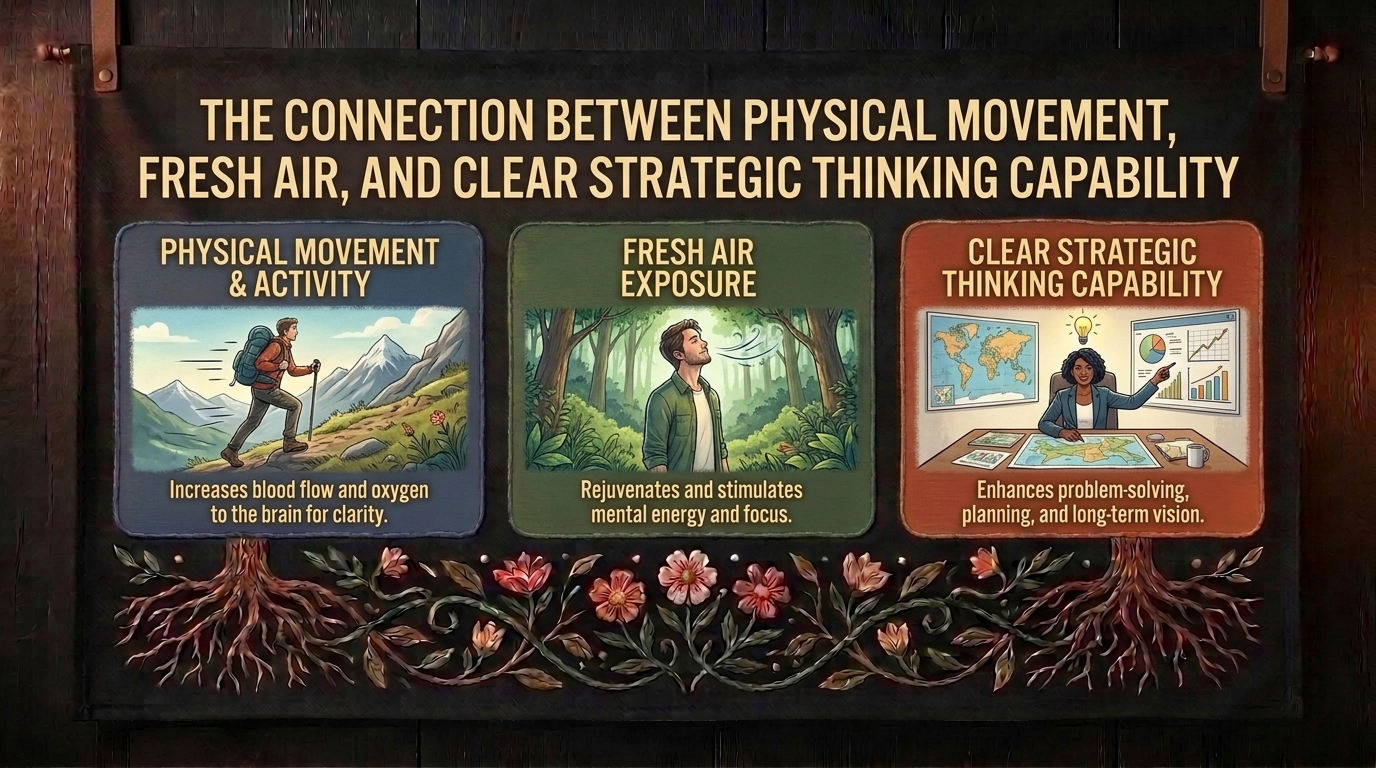
The Connection Between Physical Movement, Fresh Air, and Clear Strategic Thinking Capability
Introduction
In the modern knowledge economy, we have collectively fallen prey to a dangerous physiological illusion: the belief that the human brain operates independently of the physical body. We treat our bodies as mere transport systems designed to ferry our heads from one ergonomic chair to another, parking ourselves in front of multi-monitor setups for ten to twelve hours a day.
Whether you are navigating high-stakes financial environments in New York, scaling venture-backed startups in San Francisco, expanding enterprise operations across Texas, designing public policy in Washington, or driving creative industries throughout California, the standard corporate routine encourages sedentary, indoor isolation.
We sit hunched over keyboards, sip endless cups of coffee to override fatigue, and wonder why our strategic thinking feels sluggish, why burnout creeps in, and why complex problem-solving feels like wading through wet cement.
The secret weapon of history’s greatest thinkers, philosophers, scientists, and modern visionary executives is astonishingly low-tech, free, and instantly accessible: combining physical movement with fresh air.
Movement and oxygen are not merely beneficial for physical fitness; they are the fundamental biological prerequisites for high-level cognitive performance, neurological repair, and visionary strategic planning.
For forward-thinking entrepreneurs, leaders, and modern professionals engaging with platforms like nyattitude.com, understanding and leveraging the mind-body connection is the ultimate competitive advantage. This comprehensive guide explores the neuroscience of physical activity, the cognitive benefits of outdoor environments, step-by-step framework integration, regional navigation across major U.S. hubs, actionable daily tips, and answers to the most frequently asked questions.
1. The Neuroscience of Motion: How Movement Fuels the Mind
To understand why a brisk walk outdoors clears mental fog faster than any productivity app, we must look beneath the skull into the neurobiological mechanisms of physical motion.
The Evolutionary Imperative of Movement
Human brains did not evolve sitting in comfortable office chairs; they evolved over millions of years on the move. Our ancestors walked, hunted, and foraged across miles of changing terrain every single day.
- The Neurotransmitter Flush: When you engage in moderate physical movement—such as walking, cycling, or light stretching—your heart rate increases, pumping oxygen-rich blood directly into the brain. This surge triggers the release of vital neurotransmitters, including dopamine (which fuels motivation and focus), serotonin (which regulates mood), and norepinephrine (which enhances attention and alertness).
BDNF: Miracle-Gro for Brain Cells
Perhaps the most profound discovery in modern neuroscience is the impact of exercise on a protein called Brain-Derived Neurotrophic Factor (BDNF). Often described by neuroscientists as “Miracle-Gro for the brain,” BDNF stimulates the growth of new neurons, strengthens existing synaptic connections, and enhances neuroplasticity.
- When you move your body, your brain floods with BDNF, transforming your neurological hardware into an optimized engine for complex strategic reasoning, memory retention, and creative synthesis.
2. The Biophilia Hypothesis: Why Fresh Air Resets Cognition
Physical movement indoors on a treadmill is undoubtedly beneficial, but when you combine movement with fresh air and natural environments, you unlock a second powerful layer of cognitive enhancement known through the Biophilia Hypothesis.
Attention Restoration Theory (ART)
Developed by environmental psychologists Rachel and Stephen Kaplan, Attention Restoration Theory explains that modern urban environments and digital screens demand directed attention—a depleting cognitive resource that requires active inhibition of distractions. Over time, directed attention leads to mental fatigue, irritability, and tunnel vision.
- Soft Fascination: Natural environments, parks, trees, and open skies engage what psychologists call “soft fascination.” Natural stimuli capture your attention effortlessly without draining your cognitive reserves. This allows your prefrontal cortex to rest, recharge, and process complex strategic problems in the background—a phenomenon known as incubation.
The Oxygen and Ion Factor
Indoor spaces are frequently plagued by stale air, elevated carbon dioxide levels, and synthetic micro-particles, all of which directly induce sleepiness and reduce cognitive throughput. Stepping outside exposes your lungs to higher concentrations of negative air ions and pure oxygen, lowering blood pressure, reducing cortisol, and instantly sharpening mental clarity.
3. Regional Perspectives: Movement and Air Across Major U.S. Hubs
Integrating physical movement and fresh air takes on unique rhythms and lifestyle expressions across the diverse geographic landscapes connected to nyattitude.com:
- New York: Amidst the dense, vertical concrete canyons of Manhattan and Brooklyn, finding fresh air requires intentionality. New York professionals leverage urban green spaces—walking through Central Park, pacing along the Hudson River Greenway, or scheduling walking meetings—to puncture the hyper-velocity noise of Wall Street and media headquarters.
- San Francisco: Blessed with microclimates, coastal fog, and dramatic topography, the Bay Area has long embraced outdoor walking culture. Tech founders, designers, and VCs in San Francisco frequently conduct strategic brainstorming sessions on walking trails around the Presidio or through Golden Gate Park.
- Texas: Spanning the sunlit expanses of Austin, Dallas, and Houston, Texas provides wide-open skylines and extensive trail networks (like Austin’s Lady Bird Lake). Texas leaders use early-morning outdoor walks to beat the heat, clear their heads, and map out enterprise growth strategies.
- Washington: Anchored by monumental architecture, wide parkways, and the Pacific Northwest’s lush natural canopy, Washington professionals integrate movement by walking the National Mall or exploring regional hiking trails to find diplomatic clarity amidst high-stakes political landscapes.
- California (Southern & Broader): Balancing coastal beach culture, canyon hikes, and year-round sunshine, California lifestyle encourages a seamless blending of outdoor vitality with professional innovation and creative wellbeing.
4. Step-by-Step Framework: The Strategic “Walk and Think” Protocol
Transitioning from sedentary desk-bound thinking to active, outdoor strategic planning requires a structured approach. Follow this step-by-step framework to embed movement into your executive routine:
Step 1: Pre-Walk Question Formulation
Never head out for a walk without a clear cognitive objective. Before stepping away from your desk, write down a single, complex strategic question in your notebook (e.g., “How should we restructure our Q3 go-to-market strategy?” or “What is the root cause of the friction on our leadership team?”).
- Plant this question in your subconscious mind right before you lace up your shoes.
Step 2: The First 10 Minutes (Biological Warm-Up)
During the first ten minutes of your walk, focus purely on your physical senses and breath. Let your heart rate elevate gently, notice the fresh air filling your lungs, and let go of immediate work anxieties. This phase acts as a neurological palate cleanser, flushing out accumulated screen fatigue.
Step 3: The Middle Phase (Free-Flow Ideation)
Once your body is in rhythm, introduce your pre-formulated question. Without holding a notepad or phone, let your mind wander around the problem. Because your prefrontal cortex is relaxed by soft fascination and exercise, your brain will make unexpected connections, synthesize abstract ideas, and uncover innovative angles you would never notice staring at a screen.
Step 4: The Final 10 Minutes (Capture and Crystallization)
As you approach the end of your walk, shift from open-ended wandering to capturing your insights. Use a voice-memo app on your phone to record your thoughts in real-time, or keep a pocket notebook ready. Dictate your breakthrough realizations before they fade.
Step 5: Post-Walk Integration
Return to your workspace and spend ten minutes transferring your voice memos or rough notes into your action planner. Turn your walking insights into concrete operational milestones.
5. Actionable Tips to Build Daily Movement and Air Habits
Incorporate these practical micro-habits into your daily work schedule to supercharge your strategic thinking capacity:
- Convert 1-on-1 Calls into Walking Meetings: If you have virtual check-ins, coaching sessions, or catch-ups that do not require screen sharing or slide decks, take them using wireless headphones while walking outside.
- Implement the “Pomodoro Walk”: For every 50 minutes of deep desk work, take a mandatory 10-minute fresh air break. Walk around the block, stretch, or look out at the farthest horizon to reset your visual focus.
- Establish a “Think Walk” Routine: Dedicate two 30-minute blocks per week explicitly labeled as “Strategic Think Walks.” No podcasts, no music, no phone calls—just silence, movement, and your own mind tackling major business challenges.
- Optimize Your Workspace Air Quality: On days when outdoor access is limited, invest in high-grade indoor air purifiers, keep houseplants, and crack your office windows for ten minutes every morning to flush out stale carbon dioxide.
- Ditch the Elevator for Stairs: Whenever possible, take the stairs instead of the elevator. Short bursts of cardiovascular exertion spike your heart rate and provide an instant cognitive alertness boost.
- Change Your Scenery for Difficult Decisions: If you find yourself staring blankly at a complex spreadsheet or strategic document, stop fighting it. Grab your papers, step outside to a park bench, and read them under an open sky. The change of environment instantly shifts your cognitive state.
6. Ten Frequently Asked Questions (FAQs)
1. How does physical movement directly improve strategic thinking and decision-making?
Movement increases cerebral blood flow, oxygenation, and the release of BDNF and dopamine. This biochemical cascade enhances prefrontal cortex function, improves working memory, reduces mental fatigue, and allows your brain to connect disparate ideas into brilliant strategic solutions.
2. Why is fresh air specifically important compared to indoor exercise?
While indoor exercise improves cardiovascular health, outdoor fresh air provides exposure to natural negative ions, higher oxygen purity, and natural sunlight. Furthermore, outdoor environments engage “soft fascination,” which actively restores depleted mental attention spans.
3. How long does a walk need to be to notice cognitive benefits?
Neuroscientific studies show that even a brisk 15-to-20-minute walk outdoors is enough to measurably boost creative problem-solving, cognitive flexibility, and mood. For deep strategic planning, 30 to 45 minutes is the optimal duration.
4. What should I do if my work schedule is too packed to leave my desk?
Break your day into micro-increments. Taking three separate 10-minute outdoor walks after meals (breakfast, lunch, and mid-afternoon) requires minimal time commitment while delivering cumulative cognitive and metabolic benefits throughout the day.
5. Can walking really help solve complex business or creative problems?
Yes. When you step away from a problem to move your body, your brain shifts from active, narrow focused-mode thinking to default mode network (DMN) processing. The DMN quietly connects background data, memories, and concepts, often delivering the “Eureka!” moment just as you cross the street.
6. What if the weather is terrible or I live in a dense urban environment?
Indoor walking on a treadmill near a large window, pacing through a brightly lit indoor atrium, or even doing light dynamic stretching while ventilating your room with a window cracked open can capture many of the same physiological benefits when outdoor access is constrained.
7. Should I listen to podcasts or music during my strategic think walks?
For active physical exercise, music is great. However, for deep strategic thinking, walking in silence is superior. Silence allows your brain to wander, process information, and listen to its own internal insights without outside interference.
8. How does regular movement prevent professional burnout?
Sedentary work habits trap cortisol and adrenaline in the body, manifesting as chronic muscle tension, fatigue, and mental exhaustion. Physical movement metabolizes stress hormones, resets your nervous system, and provides a daily mental decompression valve that wards off burnout.
9. How do regional metropolitan cultures approach outdoor working habits?
Innovation hubs like San Francisco and Austin heavily embrace outdoor culture, offering walking meetings and bike-commute infrastructure as standard professional practice. Adopting these regional habits helps modern knowledge workers escape indoor fatigue.
10. What is the single easiest first step I can take today?
Take your next phone call or routine conversation outside. Leave your computer behind, put on your walking shoes, step out into the fresh air, and let your body move while you talk. You will instantly feel the shift in your mental clarity.
Conclusion
Your brain is not a disembodied computer; it is the control center of a living, breathing biological organism. Starve that organism of movement and fresh air, and your strategic thinking will inevitably wither into sluggish reactivity. Nourish it with daily motion and outdoor vitality, and your capacity for clarity, innovation, and leadership expands exponentially.
Whether you are scaling an enterprise across Texas, New York, California, Washington, or San Francisco, remember that your greatest strategic breakthroughs will rarely happen while you are slumped in an office chair. Step outside, move your body, breathe the fresh air, and let your mind soar.
What is one sedentary block in your daily schedule tomorrow that you can convert into an outdoor walking strategy session?