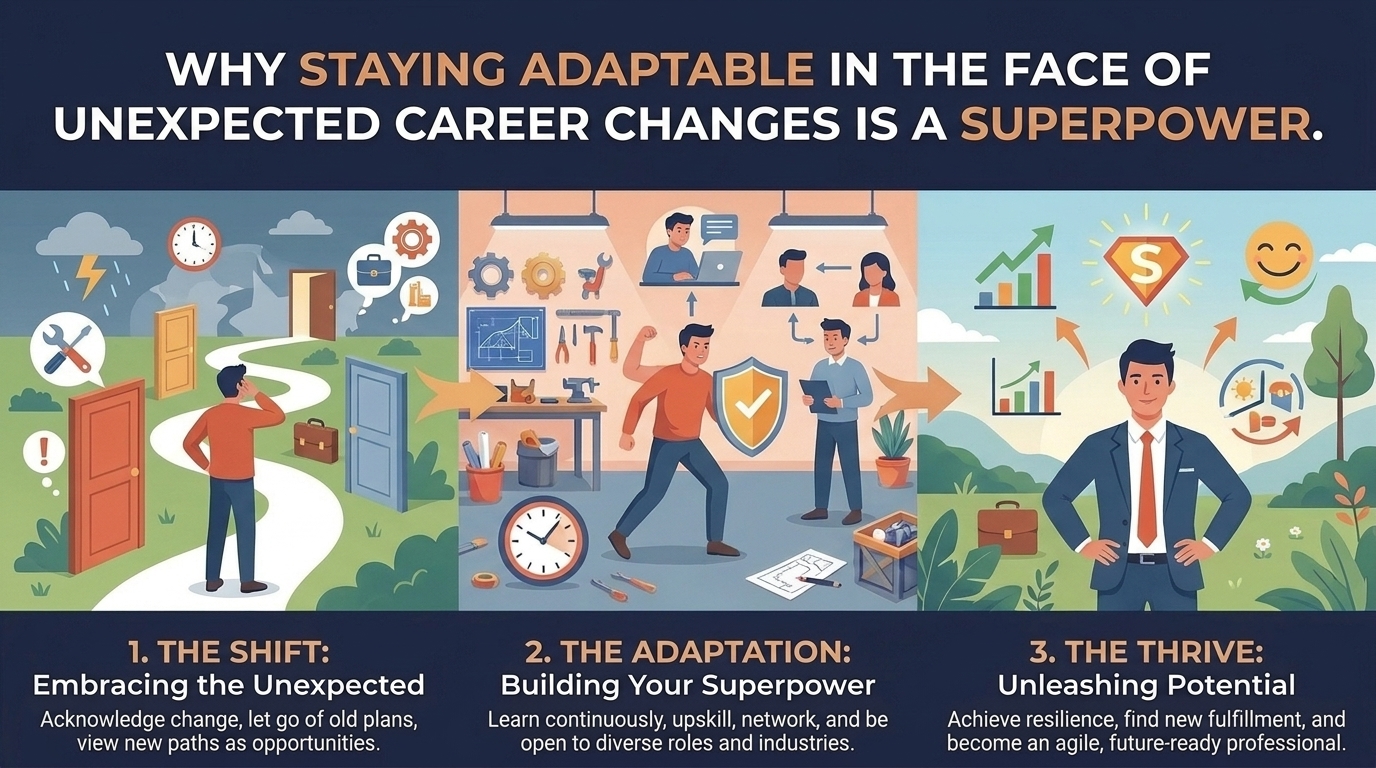
Why Staying Adaptable in the Face of Unexpected Career Changes Is a Superpower
Introduction
In the twenty-first-century global economy, the old professional playbook—the one that promised a linear climb up a single corporate ladder, a gold watch after thirty years of loyal service, and predictable career security—is entirely dead. In its place is a volatile, high-velocity landscape defined by rapid technological disruption, artificial intelligence breakthroughs, shifting macroeconomic tides, and unpredictable industry pivots.
Nowhere is this volatile reality more visible than in America’s premier metropolitan economic engines. Whether you are navigating sudden structural realignments in the financial and media towers of New York, riding the breathtaking boom-and-bust waves of tech innovation in San Francisco and broader California, reacting to sweeping legislative and regulatory shifts in Washington, or scaling dynamic enterprises across the explosive markets of Texas, change is the only constant.
When an unexpected career disruption strikes—such as a sudden layoff, a botched startup funding round, an automated role elimination, or a forced industry pivot—most people experience panic, paralysis, and grief. However, elite performers view disruption through an entirely different lens. They understand that adaptability is the ultimate professional superpower.
This comprehensive guide explores the cognitive science of adaptability, why rigid career paths are liability traps, and a battle-tested blueprint to help you not only survive unexpected career changes but use them as a springboard to unprecedented long-term success.
1. The Psychology of Change: Why Our Brains Resist Pivots
To master adaptability, we must first understand why unexpected career changes feel so terrifying on a neurological level.
- The Predictability Bias: Human brains are master pattern-recognition machines designed to conserve metabolic energy by establishing predictable routines. When a career path is abruptly disrupted, the brain’s amygdala triggers a threat response, flooding the body with cortisol and adrenaline.
- Identity Entanglement: Many ambitious professionals dangerously fuse their self-worth and identity with their job title or employer (“I am a senior VP at X firm” or “I am a startup founder”). When the title vanishes, the ego experiences an identity crisis, making objective problem-solving difficult.
- The Antifragile Advantage: As popularized by risk analyst Nassim Nicholas Taleb, things are either fragile (break under stress), robust (resist stress), or antifragile (actually improve and grow stronger when exposed to volatility, shocks, and disorder). Adaptability transforms you from a fragile worker into an antifragile operator.
2. Regional Landscapes of Disruption: Coast-to-Coast Agility
Different metropolitan regions present unique economic climates, meaning the nature of career disruptions—and the adaptability required to conquer them—varies from coast to coast:
New York and San Francisco: Volatility, Velocity, and Reinvention
- New York: In NYC’s competitive financial, legal, fashion, and media sectors, sudden corporate restructurings and market corrections are common. Adaptability here means being able to pivot your specialized skill set across adjacent industries overnight without missing a beat.
- San Francisco: In the Bay Area’s tech ecosystem, the lifecycle of companies moves at lightspeed. A startup can scale to unicorn status or fold in eighteen months. Adaptability in SF requires treating every failed venture or layoff as a tuition payment in master-level market education.
Texas, California, and Washington: Growth, Scale, and Regulatory Shifts
- California: Across broader California, professionals in entertainment, green tech, and biotech must constantly reinvent their portfolios as consumer tastes and climate policies evolve.
- Texas: In booming Texas hubs like Austin, Dallas, and Houston, rapid corporate relocations and massive economic expansion mean professionals must stay nimble to capture emerging opportunities in real estate, energy, tech, and logistics.
- Washington: In the Pacific Northwest, career resilience in policy, defense, and enterprise tech requires adapting quickly to shifting federal administrations, regulatory landscapes, and institutional priorities.
3. The Core Pillars of Professional Adaptability
Cultivating adaptability requires more than a positive attitude; it demands structural cognitive habits and skill diversification. Implement these four core pillars:
| Adaptability Pillar | Strategic Execution | Long-Term Benefit |
|---|---|---|
| Transferable Skill Mapping | Regularly audit your core competencies (e.g., project management, data analysis, persuasive writing) independent of your current job title. | Ensures you instantly recognize how your value translates across entirely different industries. |
| Cognitive Reappraisal | Consciously reframe unexpected job loss or role shifts from a “catastrophe” into an “unplanned sabbatical and pivot opportunity.” | Shuts down panic neurochemistry and reactivates executive functioning in your prefrontal cortex. |
| Continuous Micro-Upskilling | Dedicate 3 to 5 hours weekly to learning adjacent skills (e.g., basic coding, AI prompting, financial modeling, or public speaking). | Keeps your market relevance razor-sharp, protecting you against sudden technological obsolescence. |
| Diversified Professional Network | Build active, authentic relationships outside your immediate department and company long before you need a new job. | Provides an instant safety net of warm contacts, insider insights, and unlisted career opportunities during a transition. |
4. Step-by-Step Blueprint: Navigating an Unexpected Career Pivot
When an unexpected career disruption hits, panic is your worst enemy and speed-with-strategy is your best ally. Use this four-step tactical roadmap to navigate the transition:
- The 48-Hour Decompression Window: When laid off or hit with a major career shock, give yourself 48 hours to feel the emotional shock without making frantic, fear-driven moves. Sleep, clear your head, and let the initial adrenaline flush out of your system.
- The Assets and Liabilities Audit: Conduct an honest inventory of your financial runway (savings), emotional support system, and professional assets. Knowing your exact numbers eliminates vague, catastrophic anxiety and grounds you in objective reality.
- The Hypothesis-Testing Phase: Treat your career pivot like a scientific experiment rather than a desperate job hunt. Formulate three different hypotheses for your next career move (e.g., pivot to consulting, join an early-stage startup, or pivot industries entirely) and run small tests—informational interviews, freelance gigs, or quick projects—to validate them.
- The Relentless Execution Sprint: Once you select your new direction, commit to daily, disciplined execution. Treat your job search or business launch like a full-time job, tracking outreach metrics, interviews, and skill-building milestones with rigorous accountability.
5. Ten Frequently Asked Questions (FAQ)
1. Why do some people bounce back from career disruptions instantly while others remain paralyzed?
Resilience and adaptability are largely rooted in cognitive flexibility and an internal locus of control. People who view setbacks as temporary external data points recover much faster than those who interpret setbacks as personal failures.
2. How can I make my resume attractive to hiring managers when I have a major industry gap or pivot?
Focus on transferable skills rather than chronological job titles. Highlight problem-solving achievements, leadership wins, and continuous learning projects that prove you can deliver results regardless of the specific industry niche.
3. Is it possible to completely change careers in my 30s, 40s, or beyond?
Absolutely. With the rise of modular education, micro-certifications, and skill-based hiring, thousands of professionals successfully execute major career pivots later in life, leveraging their mature emotional intelligence and foundational experience.
4. How do I manage the financial anxiety that comes with an unexpected job loss?
Build a “fuck-you fund” (3 to 6 months of living expenses) as early in your career as possible. Financial runway buys you the psychological luxury of being strategic and selective during a transition rather than accepting the first toxic job out of desperation.
5. What role does networking play in adapting to sudden career changes?
Networking is your primary early-warning system and opportunity pipeline. Over 70% of high-level roles are filled through unlisted channels and warm referrals. A robust network means you never have to rely solely on cold applications.
6. How can I future-proof my career against AI and rapid technological disruption?
Focus on uniquely human skills that algorithms cannot easily replicate: high-level strategic thinking, complex negotiation, emotional intelligence, creative synthesis, and leadership. Learn how to use AI as a leverage tool rather than viewing it as an enemy.
7. What is the difference between being adaptable and being a pushover?
Adaptability means adjusting your strategy, tactics, and industry focus in response to market reality while holding true to your core values and long-term vision. Being a pushover means passively accepting mistreatment or lacking firm professional boundaries.
8. How do major metropolitan cities foster professional adaptability?
High-density hubs like New York and San Francisco concentrate diverse industries, capital, and talent pools in close proximity, making cross-pollination of ideas and rapid industry pivoting much more accessible than in smaller, isolated markets.
9. How do I explain an unexpected termination or layoff during an interview with confidence?
Keep it brief, objective, and forward-looking. State the factual business reality (e.g., company restructuring, funding pivot, or department elimination) and immediately pivot the conversation to what you learned and how it makes you a stronger candidate for this new role.
10. Where can I find more resources on career strategy, resilience, and urban success?
Keep exploring specialized lifestyle, career, and culture hubs like nyattitude.com, where we provide actionable insights, local strategies, and expert guides to help you master change and thrive across America’s greatest cities.
Conclusion
Change is no longer an occasional interruption in an otherwise predictable professional life; it is the fundamental fabric of the modern economy. Whether you are navigating corporate restructuring in New York, riding tech waves in San Francisco, building ventures across California, shaping policy in Washington, or scaling businesses in Texas, the ability to adapt is your ultimate competitive weapon. By shedding rigid expectations, diversifying your skills, embracing continuous learning, and treating unexpected disruptions as launchpads for reinvention, you transform uncertainty from a threat into your greatest superpower.
Ready to master adaptability, elevate your mindset, and conquer your career goals? Continue browsing nyattitude.com to inspire your growth journey forward!