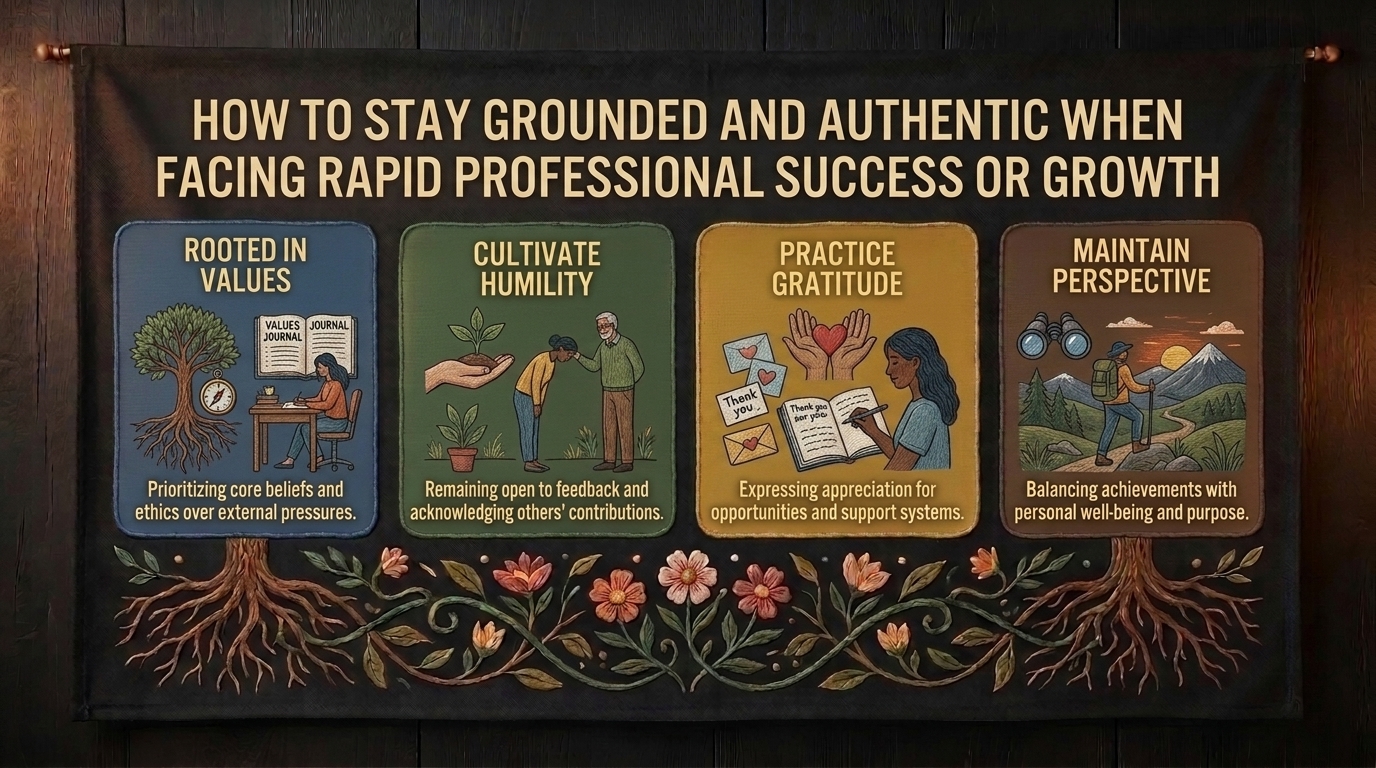
How to Stay Grounded and Authentic When Facing Rapid Professional Success or Growth
Introduction
In the collective imagination, rapid professional success is painted exclusively in glowing terms: triumphant celebrations, soaring bank balances, media spotlights, and the sweet validation of hard work paying off. Whether launching a hyper-growth tech startup in San Francisco, scaling a venture across Texas, closing high-stakes deals in New York, expanding technological footprints in Washington, or driving cultural influence throughout California, the pursuit of explosive growth is the ultimate engine of modern ambition.
However, behind the polished LinkedIn posts and press releases lies a stark, rarely discussed psychological reality: rapid professional growth can be profoundly disorienting, isolating, and destabilizing.
When your career or enterprise accelerates faster than your internal psychological operating system can process, you risk falling victim to impostor syndrome, ego inflation, burnout, or the quiet loss of your core identity. Success changes your external environment overnight, but maintaining your internal anchor requires fierce intentionality.
For ambitious leaders, entrepreneurs, and forward-thinking creators engaging with platforms like nyattitude.com, learning how to stay grounded and authentic amidst explosive growth is the ultimate defensive strategy. This comprehensive guide explores the psychology of success-induced disruption, the pillars of authenticity, step-by-step grounding frameworks, regional dynamics across major U.S. hubs, actionable tips, and answers to the most frequently asked questions.
1. The Hidden Psychological Turbulence of Rapid Success
To protect your authenticity, you must first understand why rapid success triggers internal crisis. We tend to view failure as stressful, but psychologists note that positive life changes can induce acute stress known as “success trauma” or “acceleration shock.”
The Identity Lag
When you achieve massive professional success rapidly—such as scaling a company, receiving a massive promotion, or securing venture funding—your external title and social status shift instantly. However, your internal self-concept (how you view yourself) takes much longer to catch up.
- The Result: This disconnect creates a profound psychological vacuum. You may look successful on paper while feeling like an absolute fraud on the inside, leading to intense performance anxiety and defensive posturing.
The Echo Chamber Effect
As you ascend professionally, a dangerous phenomenon occurs: the people around you stop telling you the truth. Employees, partners, and acquaintances begin agreeing with your every idea, laughing at jokes they don’t find funny, and shielding you from critical feedback. Without honest mirrors, ego inflation and loss of touch with reality become almost inevitable.
2. The Core Pillars of Grounded Authenticity
Staying authentic during rapid growth is not about accidental luck; it is a disciplined practice built upon four fundamental pillars:
1. Unwavering Value Alignment
Success often tempts us with external metrics—prestige, awards, followers, or square footage—that have nothing to do with our authentic desires. Grounded individuals evaluate every new opportunity through the filter of their core personal values rather than societal status symbols.
2. Radical Intellectual Humility
As your net worth, network, or team size expands, the temptation to believe you are suddenly an expert at everything is dangerously seductive. True grounding requires recognizing that success is often a confluence of hard work, timing, and privilege, keeping you open to learning from anyone, regardless of their title.
3. Deliberate Sanctuary Creation
Rapid growth demands relentless decision-making and public visibility. To stay authentic, you must carve out private sanctuaries—time and spaces completely detached from professional performance where you can simply exist as a human being rather than a corporate entity.
4. Relational Accountability
Surrounding yourself with people who knew you before your success—friends, family, or mentors who do not care about your title or bank account—is your ultimate insurance policy against ego inflation.
3. Regional Perspectives: Staying Grounded Across Major U.S. Markets
The cultural pressures of rapid success take on distinct characteristics across the diverse economic and geographical landscapes connected to nyattitude.com:
- New York: Amidst the high-velocity corporate and financial networks of Manhattan, rapid success often tempts individuals into a relentless status game driven by luxury and prestige. Staying grounded in New York requires cultivating deep personal boundaries, protecting private family time, and remembering that professional title is not human worth.
- San Francisco: In the tech and startup ecosystems of the Bay Area, rapid scaling is celebrated with hyper-public valuations and aggressive disruption culture. Grounded innovators in San Francisco resist the trap of ego-driven hubris, staying anchored in product mission, ethical responsibility, and mindful living.
- Texas: Spanning thriving hubs like Austin, Dallas, and Houston, Texas professional culture blends rapid economic expansion with deep-rooted community values, warmth, and hospitality. Success here is frequently grounded in personal integrity, civic engagement, and long-term relationship building.
- Washington: Anchored by public policy, defense, and Pacific Northwest innovation, Washington professionals navigate high-visibility public and institutional influence. Grounded leaders in this region maintain authenticity through diplomatic integrity, service-oriented leadership, and immersion in the region’s natural environments.
- California (Southern & Broader): Balancing entertainment, design, and wellness, California rewards creative visibility. Grounded success here cuts through superficial image cultivation, prioritizing holistic well-being, authentic self-expression, and mental health.
4. Step-by-Step Framework: Navigating Rapid Growth Without Losing Yourself
When growth hits like a tidal wave, you need a systematic framework to keep your feet firmly planted on the ground. Follow these steps:
Step 1: Conduct an Annual “Alignment Audit”
At the end of every quarter or year, review your professional trajectory. Ask yourself: Are the projects I am working on aligned with my core purpose, or am I merely chasing external validation and bigger numbers? If your ambitions have drifted away from your authentic values, course-correct immediately.
Step 2: Appoint a “Truth Committee”
Explicitly invite two or three trusted individuals (a spouse, a lifelong friend, or a seasoned mentor) to act as your truth committee. Give them explicit permission to call you out if they notice your ego inflating, your listening skills declining, or your priorities shifting away from integrity.
Step 3: Protect Your “Non-Performance” Hours
Block out specific hours in your weekly schedule where you are forbidden from talking about, thinking about, or working on your business. Use this time for physical exercise, creative hobbies, cooking, or quiet family connection to nourish parts of your identity outside of your career.
Step 4: Practice Radical Gratitude and Giving Back
Nothing grounds an expanding ego faster than active contribution. When you experience massive success, channel a portion of your time, capital, or expertise into mentoring others, supporting local community initiatives, or backing philanthropic causes. Gratitude shifts your focus from what you are accumulating to what you can share.
Step 5: Embrace Beginner’s Mind in New Domains
When you master one industry or reach the top of your current ladder, challenge yourself by stepping into an arena where you know nothing—whether learning a physical martial art, studying a musical instrument, or mastering a new language. Being a humble beginner recalibrates your ego.
5. Actionable Tips to Maintain Daily Authenticity
Incorporate these practical micro-habits into your daily routine to safeguard your authenticity during high-growth phases:
- Limit Vanity Metric Consumption: Stop obsessing over your follower counts, media mentions, stock tickers, or industry ranking lists. These metrics are external noise that distort your internal sense of reality.
- Keep an Analog Journal: Write down your raw thoughts, fears, and reflections in a physical notebook rather than typing on a corporate device. Analog writing fosters deeper self-awareness and emotional honesty.
- Say “No” to High-Visibility Traps: As you grow, you will receive dozens of invitations to panels, galas, and interviews that boost your ego more than your actual mission. Master the art of polite refusal to protect your focus and humility.
- Maintain Regular Contact with Your Roots: Regularly call friends and family members who knew you before your breakthrough. Talk about ordinary, mundane life topics to remind yourself that your worth is independent of your professional status.
- Practice Active Empathy on Your Team: As a successful leader, consciously check in on the human beings working alongside you. Remember what it felt like when you were building from the ground up, and lead with empathy rather than authoritarian executive commands.
- Schedule Unstructured Boredom: Do not fill every single minute of your calendar with high-level strategy meetings. Allow yourself periods of quiet solitude where your mind can wander and process your rapid experiences naturally.
6. Ten Frequently Asked Questions (FAQs)
1. Why does rapid professional success often feel lonely or unsettling?
Rapid success changes your social and professional dynamics faster than your brain can adapt. Old friendships may shift due to changing availability or subtle envy, and new relationships can feel transactional. This sudden shift creates an emotional vacuum, leading to feelings of isolation.
2. What is the difference between true confidence and ego inflation?
True confidence is rooted in self-awareness, competence, and inner security; it allows you to admit mistakes and listen to others. Ego inflation is a fragile defense mechanism rooted in insecurity; it demands constant validation, dismisses criticism, and requires superiority over others.
3. How do I prevent success from making me arrogant?
Cultivate intellectual humility by intentionally surrounding yourself with brilliant, dissenting voices, maintaining a “beginner’s mind” through new hobbies, and regularly remembering the mentors, circumstances, and sheer luck that contributed to your breakthrough.
4. How do I handle people who treat me differently after I become successful?
Recognize that people often project their own aspirations, insecurities, or transactional motives onto successful individuals. Set firm relational boundaries, appreciate authentic connections, and do not take opportunistic behavior personally.
5. Can rapid success lead to burnout?
Yes. The adrenaline rush of explosive growth often pushes individuals to work unsustainable hours, ignore physical health warning signs, and skip recovery. Grounded self-care and boundary setting are essential to survive rapid scaling without burning out.
6. How do I stay authentic when media and public spotlight demand a “persona”?
Draw a sharp boundary between your public professional role and your private human identity. Understand that media profiles, interviews, and brand personas are tools for communication, but they do not define your soul or your private reality.
7. What is “impostor syndrome” during rapid growth, and how do I cope with it?
Impostor syndrome is the persistent fear that you are a fraud who will be exposed as unqualified despite your achievements. Coping with it requires accepting that growth always pushes you into uncharted territory where feeling slightly out of your depth is completely normal.
8. How can mentorship help me stay grounded?
Having a seasoned mentor who has already navigated the rollercoaster of massive success provides a crucial reality check. They can normalize your psychological turbulence, offer objective wisdom, and guide you away from common ego traps.
9. How do regional startup or corporate cultures impact ego inflation?
Hyper-competitive tech and finance hubs like San Francisco and New York often amplify status games and valuation culture. Recognizing these regional echo chambers allows you to consciously step outside them and reconnect with grounded local community realities.
10. How long does it take for my internal identity to catch up with my external success?
Identity integration is an ongoing psychological process. With intentional self-reflection, journaling, therapy, and supportive relationships, most individuals feel a stabilizing alignment within 12 to 24 months of major professional acceleration.
Conclusion
Rapid professional success is an extraordinary milestone, but it is ultimately just a chapter in your life’s story, not your permanent definition. True fulfillment is not found in how fast you scale or how loud the applause grows, but in how deeply you stay connected to your authentic values, your humanity, and the people who matter most.
Whether you are building a visionary enterprise across Texas, New York, California, Washington, or San Francisco, remember to celebrate your achievements with joy, wear your success with humility, and keep your roots planted firmly in the soil of your authentic self.
What is one foundational value or personal habit from your pre-success days that you vow to protect no matter how large your enterprise grows?