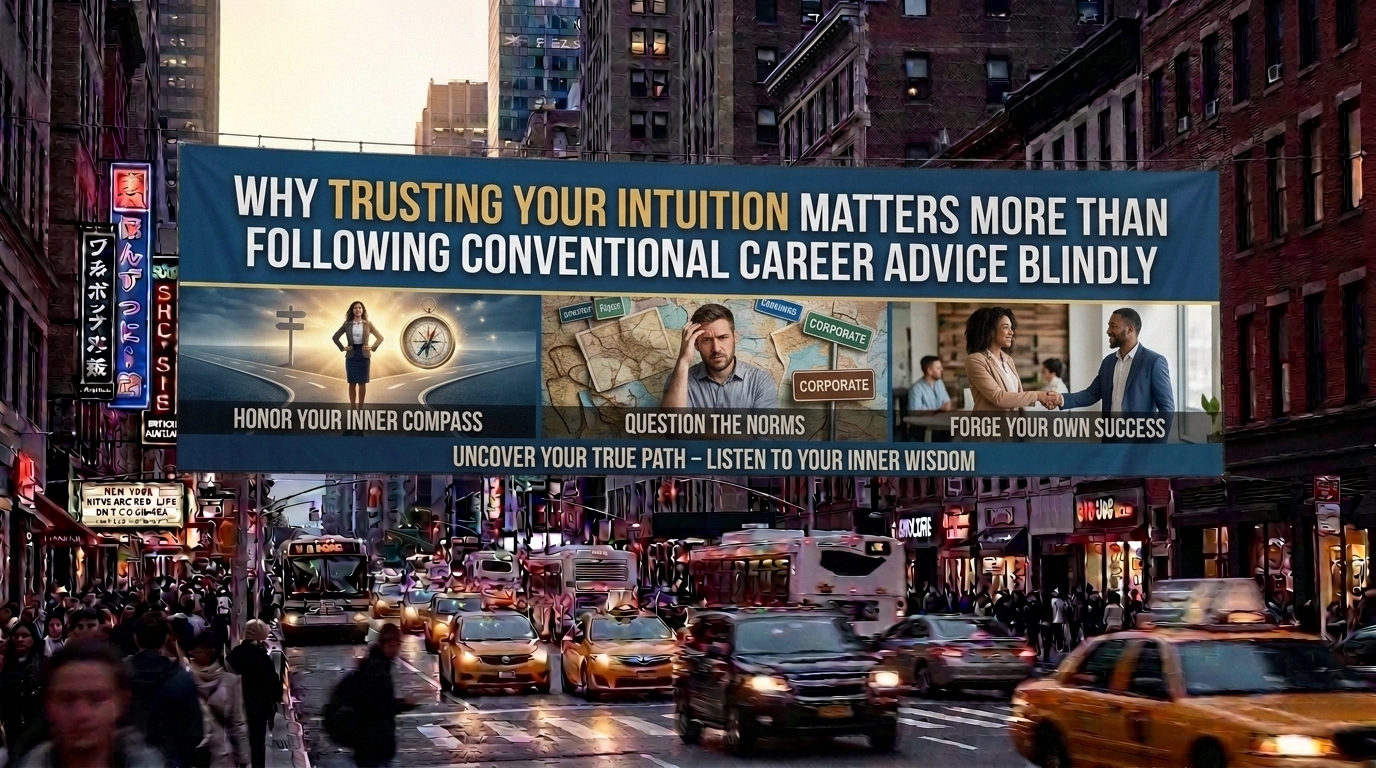
In the fast-moving professional landscape of modern economic hubs—from the financial corridors of New York and the tech centers of San Francisco and Seattle, Washington, to the rapidly growing business hubs across Texas and California—career guidance is everywhere. Books, podcasts, corporate workshops, and online influencers constantly promote standardized templates for success.
We are told to follow linear promotion tracks, stay at roles for fixed durations to avoid resume gaps, optimize every decision for immediate salary gains, and play it safe within traditional corporate hierarchies.
While conventional career wisdom provides useful baselines, applying it blindly often leads to misalignment, chronic stress, stagnation, and burnout.
Conventional advice is built on historical averages and safe, risk-averse paths. It does not account for your unique strengths, values, risk tolerance, or real-time market shifts.
This is where internal intuition—backed by experience, pattern recognition, and self-awareness—becomes a critical professional asset. Learning to integrate intuitive judgment with analytical reasoning allows you to navigate ambiguity, spot unconventional opportunities, and build a career defined by genuine impact rather than superficial compliance.
The Cognitive Science Behind Intuition
Intuition is often misunderstood as magical thinking or emotional impulse. In reality, modern cognitive science and psychology define intuition as rapid, unconscious pattern recognition.
External Market Stimuli ───► Subconscious Pattern Matching ───► Somatic / Intuitive Signal
                                     │
                        [Analysis & Verification]
                                     │
                                     ▼
                     Strategic, High-Leverage Decision
- Subconscious Pattern Recognition: The human brain processes millions of bits of sensory and experiential information every second, while conscious awareness manages only a fraction. Your brain constantly cross-references present situations against years of accumulated, implicit experiences, delivering rapid conclusions before your conscious mind articulates them.
- The Somatic Marker Hypothesis: Pioneered by neuroscientist Antonio Damasio, research shows that emotional and physical body signals (such as a drop in your stomach or a sense of ease) guide decision-making. These physical markers help you filter choices rapidly by attaching emotional values to potential outcomes based on past experience.
- System 1 vs. System 2 Thinking: Psychologist Daniel Kahneman categorized mental processing into System 1 (fast, automatic, intuitive) and System 2 (slow, deliberate, analytical). In complex, high-stress environments with incomplete data, relying solely on System 2 causes decision paralysis. System 1 offers vital direction by drawing on internalized expertise.
Conventional Career Advice vs. Intuitive Strategic Decision-Making
Blindly accepting standard career rules can blind you to high-leverage, non-linear opportunities.
| Career Scenario | Conventional Advice (Generic Baseline) | Intuitive / Strategic Decision (Personalized) |
| Job Offers | Choose the highest salary or most prestigious brand name. | Choose the team, leadership alignment, and learning trajectory that feel right, even if short-term compensation is lower. |
| Pivoting Fields | Stay in your current industry to preserve specialized seniority. | Leverage cross-disciplinary skills to pivot into emerging sectors where your unique background creates an advantage. |
| Timing an Exit | Endure toxic or stagnant roles for at least 2 years to protect your resume. | Exit systematically once internal growth stops and the environment begins eroding your confidence and health. |
| Risk Management | Take predictable, incremental steps within established corporate ladders. | Take calculated bets on high-upside projects, early-stage ventures, or non-traditional roles aligned with market shifts. |
When to Trust Intuition vs. Analytical Data
Intuition is a powerful tool, but it should not operate in a vacuum. The most successful professionals balance intuitive insights with objective analysis.
Trust Intuition When:
- Operating in High-Ambiguity Environments: When data is incomplete, conflicting, or unavailable (e.g., emerging markets, startup environments, novel creative projects).
- Evaluating People and Culture: Assessing team dynamics, managerial trustworthiness, and organizational alignment during interviews or partnership negotiations.
- Experiencing Persistent Discomfort: When a project, partnership, or offer looks perfect on paper, but an underlying sense of friction persists.
Rely on Analytical Data When:
- Evaluating Technical or Financial Metrics: Assessing contractual terms, market sizes, equity valuations, or complex financial models.
- Lacking Domain Experience: When operating in an entirely new field where your subconscious has not yet built reliable pattern recognition.
- Experiencing Emotional Highs/Lows: When intense fear, anxiety, or excitement threatens to distort objective reality.
Step-by-Step Framework for Integrating Intuition into Career Decisions
To systematically use intuitive judgment without making reckless choices, use this five-step framework:
1.Audit Your Internal Signals:Separate genuine intuition from fear or wishful thinking.
Pay attention to physical and emotional cues when faced with a decision. Fear is usually loud, urgent, and reactive. Genuine intuition feels quieter, persistent, and grounded—even when it pushes you toward a challenging decision.
2.Create Space for Subconscious Processing:Clear cognitive clutter to allow subconscious processing.
Intuitive breakthroughs rarely occur during back-to-back meetings or endless scrolling. Build quiet space into your schedule through walking, journaling, or stepping away from screens to let your subconscious synthesize information.
3.Cross-Examine Your Gut Feeling with Hard Data:Pressure-test intuitive insights against objective facts.
Once an intuitive direction emerges, gather objective facts to test it. Ask: “What evidence supports this feeling? What evidence contradicts it? Am I overlooking key facts because of personal bias?”
4.Execute Low-Risk Micro-Experiments:Run small, low-risk experiments to validate direction.
Before making a major career leap based on a gut feeling, run small experiments. Take a short consulting gig, conduct informational interviews, or test a project on the side to validate your intuition with real-world feedback.
5.Document Decisions and Conduct Retrospectives:Refine your decision-making framework over time.
Maintain a decision log. Write down key choices, the gut feelings you experienced, the analytical data you used, and the eventual outcomes 6 to 12 months later. This refines your internal pattern recognition over time.
Actionable Tips for Cultivating Career Self-Trust
Building the confidence to trust your intuition in high-stakes environments—whether in New York, San Francisco, Texas, Washington, or California—requires intentional practice:
- Practice Decisiveness on Low-Stakes Choices: Make quick, confident decisions on minor everyday choices (like menu selections or daily task ordering) without second-guessing to build self-trust muscle memory.
- Conduct an Audit of Past Decisions: Reflect on 3 major career turning points. Did you follow conventional advice or trust your internal judgment? What were the results?
- Limit External Feedback Circles: When facing a critical decision, seek advice from 2-3 trusted mentors rather than crowdsourcing opinions from dozens of acquaintances, which dilutes focus.
- Define Your Personal Values: Clarify your core non-negotiable values (e.g., autonomy, mastery, financial growth, impact). Intuition functions best when aligned with clear internal standards.
Top 10 Frequently Asked Questions (FAQ)
1. What is the difference between intuition and anxiety?
Anxiety is loud, chaotic, future-focused, and driven by fear or worst-case scenarios. Intuition is quiet, persistent, present-oriented, and provides a clear sense of clarity or caution without panic.
2. Is it risky to trust intuition in conservative industries like finance or law?
Not when used appropriately. In conservative fields across hubs like Wall Street or major corporate legal sectors, data and precedent govern technical execution, while intuition guides strategic networking, career timing, and reading unspoken workplace dynamics.
3. Can early-career professionals trust their intuition without years of experience?
Early-career professionals have less domain-specific pattern recognition, making analytical validation more important. However, intuition regarding personal alignment, safety, ethics, and workplace culture remains valid at any career stage.
4. How do I explain an intuitive career decision to family or colleagues who prefer safe, conventional paths?
Translate your intuitive choice into clear, logical reasoning. Explain your decision in terms of long-term skill acquisition, market trends, personal alignment, and strategic growth rather than saying “it just felt right.”
5. What should I do if my intuition contradicts a lucrative job offer?
Pause and investigate the source of hesitation. Research the team culture, managerial turnover, and company health. Unconscious red flags often surface as gut friction before appearing on paper.
6. How does intuition improve leadership capabilities?
Intuitive leaders read team dynamics quickly, spot unspoken friction, anticipate market shifts before data catches up, and make timely decisions during crises when complete information is unavailable.
7. Can remote work impact my professional intuition?
Remote work reduces informal physical cues, making reading culture more challenging. To compensate, pay closer attention to tone, responsiveness, communication consistency, and operational transparency.
8. How do I rebuild trust in my intuition after a career mistake?
Treat the mistake as a data point, not a failure of judgment. Analyze what went wrong: Did you ignore clear red flags, act out of fear, or misread incomplete data? Adjust your framework and move forward.
9. Why do conventional career guides promote one-size-fits-all templates?
Conventional advice is designed for mass applicability and risk minimization. It prioritizes predictable, average outcomes over high-upside, non-linear trajectories tailored to individual strengths.
10. How can I strengthen my intuitive decision-making skills daily?
Journal regularly, reduce digital noise, practice mindfulness or outdoor walks, and track your decision-making outcomes in a dedicated log.
Conclusion
Conventional career wisdom offers helpful guardrails, but it cannot navigate the unique nuances of your career path. Relying solely on generic rules leads to safe, predictable outcomes that may leave you unfulfilled. By cultivating self-awareness, clearing cognitive noise, and learning to balance intuitive signals with analytical facts, you gain the confidence to make bold, strategic choices. Whether navigating opportunities across Texas, California, Washington, New York, or San Francisco, trusting your internal guidance is essential for building a resilient, high-impact career.