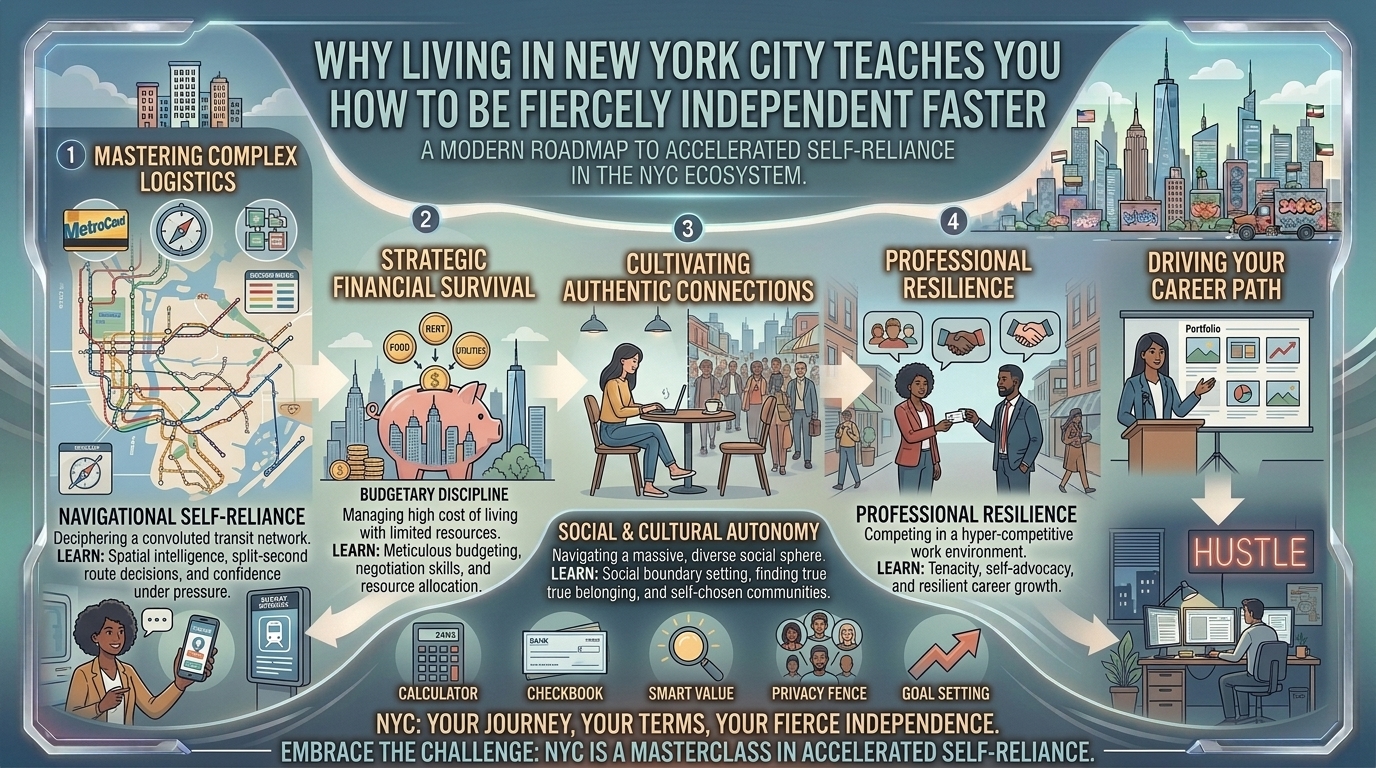
Why Living in New York City Teaches You How to Been Fiercely Independent Faster
Welcome to nyattitude.com, your ultimate digital authority on high-performance urban living, fast-lane career progression, and the uncompromising grit required to thrive in America’s most demanding metropolitan hubs. Whether you are scaling corporate heights in Manhattan, navigating the tech incubators of San Francisco and California, pushing through policy and legal sprints in Washington D.C., or expanding enterprise footprints across Texas, one universal milestone stands out: moving to New York City is an accelerated masterclass in personal sovereignty.
When you arrive in New York, you quickly realize it is a city that does not coddle you. There is no cushion, no slow introductory period, and no built-in safety net waiting to catch your mistakes. From the moment you sign a brutal apartment lease, navigate your first rush-hour subway transfer error, or stand your ground on a crowded sidewalk, the city demands one immediate transformation: you must learn how to depend on yourself, fast.
This comprehensive guide explores the psychology of urban self-reliance, why New York strips away dependency faster than any other environment on earth, the daily mechanics of building fierce independence, a 10-point FAQ section, and a concluding master blueprint to help you master your own life.
Part 1: The Psychology of Urban Independence
Why does living in New York City accelerate personal growth and independence at a rate that feels compressed into dog years? It comes down to urban sociology and environmental psychology.
1. The Death of the Safety Net
In smaller towns, suburbs, or structured environments, your support system is usually a phone call away. Need someone to help you move a couch? Call a family member. Need someone to fix your car? Call a local mechanic you’ve known for a decade.
- In New York, your social fabric is initially nonexistent. Millions of people live shoulder-to-shoulder, yet you are fundamentally on your own.
- When your radiator stops working, your grocery bag rips open in the middle of a pedestrian crosswalk, or you miss the last train home, nobody is coming to rescue you. You have to troubleshoot, problem-solve, and execute solutions yourself. This constant friction forges a psychological armor of self-reliance.
2. Anonymity as a Liberator
Sociologists like Georg Simmel noted that city life creates a unique culture of anonymity. In a small town, everyone knows your business, which can breed conformity and fear of judgment. In New York, nobody cares what you are wearing, where you are going, or what mistakes you made yesterday because eight million other people are entirely consumed by their own frantic hustle.
- This radical anonymity strips away external validation-seeking. You stop looking over your shoulder for permission and start making decisions entirely for yourself.
Part 2: Everyday Arenas Where New York Forces Independence
Independence in NYC isn’t a philosophical concept; it is practiced out of sheer logistical necessity across daily routines.
1. Spatial and Logistical Self-Sufficiency
In car-centric metropolitan hubs like Texas or Los Angeles, mobility is outsourced to an internal combustion engine. You sit in a climate-controlled box, drive to a strip mall parking lot, and roll your cart directly to your trunk.
- In New York, your body is your vehicle. You walk miles every day, carry your groceries in heavy canvas totes up four flights of pre-war walk-up stairs, navigate complex underground public transit networks, and manage your physical logistics through sheer physical and mental stamina. You become master of your own physical displacement.
2. Financial and Administrative Accountability
The barrier to entry for urban living is unforgiving. Dealing with stubborn landlords, aggressive utility companies, complex tax structures, and high living costs means you quickly graduate from financial naivety to absolute administrative literacy. You learn how to read contracts line-by-line, advocate for your tenant rights, track every dollar, and handle your own bureaucratic hurdles without leaning on others.
Part 3: Step-by-Step Blueprint for Cultivating Fierce Independence
You don’t have to wait years to develop the resilient independence that New York demands. Accelerate your personal growth using this 4-step framework:
Step 1: Embrace Radical Problem-Solving (Stop Outsourcing Frustration)
When things break down—whether it’s a tech glitch, a logistical travel delay, or a flat apartment tire—resist the urge to immediately complain or look for someone else to fix it. Adopt an engineer’s mindset: What are the variables? What are my options? What is step one?
Step 2: Master Solitude Without Loneliness
There is a profound difference between being alone and being lonely. New York teaches you how to sit at a bar counter with a book, explore a museum entirely by yourself, or take a solo evening walk along the Hudson River without feeling awkward. Cultivating comfort in your own company is the ultimate hallmark of independence.
Step 3: Build Boundaries of Steel
In a hyper-connected city that never sleeps, your personal energy is your most valuable currency. Independence means learning to say “no” to draining social obligations, professional scope creep, and chaotic drama without feeling guilty.
Part 4: Frequently Asked Questions (FAQ)
1. Why does living in New York City make people feel more resilient?
Because the city constantly tests your logistical and emotional limits. From transit delays and high rent pressures to unpredictable weather and dense crowds, surviving and thriving in NYC requires you to adapt quickly or burn out. Overcoming these daily trials builds profound psychological resilience.
2. Is it possible to be independent in New York if you are naturally an introvert?
In many ways, introverts thrive in New York’s independent culture. The city respects boundaries and values personal space. You can enjoy rich, vibrant urban experiences entirely on your own terms without feeling pressured to conform to extroverted social expectations.
3. How long does it take to stop feeling overwhelmed by NYC?
Most long-term New Yorkers report that the initial adjustment period takes roughly 6 to 12 months. Once you learn the unwritten rules of transit, map out your neighborhood safe havens, and establish a reliable daily routine, the overwhelming chaos transforms into an exhilarating rhythm.
4. Does living without a car really increase your independence?
Paradoxically, yes. While owning a car provides suburban mobility, relying entirely on public transit, walking, and your own physical navigation forces you to map out your city mentally, calculate time precisely, and take absolute ownership of your schedule.
5. How do you handle financial stress independently in an expensive city like New York?
By adopting strict budgeting habits, learning how to cook at home, identifying free urban cultural events, and treating your finances as a serious operational business rather than an afterthought.
6. What is the biggest trap that stops people from becoming independent in the city?
Relying too heavily on roommates, partners, or family back home to bail them out of minor inconveniences. True independence begins the day you accept full accountability for your own choices and outcomes.
7. How does professional independence in New York differ from other cities?
In competitive hubs like Manhattan and San Francisco, professional advancement relies less on corporate hand-holding and more on your personal output, network-building grit, and ability to pitch your own value without waiting for permission.
8. Why do people say New York can feel lonely even when surrounded by millions?
Because physical density does not automatically equal emotional intimacy. Millions of people live packed together in transient bubbles, which means building deep connections takes deliberate effort, leaving superficial interactions to dominate daily life.
9. What should I do if I feel like quitting during my first year in NYC?
Give yourself permission to take a mental reset weekend, step away from the concrete grid, and remember why you came. Growth is uncomfortable; feeling challenged means you are expanding beyond your old limitations.
10. Can anyone learn how to be fiercely independent, or is it an innate trait?
Independence is a learned skill, not an innate personality trait. Like any muscle, it strengthens through repeated exposure to challenges, problem-solving, and stepping outside your comfort zone.
Conclusion
Living in New York City is an uncompromising, exhilarating trial by fire. It strips away illusions, challenges your comfort zones, and forces you to develop a deep, unshakeable self-reliance. By embracing radical problem-solving, mastering solitude, navigating urban logistics on your own terms, and protecting your personal boundaries, you transform the city’s frantic energy into your greatest personal asset. Own your journey, trust your resilience, and conquer the world on your own terms.
How Living in New York City Changes Your Mindset Forever
Watch this insightful video exploration breaking down how the psychological intensity, fast pace, and unique challenges of living in New York City forge lifelong personal independence and resilience.