There is a distinct, cinematic romance embedded in the historic streets of Brooklyn. For travelers and transplants who have relocated from the sprawling horizon lines of Texas, the sun-baked coastal grids of California, the evergreen canopies of Washington, or the tech-pioneering hills of San Francisco, stepping onto a quiet, tree-lined Brooklyn block for the first time feels like walking straight onto a movie set.
When people picture classic New York City residential architecture, they picture the brownstone. Row after row of warm, chocolate-hued sandstone facades, grand stoops rising gracefully to arched double doors, wrought-iron railings, and intricate cornices define the visual poetry of Kings County.
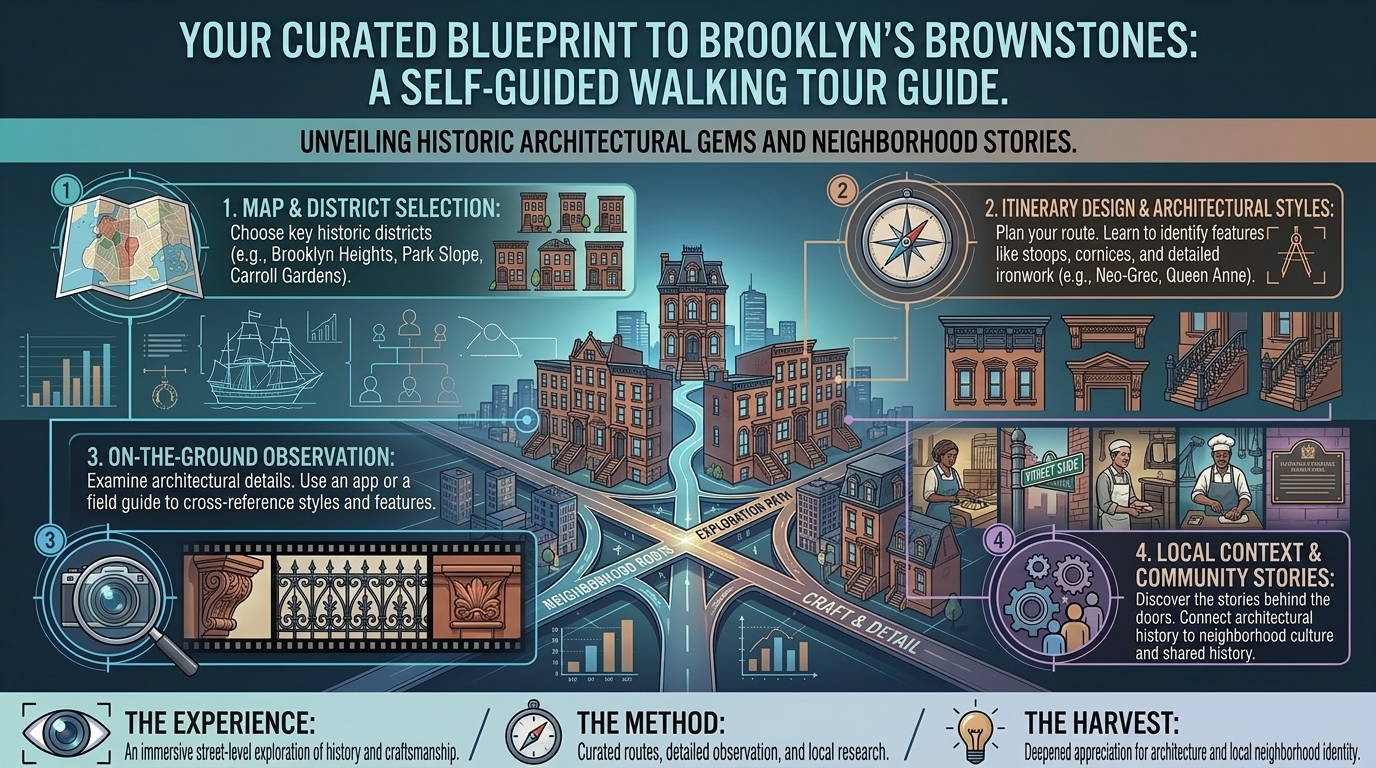
While commercial tour buses stick to Manhattan landmarks, the ultimate way to experience this architectural heritage is on foot. This comprehensive, SEO-optimized guide provides the complete blueprint for planning an unforgettable, self-guided walking tour of historic brownstone architecture in Brooklyn, focusing on its crown jewels: Brooklyn Heights and Park Slope.
The Anatomy of a Brownstone: What Are You Actually Looking At?
Before lacing up your walking shoes, it helps to understand what makes a brownstone a brownstone. Contrary to popular belief, brownstone is not an architectural style; it is a material.
- The Stone: “Brownstone” is actually a soft, dark reddish-brown Triassic-Jurassic sandstone quarried extensively in New Jersey, Connecticut, and Massachusetts during the 18th and 19th centuries.
- The Construction Trick: Builders in the mid-to-late 1800s would construct the core structural walls of these row houses out of standard, cheaper red brick, and then apply a thin veneer layer of brownstone blocks to the front facade to give it an air of aristocratic European wealth and uniformity. Because the stone is relatively soft, it weathers over time, giving historic Brooklyn facades their rich, lived-in patina.
- The High Stoop: The iconic grand staircase (the stoop) wasn’t just built for aesthetic drama. In 19th-century urban design, raising the main parlor floor above street level kept domestic living spaces safely away from muddy streets, horse-drawn traffic, and damp basements, while allowing servants to enter through the garden-level basement door.
Route Option A: The Historic Suburb (Brooklyn Heights)
As America’s very first designated historic district, Brooklyn Heights boasts the highest concentration of preserved 19th-century residential architecture in New York City, ranging from Federal-style frame houses to Gothic and Renaissance Revival brownstone mansions.
Step-by-Step Itinerary:
- The Starting Gate (Clark Street Subway Station): Emerge from the 2 or 3 train right into the heart of the historic neighborhood. Walk down the quiet residential stretch of Pierrepont Street.
- The Literary Haunts of Willow Street: Turn onto Willow Street, widely considered one of the most visually stunning architectural corridors in America. Pause at 70 Willow Street, the gorgeous brick-and-brownstone mansion where writer Truman Capote lived when he penned Breakfast at Tiffany’s.
- Discovering Secret Mews (Grace Court Alley): Slip down into Grace Court Alley, a hidden 19th-century dead-end mews lined with ivy-covered former carriage houses and rustic cobblestones that completely insulate you from city noise.
- The Grand Finale (The Brooklyn Heights Promenade): Conclude your walk along the cantilevered pedestrian promenade, offering breathtaking, postcard-quality views of the Manhattan skyline, the East River, and the harbor.
Route Option B: The Brownstone Capital (Park Slope)
If Brooklyn Heights is the refined colonial ancestor, Park Slope is the Victorian-era masterpiece. Stretching west from Prospect Park, Park Slope features what architectural critics consider the finest, most envy-provoking blocks of residential brownstone architecture in the world.
Step-by-Step Itinerary:
- Prospect Park West Approach: Take the F or G train to the 7th Avenue station, walk toward the lush expanse of Prospect Park, and head down side streets like Carroll Street and Garfield Place.
- The King of Residential Blocks: Walk down Montgomery Place, a stunning landmarked block framed by interlocking Renaissance Revival and Romanesque Revival row houses with deep setbacks, curved bays, and stained-glass transoms.
- The Montauk Club: Finish your route by viewing the legendary Montauk Club (at 8th Avenue and Lincoln Place), a Venetian Gothic architectural marvel designed in 1891 by architect Francis H. Kimball, complete with terra-cotta carvings and wrought-iron balconies.
Essential Tips for Your Self-Guided Tour
- Wear Sturdy Walking Shoes: Historic blocks feature original blue-stone sidewalks, slate pavers, and uneven cobblestones. Leave smooth fashion heels at home; supportive walking shoes or trail sneakers are essential.
- Respect Private Property: Remember that these brownstones are private homes, not open-air museums. Admire the architectural details, ironwork, and doorways from the public sidewalk, and avoid peering directly into ground-floor windows.
- Look Up: Most sightseers keep their eyes locked at street level. Tilt your head upward to examine the intricate wood-and-copper cornices, carved brownstone lintels over the windows, and original eyebrow dormers on the rooflines.
10 Frequently Asked Questions (FAQs)
1. How long does a self-guided brownstone walking tour take?
A thorough, leisurely self-guided walking tour through either Brooklyn Heights or Park Slope typically takes between 1.5 to 3 hours, depending on how many photos you snap and how often you stop to linger.
2. Is it safe to walk these residential Brooklyn neighborhoods alone?
Yes, absolutely. Brooklyn Heights and Park Slope are among the safest, wealthiest, and most desirable residential neighborhoods in New York City, maintaining heavy pedestrian activity and welcoming neighborhood atmospheres.
3. What is the difference between a brownstone and a limestone?
While brownstones are faced with dark reddish-brown Triassic sandstone, “limestones” (popular along select blocks of Park Slope and the Upper West Side) feature pale grey or cream-colored Indiana limestone facades, which allowed for crisper, more ornate classical carvings.
4. Can I go inside any of these historic brownstones?
The vast majority are divided into private co-op apartments or single-family private residences and are not open to the public. However, historic house museums like the Merchant’s House Museum in Manhattan or occasional historic house tours offer rare glimpses into interiors.
5. When is the best time of year to take a walking tour?
Spring (when cherry blossoms and wisteria bloom across iron fences) and autumn (when golden canopy leaves frame the sandstone facades) offer the most visually stunning conditions for photography.
6. Are these walking routes wheelchair and stroller accessible?
Yes, the concrete and bluestone sidewalks are wide and generally flat. However, watch out for historic tree roots pushing up pavement blocks and occasional slate step-ups near building entrances.
7. What architectural styles will I see on a Brooklyn brownstone tour?
You will encounter a rich mix of Federal, Greek Revival (distinguished by heavy Greek columns and entry porticos), Gothic Revival, Italianate (featuring bracketed cornices and arched windows), and Romanesque Revival styles.
8. Are guided walking tours available if I prefer not to go alone?
Yes, numerous local organizations—including the Municipal Art Society, Brooklyn Historical Society (Center for Brooklyn History), and independent walking tour companies—offer expert-led weekend tours.
9. Can I bring my dog along on the walking tour?
Certainly! Brooklyn’s residential neighborhoods are exceptionally dog-friendly. Just ensure your dog remains leashed on the sidewalk and respect local clean-up ordinances.
10. How can I learn more about the specific history of an individual building?
You can search historic district designation reports online via the New York City Landmarks Preservation Commission (LPC) website, which catalogs the architectural history and construction date of nearly every building in the district.
Conclusion
Planning a self-guided walking tour of historic brownstone architecture in Brooklyn is one of the most rewarding cultural experiences you can have in New York City. By stepping away from the commercial tourist hubs and wandering down the historic, tree-lined lanes of Brooklyn Heights and Park Slope, you connect directly with the architectural soul and human history of the borough.
Grab your camera, slow down your pace, and discover more urban exploration guides, neighborhood histories, and lifestyle inspiration right here at nyattitude.com to help you master life in the greatest cities on earth!