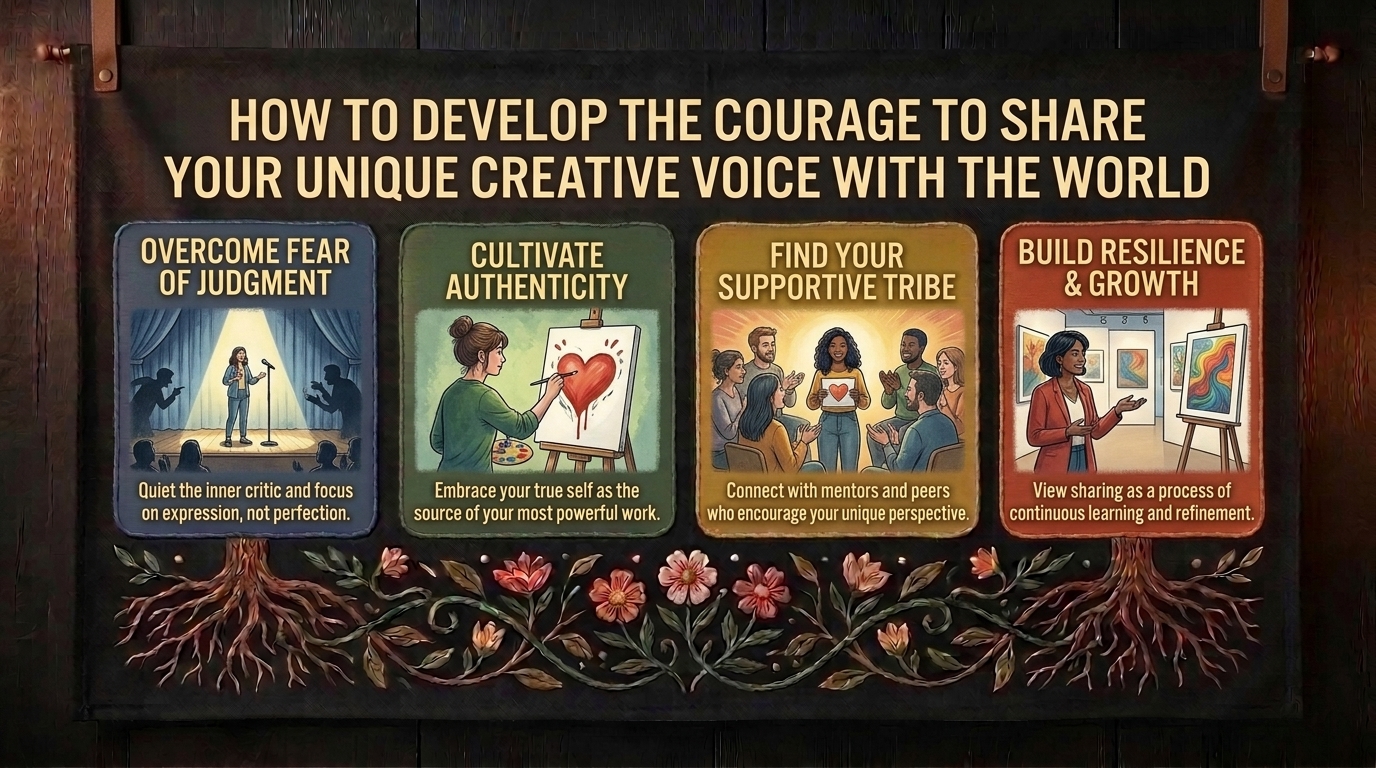
How to Develop the Courage to Share Your Unique Creative Voice with the World
Introduction
In a hyper-connected digital landscape flooded with millions of voices, polished portfolios, and algorithmic echo chambers, sharing your authentic creative work can feel like stepping onto an open stage completely exposed. Whether you are building an indie art brand in California, writing disruptive code or design systems in San Francisco, crafting strategic narratives in New York, launching innovative ventures across Texas, or shaping public discourse and digital culture in Washington, the desire to express your true creative voice often wars with a paralyzing fear of judgment.
We have all felt it: the cursor blinking on a blank white screen, the canvas left half-finished in the corner of the studio, the business pitch rewritten ten times until all its sharp, exciting edges have been safely sanded down.
We worry about what our peers will think, whether our work is “good enough,” or if we will be dismissed as amateurs.
This universal resistance keeps countless brilliant ideas, revolutionary products, deeply moving art, and transformative perspectives locked away inside the minds of their creators.
Yet, the world does not need another polished replica of what already exists. It desperately hungers for raw, distinct, and unapologetically unique perspectives.
For creators, entrepreneurs, and forward-thinking visionaries engaging with platforms like nyattitude.com, cultivating the courage to share your authentic creative voice is the ultimate catalyst for personal fulfillment and professional impact. This comprehensive guide explores the psychology of creative vulnerability, the mechanics of overcoming imposter syndrome, step-by-step frameworks for fearless expression, regional nuances across major U.S. hubs, actionable daily tips, and answers to the most frequently asked questions.
1. The Anatomy of Creative Fear: Why We Hide
Before we can build the courage to share our work, we must first understand the invisible forces keeping us silent. Creative fear is not a personal flaw; it is an evolutionary survival mechanism.
The Tribal Roots of Criticism
For early humans, standing out from the tribe was a literal death sentence. If you expressed a radical idea, dressed differently, or created something unconventional, you risked banishment from the community—and banishment meant certain death on the savannah.
- The Modern Manifestation: Today, when you hit “publish” on an essay, launch an unconventional startup, or display original artwork online, your primitive brain interprets negative feedback, silence, or social media indifference not as minor critiques, but as life-threatening tribal rejection. Recognizing that your fear is just an outdated biological alarm system helps you disarm it.
The Perfectionism Trap
Perfectionism is rarely about high standards; it is disguised fear. Perfectionists tell themselves, “Once my work is flawless, I will share it.” In reality, perfectionism is a shield used to avoid vulnerability. Because perfection is mathematically impossible, staying in permanent “editing mode” guarantees you never have to face the terrifying possibility of being seen, evaluated, and potentially rejected.
2. Authenticity as Your Ultimate Competitive Advantage
In an era dominated by artificial intelligence and hyper-homogenized corporate content, authenticity is the rarest and most valuable currency on earth.
The Homogenization Crisis
Algorithms and mass production encourage creators to mimic what is already trending. We see a successful style, business model, or aesthetic and instinctively copy it.
- The Result: The internet becomes saturated with a sea of sameness. When everything looks and sounds identical, audiences experience profound fatigue.
Why Your Flaws Are Your Signature
True creative resonance lives in your imperfections, your distinct background, your specific regional or cultural influences, and your quirky worldview. No one else has walked your exact path through life, experienced your specific trials, or synthesized information the way your mind does. Your unique voice is your only true monopoly. When you lean into your weirdness rather than hiding it, you attract the exact audience, clients, or collaborators meant for your work.
3. Regional Perspectives: Cultivating Creative Courage Across Major U.S. Hubs
The cultural pressures of creative expression and public exposure take on distinct textures across the diverse geographical landscapes connected to nyattitude.com:
- New York: Fast-paced, hyper-critical, and fiercely competitive. In New York’s cultural and financial arenas, sharing your voice requires thick skin and unshakeable self-assurance. Authenticity here means cutting through cynical noise and standing firmly behind your distinctive creative vision.
- San Francisco: At the crucible of technological innovation and startup culture, creative expression often takes the form of disruptive product design, coding, or venture building. Courage in San Francisco means betting on unconventional ideas and risking public failure to build the future.
- Texas: Spanning thriving creative hubs like Austin, Dallas, and Houston, Texas professional culture blends bold independence with rich storytelling traditions. Creators here thrive by embracing local grit, authentic community roots, and unvarnished self-expression.
- Washington: Anchored by policy, advocacy, and Pacific Northwest innovation, Washington requires creators and writers to navigate high-stakes institutional visibility. Courage here involves articulating complex ideas clearly, standing up for intellectual integrity, and driving meaningful public discourse.
- California (Southern & Broader): Balancing entertainment, design, and wellness, California rewards visual and emotional storytelling. Creative courage in this region involves cutting through superficial image cultivation to deliver raw, soulful, and resonant work.
4. Step-by-Step Framework: Overcoming Resistance and Sharing Your Work
Building the courage to share your voice is a systematic process of expanding your emotional bandwidth. Follow this step-by-step framework:
Step 1: Decouple Your Self-Worth from the Output
The number one reason creators hesitate to share their work is identity fusion—believing that if someone criticizes their article, product, or artwork, they are criticizing them as a human being.
- Practice viewing your creative output as an external experiment. You are the scientist conducting the experiment; your work is merely the data. If the data is poorly received, it doesn’t mean you are flawed; it simply means you adjust your variables for the next iteration.
Step 2: Build a “Safe Harbor” First
Before broadcasting your work to the entire internet or global market, build a small, supportive sanctuary. Share your raw drafts, early prototypes, or rough sketches with a trusted circle of three to five supportive mentors, friends, or peers who understand your vision. Experiencing positive reception in a safe micro-environment builds the emotional muscle required for public exposure.
Step 3: Lower the Stakes (The “Draft 0” Philosophy)
Give yourself explicit permission to create and share imperfect work. Adopt the “Draft 0” mindset: publish or share things that are 80% finished. Frame your public journey as an open-source evolution rather than an unblemished masterwork. Audiences love watching creators grow, learn, and iterate in real-time far more than they enjoy interacting with cold, untouchable perfection.
Step 4: Define Your “Minimum Viable Audience”
You do not need millions of followers or universal praise to make an impact. According to Kevin Kelly’s famous creator economy thesis, you only need 1,000 true fans—people who resonate deeply with your unique voice and will support everything you create. When you stop trying to please the mass crowd and focus entirely on serving your niche tribe, the fear of broader criticism evaporates.
Step 5: Ship and Detach (The Art of Letting Go)
The moment your creative work leaves your hands and enters the world, it no longer belongs solely to you; it belongs to the audience and how they interpret it. Accept that you cannot control how people react. Some will love it, some will hate it, and most won’t notice. Once you ship your work, detach your mind from the outcome and immediately start creating the next piece.
5. Actionable Tips to Build Daily Creative Confidence
Incorporate these practical micro-habits into your daily routine to train your mind for fearless expression:
- Practice “Ugly Creation”: Dedicate ten minutes a day to create something intentionally terrible—write a horrible poem, sketch a messy doodle, or record a rough audio memo. This breaks the paralysis of the blank page and proves to your brain that failure is harmless.
- Document Your Process, Not Just the Final Product: People are endlessly fascinated by behind-the-scenes journeys. Share your rough notes, failed prototypes, and lessons learned. Process-sharing removes the pressure of needing every public output to be a masterpiece.
- Audit Your Consumption-to-Creation Ratio: If you spend four hours a day consuming other people’s work and zero hours producing your own, your creative confidence will atrophy. Flip the ratio: produce before you consume.
- Reframe Haters and Critics: When you encounter harsh criticism or online indifference, remind yourself of Elbert Hubbard’s famous maxim: “To avoid criticism, say nothing, do nothing, be nothing.” Criticism is proof that you are active, visible, and making an impact.
- Keep a “Proof Vault”: Create a digital folder where you save every kind message, testimonial, thank-you note, or positive comment you have ever received. On days when self-doubt creeps in, open your Proof Vault to remind yourself of the tangible value you bring to others.
- Set a Public Commitment Deadline: Announce a project release date or publishing schedule to a friend or small community before it’s completely ready. External accountability forces you past your internal procrastination and perfectionism.
6. Ten Frequently Asked Questions (FAQs)
1. Why is sharing creative work so emotionally terrifying?
Creative work is an extension of your inner psyche, thoughts, and identity. When you share it publicly, you expose yourself to potential rejection, criticism, or indifference. Because our brains equate social rejection with ancient tribal banishment, the nervous system triggers a profound fear response.
2. How can I overcome imposter syndrome when sharing my unique voice?
Impostor syndrome is common among people entering new creative or professional territories. Remember that feeling like a beginner or an outsider simply means you are growing and pushing past your previous boundaries. Focus on sharing your honest perspective rather than pretending to be an all-knowing guru.
3. What if my creative voice is too weird or unconventional for the market?
Weirdness is your greatest asset. The most memorable, iconic artists, entrepreneurs, and thinkers in history were initially dismissed as unconventional. Trying to fit into a generic mold makes you forgettable. Lean into your unique perspective; your tribe will find you.
4. How do I handle negative comments or harsh public criticism?
First, separate constructive feedback (which helps you improve) from malicious trolling (which is about the critic’s insecurities). For trolls, remember the golden rule of the internet: do not feed them. For valid critiques, take what serves your growth, discard the emotional hostility, and keep moving forward.
5. Do I need to be an extrovert to share my work successfully?
Not at all. Many of the world’s most profound writers, coders, artists, and founders are introverts. Digital media allows you to share your voice asynchronously, thoughtfully, and on your own terms without ever needing to perform in high-stimulus extroverted environments.
6. How do I find my “unique voice” if I feel like I’m just copying others?
Finding your voice is a process of imitation followed by subtraction. You start by copying creators you admire to learn the mechanics of your craft. Over time, as you combine your disparate interests, life experiences, and flaws, your distinct voice naturally emerges from the synthesis.
7. What should I do if my friends or family don’t support my creative pursuits?
Family and friends often struggle to accept your evolution because they are used to seeing you in a specific, predictable role. Seek out online mastermind groups, creative communities, or mentorship circles where your ambitions are celebrated and understood.
8. How long does it take to build a loyal audience for my creative work?
Building an authentic audience requires patience and consistency. While viral moments happen, sustainable creative traction typically takes 12 to 24 months of regular publishing, engaging, and refining your craft. Focus on the work, not the follower count.
9. How do regional business and cultural hubs influence creative risk-taking?
Fast-paced hubs like San Francisco and New York foster an environment where rapid experimentation and bold public launches are normalized. Immersing yourself in these cultures—physically or digitally—desensitizes you to the fear of public exposure.
10. What is the single most important first step to start sharing my work today?
Stop waiting for permission, validation, or perfection. Publish one small piece of your creative work—an essay, a design concept, a video, or an idea—within the next 24 hours. Action cures anxiety every single time.
Conclusion
The world does not need you to be perfect; it needs you to be real. Your unique perspective, shaped by your distinct experiences, challenges, and creative insights, is a gift waiting to be shared. When you conquer the fear of judgment and give yourself permission to express your authentic voice, you unlock a profound level of professional freedom and personal alignment.
Whether you are building your creative footprint across Texas, New York, California, Washington, or San Francisco, remember that your voice matters. Stop hiding behind perfectionism, embrace your vulnerability, and share your brilliance with the world.
What is one piece of creative work, idea, or project you have been holding back out of fear, and what is one small step you will take to share it this week?