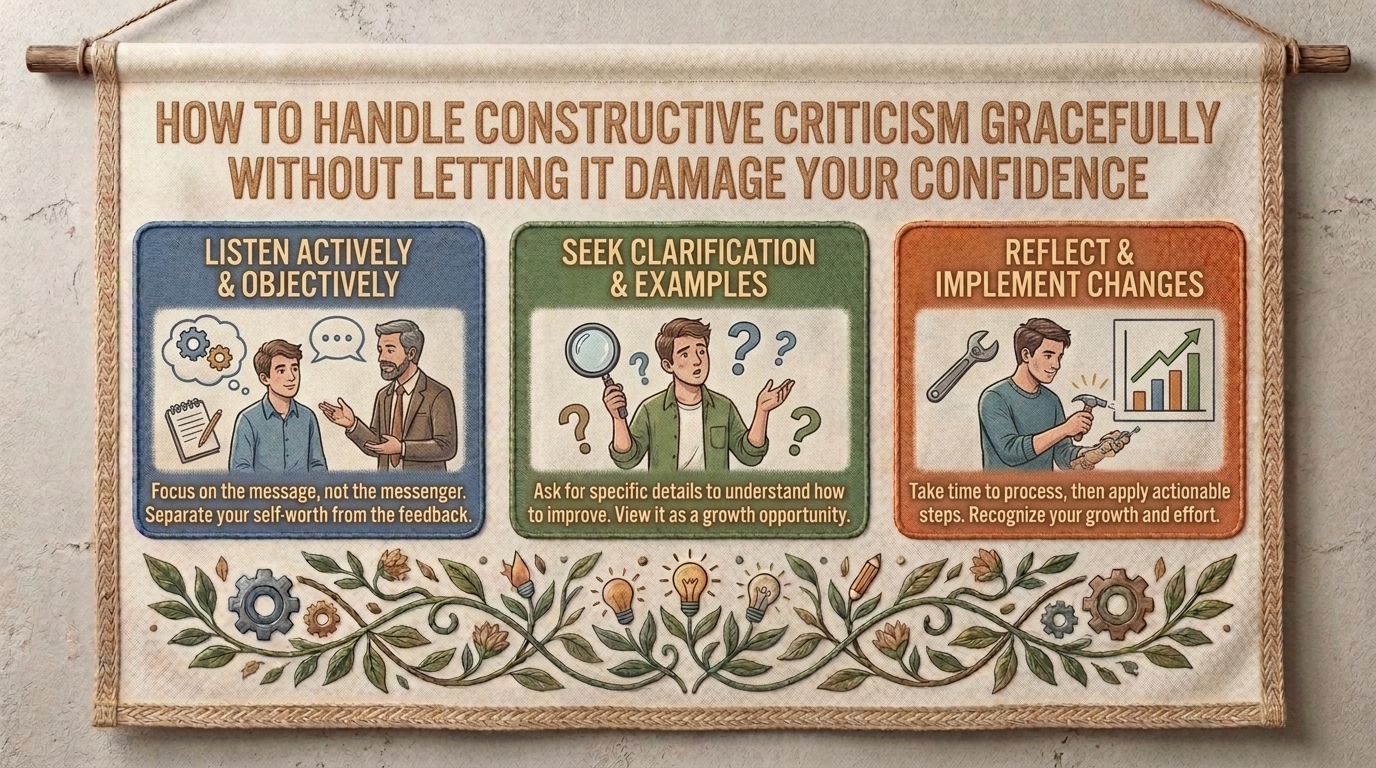
How to Handle Constructive Criticism Gracefully Without Letting It Damage Your Confidence
Introduction
In the modern professional and creative landscape, feedback is the lifeblood of growth. Whether you are navigating the high-stakes corporate corridors of New York, scaling venture-backed startups in San Francisco, expanding enterprise operations across Texas, designing public policy in Washington, or driving creative industries throughout California, you will inevitably face feedback, critiques, and evaluations.
Yet, for many ambitious professionals, receiving feedback—even when it is explicitly well-intentioned and constructive—feels less like an opportunity for growth and more like a direct, personal indictment of self-worth.
When a client points out a flaw in a pitch deck, a manager suggests a structural pivot, or a peer reviews your code with heavy edits, our nervous systems often react as if we are facing physical danger. We feel a sudden spike of heat in the chest, defensiveness floods our thoughts, and our confidence takes a heavy hit. We conflate what we do with who we are.
Mastering the art of receiving constructive criticism gracefully without letting it erode your self-confidence is one of the most powerful masterclasses for modern leadership.
For forward-thinking innovators and professionals engaging with platforms like nyattitude.com, turning external critiques into rocket fuel for excellence is an essential competitive advantage. This comprehensive guide explores the neuroscience of perceived threat, emotional regulation frameworks, step-by-step critique processing, regional navigation across major U.S. hubs, actionable daily tips, and answers to the most frequently asked questions.
1. The Neuroscience of Feedback: Why Critique Triggers a Fight-or-Flight Response
To understand why a simple piece of professional advice can ruin your entire day, we must look beneath the skull into how the brain processes social evaluation.
The Amygdala Highjack
Evolutionarily, human survival depended entirely on belonging to the tribe. Rejection, criticism, or exclusion by the tribe meant literal death.
- The Neurochemical Flood: When someone critiques your work, your brain’s evolutionary alarm system—the amygdala—often misinterprets professional feedback as a tribal threat to your social standing and survival. It floods your bloodstream with cortisol and adrenaline, triggering a classic fight-or-flight response. Your prefrontal cortex (the seat of rational, strategic thought) temporarily shuts down, making your default instinct either defensive anger or crushing self-doubt.
Separating Data from Identity
The core psychological challenge of handling criticism is learning to decouple your identity from your output. Your work, your code, your writing, or your project is an artifact you produced; it is not a mirror reflection of your soul or your ultimate worth as a human being. When you learn to view feedback as data points about a removable artifact rather than a verdict on your character, criticism loses its terrifying sting.
2. The Trap of Defensive Armor: Why We Resist Growth
When the amygdala hijacks our nervous system, we typically default to one of two destructive defensive mechanisms:
1. External Defensiveness (The Explainer)
- The Behavior: Instantly interrupting the critic, making excuses, pointing out flaws in their logic, or explaining why your way was right.
- The Result: You signal to leaders, clients, and peers that you are uncoachable, arrogant, and closed-loop, which ultimately stunts your professional upward mobility.
2. Internal Defensiveness (The Spiral)
- The Behavior: Nodding politely on the outside while mentally crumbling on the inside, telling yourself, “I’m a fraud, I knew I wasn’t cut out for this.”
- The Result: You protect your ego short-term by internalizing the critique as proof of total inadequacy, leading to prolonged anxiety and creative paralysis.
3. Regional Perspectives: Feedback Culture Across Major U.S. Hubs
The delivery, reception, and cultural expectations surrounding feedback vary significantly across the diverse economic landscapes connected to nyattitude.com:
- New York: Known for its fast-paced, direct, and unapologetically blunt communication style, New York professional culture treats feedback as rapid-fire data exchange. Learning not to take New York’s transactional directness personally is a prerequisite for survival and success on Wall Street and in media.
- San Francisco: Grounded in agile tech methodologies, San Francisco culture thrives on rapid iteration, code reviews, and post-mortems. Failure and critique are normalized as standard operational fuel for building scalable products.
- Texas: Spanning thriving business ecosystems like Austin, Dallas, and Houston, Texas professional interactions blend southern hospitality and direct business acumen. Feedback is often delivered with relational warmth, emphasizing mutual respect and long-term partnership.
- Washington: Anchored by diplomacy, policy drafting, and institutional governance, Washington communication requires high-nuance critique. Professionals here learn to separate political and policy evaluations from personal identity.
- California (Southern & Broader): Balancing entertainment, creative arts, and wellness culture, California professional circles often wrap critiques in collaborative optimism, requiring creators to extract objective gems from subjective artistic opinions.
4. Step-by-Step Framework: The 5-Step Graceful Feedback Protocol
Processing constructive criticism without damaging your confidence requires a deliberate, structured cognitive pause. Follow these five steps when receiving feedback:
Step 1: The Pause Button (Buy 3 Seconds)
When you first hear a critique, your body wants to react instantly. Force a physical pause: take one slow, deep breath, relax your shoulders, and count to three silently. This micro-pause allows your prefrontal cortex to come back online and prevents your amygdala from driving a defensive response.
Step 2: Active Clarification (The “Help Me Understand” Phase)
Instead of defending your work, adopt the stance of an investigator. Ask clarifying questions without a trace of sarcasm or attitude:
- “Can you walk me through the specific part of the presentation that felt unclear?”
- “What specific outcome were you hoping to see here?” Gathering objective data separates emotional tone from actionable advice.
Step 3: Separate the Signal from the Noise
Not all feedback is equally valid. Once you have the critique, parse it into two categories:
- The Signal: Objective, useful insights that will genuinely improve your work or sharpen your strategy.
- The Noise: Subjective preferences, stylistic biases, or emotional venting from the critic. Discard the noise without guilt, and embrace the signal with gratitude.
Step 4: Express Genuine Appreciation
Thank the person for their time and candor, even if delivery was clumsy. Saying “Thank you for taking the time to review this so thoroughly and sharing your perspective” completely disarms tension and signals high emotional intelligence.
Step 5: The Post-Processing Audit
Later that evening or the next day, review the feedback in a calm emotional state. Translate the valid signal into an actionable checklist. Taking proactive control of the fix restores your agency and reinforces your confidence.
5. Actionable Tips to Build Unshakeable Feedback Resilience
Incorporate these practical micro-habits into your professional routine to transform how you handle critique:
- Adopt a “Growth Mindset” Monicker: Remind yourself daily of Carol Dweck’s research: mistakes and critiques are not evidence of fixed stupidity; they are the exact friction required to build neurological muscle.
- Solicit Feedback Proactively: Take control of the narrative by asking for critique before someone hands it to you unprompted. Asking “What is one thing I could improve on this draft?” shifts your psychological state from defensive victim to proactive owner.
- Separate Your Self-Worth from Your Output: Create a mental boundary. Remind yourself: “My value as a person is infinite and permanent; my work product on this project is temporary and improvable.”
- Conduct a Feedback Journal: When you receive harsh critique, write it down objectively. Look back at past critiques a year later to see how those exact adjustments transformed your capabilities.
- Set Boundaries on Toxic Critique: Distinguish between constructive criticism (meant to elevate the work) and destructive criticism (meant to demean or control). You are obligated to process the former; you are fully permitted to dismiss the latter.
- Celebrate the Iteration: Frame your projects as living drafts. Every round of revisions brings your work closer to true excellence. Perfectionism is the enemy of progress; iteration is the path to mastery.
6. Ten Frequently Asked Questions (FAQs)
1. Why does constructive criticism hurt our feelings even when we know it’s helpful?
Our brains evolved to treat social evaluation and peer judgment as survival threats, triggering an automatic amygdala alarm. This biological fight-or-flight response happens faster than rational thought, causing emotional pain before logic can intervene.
2. How can I stop myself from getting immediately defensive when criticized?
Practice the three-second rule: take a slow, deep breath before speaking. Remind yourself mentally, “This feedback is about the work, not my worth as a human being.” Cultivating this micro-pause bridges the gap between emotional reaction and thoughtful response.
3. What is the difference between constructive criticism and destructive feedback?
Constructive criticism is specific, actionable, objective, and aimed at improving the outcome or skill. Destructive feedback is vague, personal, emotionally charged, and aimed at demeaning or exerting control over the recipient.
4. What should I do if feedback is delivered in a harsh or disrespectful tone?
Separate the delivery style from the core message. Even if someone delivers feedback poorly, look for the underlying data point. If the delivery is abusive or persistently toxic, calmly set a boundary or escalate the matter appropriately.
5. How can I rebuild my confidence after receiving a crushing critique?
Acknowledge the initial sting, then ground yourself in your past successes and core competencies. Remember that a single flawed project does not define your career. Refocus immediately on taking one small, proactive step to improve the work.
6. Is it okay to disagree with feedback given by a manager or client?
Yes, absolutely. Professional disagreement handled respectfully is a sign of partnership, not insubordination. Use data and objective reasoning to explain your perspective: “I understand your point about X; my rationale for choosing Y was Z. How would you like to balance those priorities?”
7. How do fast-paced metropolitan hubs like New York shape feedback culture?
Hyper-competitive hubs like New York feature direct, fast-moving communication styles where feedback is delivered rapidly. Learning to parse the business signal from blunt delivery is essential for professional survival in these markets.
8. How does proactive feedback solicitation protect my self-confidence?
When you actively ask for critique, you are in the driver’s seat. Anticipating and inviting feedback strips away the element of surprise, neutralizing your amygdala’s threat response and preserving your sense of autonomy.
9. Can perfectionism make it harder to handle criticism?
Yes. Perfectionists tie their entire self-worth to flawless execution, meaning any critique feels like total failure. Letting go of perfectionism in favor of continuous iteration is the ultimate antidote to feedback fragility.
10. What is the single best first step I can take the next time I receive criticism?
Breathe, listen actively without interrupting, and thank the person for their perspective before saying anything else. That simple discipline changes the entire dynamic of the interaction.
Conclusion
Constructive criticism is not a weapon designed to tear down your confidence; it is the raw material used to forge excellence. By understanding your brain’s threat response, separating your identity from your output, and embracing a structured framework for grace and objectivity, you transform every critique into a stepping stone toward mastery.
Whether you are building your career across Texas, New York, California, Washington, or San Francisco, remember that the most successful leaders are not those who never make mistakes, but those who welcome feedback with humility and use it to rise higher.
What is one piece of feedback you recently received that felt difficult to swallow, and what is one actionable step you can take today to extract its value?