We live in a culture that is utterly obsessed with polished highlight reels. Across social media feeds, corporate announcements, and mainstream media profiles, society celebrates the triumphant launch, the massive funding round, the prestigious award, and the flawless career trajectory. What gets conveniently edited out of the narrative is the messy, uncomfortable, and inevitable precursor to every meaningful achievement: failure.
Across America’s most competitive and visionary regions—from the high-velocity financial and creative boardrooms of New York, the disruptive tech labs of San Francisco, the sprawling innovation hubs of California, the high-stakes policy corridors of Washington, and the booming economic landscapes of Texas—the fear of failure paralyzes countless talented individuals. They hesitate to launch the startup, pitch the script, or take the career risk because they view a single misstep as a permanent verdict on their intelligence and worth.
This fear is not only emotionally exhausting; it is strategically fatal. True long-term success is never a straight line of uninterrupted wins. It is an iterative loop of testing, failing, diagnosing, and adapting. This comprehensive guide explores why embracing failure as a critical learning lesson is the ultimate catalyst for long-term triumph, backing the philosophy with cognitive science, regional insights, and actionable frameworks.
1. The Psychology of Failure: Why Our Brains Fear the Fall
To understand why embracing failure is difficult, we must examine evolutionary biology.
- The Primitive Threat Response: Thousands of years ago, failing within a tribal group—such as making a poor decision that endangered the community or being cast out—meant physical death. Our brains evolved to treat social, professional, and financial failure with the exact same panic-inducing neurochemical cascade (cortisol and adrenaline) reserved for physical predators.
- The Fixed vs. Growth Mindset: As pioneered by psychologist Carol Dweck, individuals with a fixed mindset believe their talents and intelligence are static; therefore, failing a task proves they are unintelligent or incapable. Those with a growth mindset view failure merely as temporary feedback that stretches their capabilities.
- The Cost of Perfectionism: In high-density metropolitan environments, perfectionism acts as a shield against vulnerability. However, striving for zero failure guarantees that you never attempt anything bold, innovative, or truly transformative.
2. Regional Landscapes of Risk: Coast-to-Coast Failure Cultures
Different metropolitan regions have distinct relationships with failure and risk-taking, shaping how professionals build long-term resilience:
New York and San Francisco: High Stakes and Silicon Valleys
- New York: In competitive industries like finance, law, high fashion, and media, failure can feel public and high-stakes. Yet, New York’s cultural grit relies heavily on entrepreneurs and artists who survived multiple failed ventures before striking gold. The NYC mindset requires turning public setbacks into quiet fuel.
- San Francisco: Silicon Valley institutionalized the concept of “failing fast.” In the Bay Area, venture capital firms and tech founders frequently view a failed startup or a botched product launch as a badge of honor—proof that you took massive risks and acquired invaluable, battle-tested data that novices lack.
Texas, California, and Washington: Building, Scaling, and Pivoting
- California: Beyond San Francisco, California’s diverse economic ecosystem—spanning entertainment, green tech, and design—rewards creative resilience. In Hollywood and coastal creative incubators, hearing “no” or watching a project stall is simply part of the daily weather pattern.
- Texas: In booming Texas hubs like Austin, Dallas, and Houston, the entrepreneurial spirit is anchored in a rugged “builder” mentality. Texas business culture respects those who roll up their sleeves, stumble, pick themselves up, and re-engineer their approach without making excuses.
- Washington: In the Pacific Northwest, long-term success in complex policy, environmental, or tech infrastructure sectors requires rigorous post-mortems. Failure here is analyzed systematically to ensure structural systems improve over time.
3. The Mechanics of Iteration: How Failure Fuels Innovation
Thomas Edison famously remarked when asked about his thousands of failed attempts to invent the incandescent light bulb: “I have not failed. I’ve just found 10,000 ways that won’t work.”
Every master of their craft—whether a jazz musician improvising a wrong note, a software engineer debugging code, or an author rewriting a manuscript three times—understands that iteration is the mother of mastery.
- Data Collection vs. Character Judgment: Unsuccessful people interpret failure as a statement of who they are (“I am a failure”). Successful people interpret failure as data collection (“This strategy did not achieve the desired outcome; let’s inspect the metrics”).
- The Asymmetry of Risk and Reward: In many ambitious pursuits, the downside of failure is capped (you lose a bit of time, money, or ego), while the upside of success is virtually infinite. Embracing smart, calculated failures is the only mathematical way to capture asymmetric rewards.
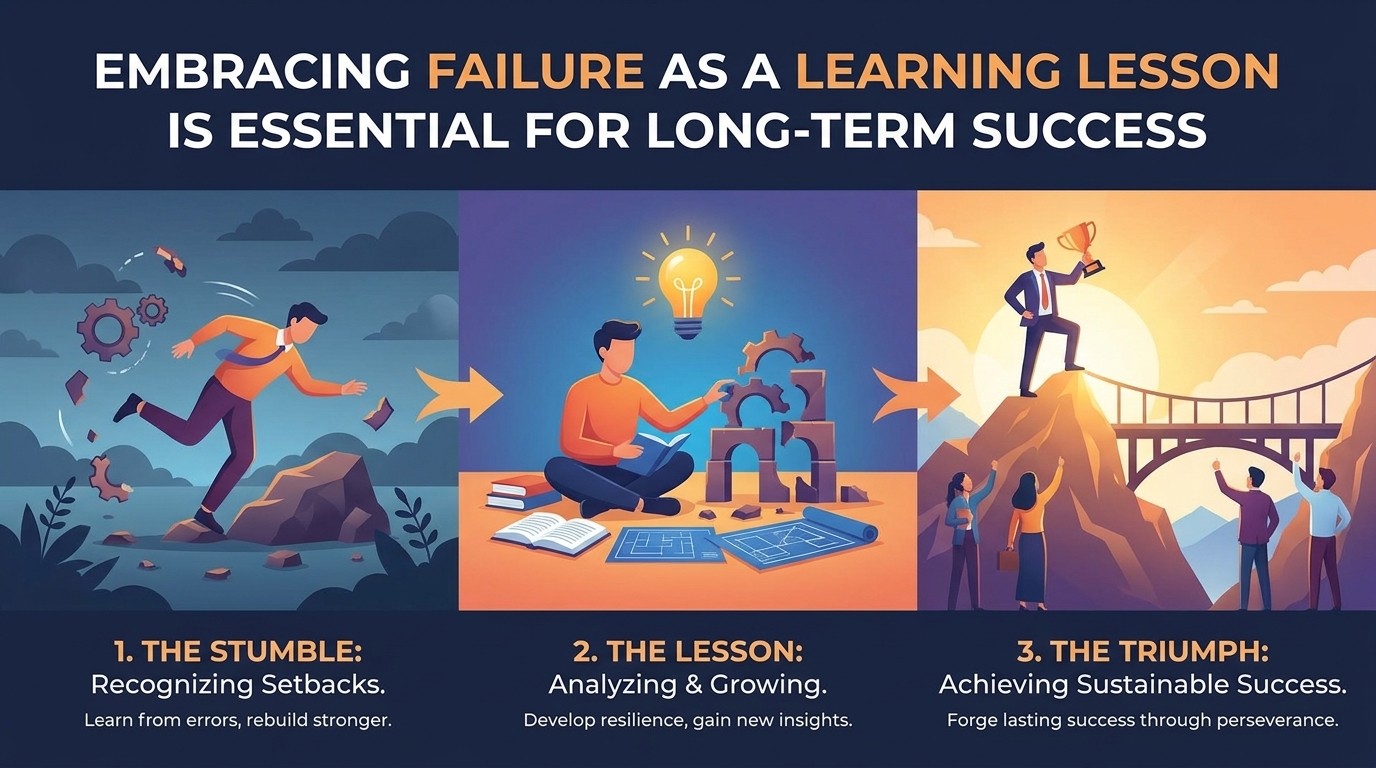
4. Step-by-Step Blueprint: Transforming Failure Into Fuel
When a major project crashes, a pitch is rejected, or a venture stalls, use this structured four-step framework to extract the lesson and bounce back stronger:
| Recovery Stage | Tactical Action | Long-Term Benefit |
| 1. The Emotional Purge | Allow 24 hours to feel the sting, frustration, or disappointment fully without toxic positivity. | Clears emotional blockage and prevents repressed stress from turning into chronic anxiety. |
| 2. The Clinical Post-Mortem | Write down three specific, objective reasons why the failure occurred, separating emotion from mechanics. | Converts a vague emotional defeat into precise, actionable technical data for your next attempt. |
| 3. The Strategy Pivot | Identify what specific variable you need to change—your target audience, your timing, your team, or your offer. | Keeps your momentum alive by directing your focus toward immediate, controllable problem-solving. |
| 4. The Immediate Re-Entry | Take one small, low-risk action toward your goal within 48 hours of your post-mortem. | Breaks the paralysis of hesitation and re-establishes your psychological locus of control. |
5. Ten Frequently Asked Questions (FAQ)
1. Why is embracing failure so difficult for high-achieving professionals?
High achievers are typically people who succeeded easily through school and early career stages by following rules. When they encounter complex real-world environments where failure is common, it threatens their established identity of being “the smart/successful one.”
2. Is there a difference between “smart failure” and “reckless failure”?
Yes. Smart failure (or intelligent experimentation) happens when you test a well-researched hypothesis, manage downside risk, and learn from the outcome. Reckless failure happens when you act carelessly, skip fundamentals, or ignore obvious warning signs.
3. How do I stop worrying about what other people will think when I fail publicly?
Remind yourself of the “Spotlight Effect”—the psychological phenomenon where people believe others are paying much more attention to them than they actually are. Most people are too wrapped up in their own lives to obsess over your setbacks.
4. What is the “failing fast” philosophy popularized in Silicon Valley?
It is an approach that encourages rapid prototyping, testing ideas quickly, and accepting small, inexpensive failures early in the development cycle so you can pivot before investing massive time and capital into a flawed concept.
5. How can I extract useful lessons from a deeply painful professional setback?
Distance yourself temporally and emotionally. Writing out a detailed case study of the failure as if you were an outside business consultant analyzing someone else’s project can provide instant clarity.
6. Can a resume or career history benefit from showing past failures?
Increasingly, yes. Forward-thinking employers, venture capitalists, and leaders value resilience, adaptability, and lessons learned from past ventures far more than an unbroken streak of untested comfort.
7. How do I rebuild my confidence after experiencing a catastrophic career failure?
Shrink your scope. Win small, manageable daily battles to rebuild your internal baseline of competence, and surround yourself with a peer group that normalizes iteration and growth.
8. What role does self-compassion play in processing failure?
Self-compassion is not weakness; it is psychological efficiency. Beating yourself up after a failure drains the exact cognitive energy you need to analyze the mistake and build a better strategy.
9. How do major cities like New York and San Francisco cultivate resilience through failure?
The sheer density, speed, and high cost of living in major hubs force individuals to adapt rapidly or exit. Those who stay develop thick skin, pragmatic problem-solving skills, and deep resilience.
10. Where can I find more resources on mindset, personal growth, and urban success?
Keep exploring specialized lifestyle, career, and culture hubs like nyattitude.com, where we provide actionable insights, local strategies, and expert guides to help you thrive across America’s greatest cities.
Conclusion
Embracing failure as a learning lesson is not merely a comforting platitude; it is the absolute bedrock of long-term success. Whether you are navigating high-stakes corporate arenas in New York, innovating in the tech sectors of San Francisco, building enterprises across California, shaping policy in Washington, or scaling ventures in Texas, the roadblocks and missteps you encounter are not stop signs—they are navigation markers. By stripping the ego from your setbacks, conducting clinical post-mortems, and iterating with relentless consistency, you transform every failure into the very stepping stone that carries you to your ultimate destination.
Ready to master your mindset, overcome setbacks, and conquer your long-term goals? Continue browsing nyattitude.com to inspire your growth journey forward!